




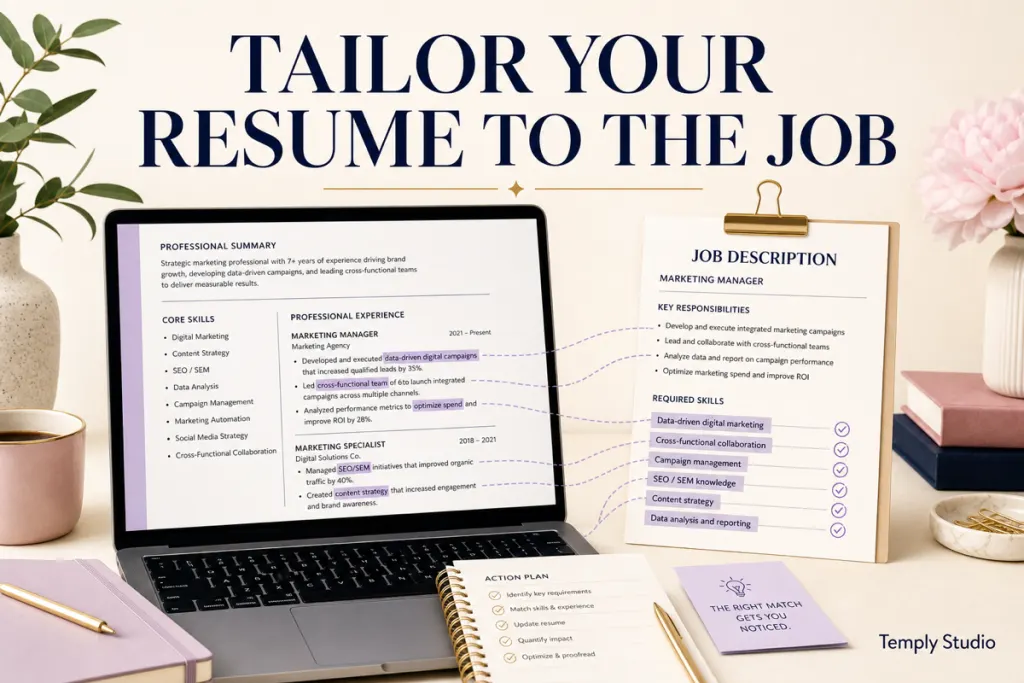
Quick answer: Proofread a resume in four passes, not one: (1) facts — every date, number, title, and claim checked against reality; (2) consistency — one date format, one tense pattern, matching punctuation and spacing; (3) mechanics — spelling, grammar, and names spelled exactly right; (4) the export — open the final PDF and read it as the recruiter will, including a copy-paste text check. Spellcheck alone will not catch a wrong year or a duplicated word.
The checklist below is ordered so the cheap fixes come first and the slow read comes last, when the file is actually final. Recruiters differ on what disqualifies an application, but a wrong phone digit or a garbled export fails everywhere.
Pass 1 — verify the facts
- Employment dates line up with what you can support; no overlapping full-time roles you cannot explain.
- Job titles, company names, and degrees are spelled exactly as the organizations wrote them.
- Every number is true and defensible — percentages, team sizes, budgets, results.
- Contact details are current: phone, email, city, and any portfolio or LinkedIn URL actually resolves.
- Anything you removed (old jobs, old skills) is gone from every section, not just the work history.
Pass 2 — check consistency
Resumes are read for pattern breaks. Pick one convention per item below and make the whole document match it:
- Dates: “Jan 2024 – Mar 2025” or “01/2024 – 03/2025”, not both.
- Tense: past tense for finished roles, present tense for the current one — applied per bullet, not just per section.
- Punctuation: bullets either all end with periods or none do.
- Formatting: one date style, one bullet glyph, consistent spacing between sections, and the same font and size everywhere the same element appears.
- Abbreviations and numbers: “5 years” vs “five years”, “P&L” vs “P and L” — one form each.
Pass 3 — the slow read
This is the pass spellcheck cannot do. Read the resume aloud once — your ear catches doubled words (“the the”), missing articles, and tense slips that your eyes skip. Then read it once backwards, line by line from the bottom up, so you see individual words instead of meaning. Pay special attention to:
- Your own name, the company’s name, and the hiring manager’s name if it appears.
- Homophones spellcheck accepts: their/there, manger/manager, public/pubic, form/from.
- Copy-paste leftovers: another company’s name, a different job title, or a bullet that belongs to a different role.
Pass 4 — check the exported file
Proofread the version you will actually send, not the working file:
- Open the final PDF at 100% zoom and on a phone; look for broken line breaks, widowed headings, and missing characters like bullets or accented letters.
- Select all the text, copy it, and paste it into a plain-text editor. If the text comes out scrambled or missing, the file will read the same way to an applicant tracking system — fix the layout or re-export.
- Confirm the file name identifies you:
firstname-lastname-resume.pdf, notresume-final-v7.pdfor the template’s default name. - Click every link in the header; a dead portfolio link is worse than no link.
- Print one copy or use print preview — some spacing problems only show on paper.
Getting a second set of eyes
If someone can review it, hand them the PDF — not the working file — and ask two specific questions: “What would you cut?” and “Is anything unclear?” A general “looks good” review catches almost nothing. If nobody is available, let the file sit overnight and re-read it once with fresh eyes before submitting.
For section naming and order, see our ATS-friendly resume headings guide. Continue with the Resume and Career hub, review the related Temply Studio products, or read the Google Docs resume template guide for a connected workflow. The U.S. Department of Labor CareerOneStop maintains general resume resources.
Frequently asked questions
Is spellcheck enough proofreading for a resume?
No. Spellcheck catches misspellings, not wrong dates, wrong company names, inconsistent formats, or words that are spelled correctly but are the wrong word. Those are the errors that actually cost interviews.
Should someone else proofread my resume?
Ideally yes — a reader who has never seen it will catch what you are blind to. If that is not possible, reading aloud and reading backwards are the two best solo substitutes.
How many times should I proofread before submitting?
At least the four passes above, and again after every edit. Each fix you make can introduce a new error in the same line.
What are the most common resume mistakes?
Typos in contact information, inconsistent date formats and verb tenses, bullets copied from a different application, and export problems — broken characters or text an ATS cannot extract.
Does a small typo really matter?
Sometimes — it depends on the reader and the role. You cannot control how it lands, so the practical answer is to remove the ones you can find rather than argue about whether they matter.
Conclusion
Good proofreading is a sequence, not a talent: facts first, then consistency, then a slow read, then the final exported file. Run the checklist once per application version — the few minutes it costs are cheaper than a wrong phone number on a resume someone wanted to call. When you want a clean starting file, explore the Temply Studio collection.
Temply Studio
Stop chasing your goals with sticky notes and scattered notebooks. Our premium digital planners and Canva templates are designed to help you plan with intention, stay consistent, and actually enjoy the process.
Questions about this guide?
Ask about the planner, share how you use it, or tell us what to cover next. Your email stays private.