

Quick answer: a digital planner for content creators should make the production cycle visible without forcing you to duplicate a full project-management system. Use it to connect publishing dates with the work that must happen before them: idea selection, research, drafting or recording, editing, approvals, publishing, and review.
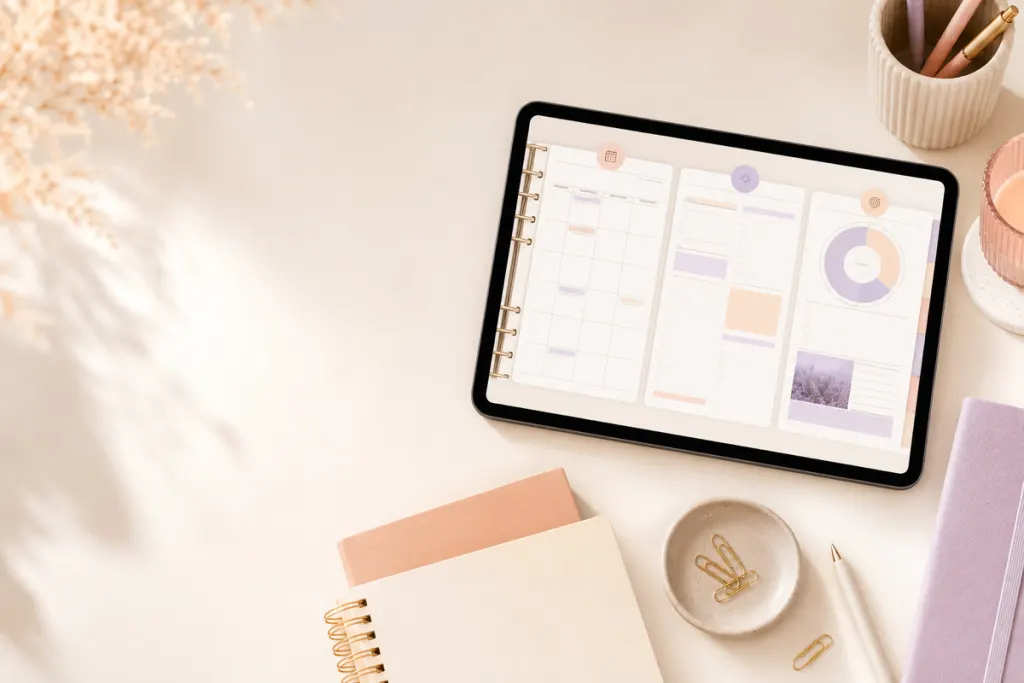
The planner does not need to contain platform-specific templates to be useful. A monthly page can hold campaigns and publishing windows, a weekly page can allocate production time, and a daily page can show the next actions. Only treat a product as having dedicated content modules when the individual listing verifies those pages are included.
Map the content workflow before choosing a planner
| Stage | Planning question | Useful planner surface |
|---|---|---|
| Ideas | Which topics are worth developing? | Notes or idea list |
| Calendar | When should each piece publish? | Monthly view |
| Production | What must be created this week? | Weekly view |
| Execution | What is the next action today? | Daily view |
| Review | What should be continued, changed, or retired? | Weekly/monthly review notes |
Use the month for publishing windows, not every production task
Start with dates that matter to the audience or business: planned publishing dates, campaign periods, launches, seasonal content, collaborations, and deadlines for approvals. Keep the month readable so you can see collisions.
If a post requires research, writing, design, recording, editing, and review, do not copy all six steps into the monthly date box. Put the publishing milestone on the month and move production actions into the relevant week.
Turn the week into a production plan
A weekly view is where the content calendar becomes work. Review what is scheduled to publish, then identify the minimum steps that must happen before those dates. Group similar work when it reduces setup time—for example, outline several posts in one session or record several short clips in one block.
Do not fill the week to maximum capacity. Content production often includes revisions, feedback, reshoots, broken links, delayed assets, or platform changes. Leave buffer so one delayed piece does not force the whole calendar to move.
A simple weekly content planning sequence
- Review the next two to four weeks of publishing dates.
- Confirm which pieces actually need to be produced this week.
- Choose the next stage for each active piece.
- Block focused production time before adding small admin tasks.
- Group approvals, uploads, metadata, and scheduling into shorter admin windows.
- Leave one buffer block for revisions or overflow.
- End the week by closing completed items and rescheduling unfinished work deliberately.
The time-blocking guide can help when production tasks need protected focus time.
Keep an idea backlog separate from committed work
An idea is not a deadline. If every idea appears on the calendar, the planner becomes a source of guilt rather than a decision tool. Keep a separate backlog for topics, hooks, references, and experiments. Promote an idea to the calendar only when you choose to develop it.
This separation makes the weekly plan easier to trust. The calendar shows commitments; the backlog shows possibilities.
Use goals as filters, not as guaranteed outcomes
Content goals can help decide which ideas deserve time, but a planner cannot guarantee audience growth, sales, reach, or engagement. Translate broad goals into actions you control: publish a defined number of useful pieces, update an old article, test a new format, or review performance at a set interval.
The digital planner goal-setting system explains how to move from an outcome to smaller actions without treating the planner as proof of future results.
Build a weekly reset around the pipeline
At the end of the week, scan every active piece and give it one clear status. Close completed work, identify anything blocked, and decide what should move into the next week. Avoid carrying vague tasks such as “work on video” indefinitely; replace them with the next action you can actually complete.
Use the weekly reset routine if you want a repeatable review process.
Keep content files organized outside the planner
The planner can point to filenames, folders, or project labels, but it does not need to contain every source file. Keep scripts, images, exports, contracts, and raw media in an organized file system with clear versions. Separate source assets from final exports so edits do not overwrite the only working copy.
If you create in Goodnotes, its Auto Backup documentation describes backup as a one-way copy and distinguishes it from sync. That distinction matters if you expect a cloud folder to behave like a live mirrored project workspace.
Choose a planner by the production decisions you make
- Publishing horizon: do you need a strong month view for campaigns and deadlines?
- Weekly capacity: can you see recording, writing, editing, and admin without crowding the page?
- Notes: is there enough space for idea references without mixing them into the calendar?
- Navigation: if the PDF is hyperlinked, can you move quickly among the views you use?
- Orientation: does the page fit your split-screen or tablet workflow?
- File type: are you annotating a ready-to-use PDF or editing a source template?
- Delivery and license: are the actual files and usage rights clear?
Common content-planning mistakes
- Planning every idea: keep an idea backlog separate from committed publishing dates.
- Using one status for everything: define simple stages such as idea, draft, edit, review, scheduled, published.
- Ignoring production time: a publishing calendar is incomplete if you do not reserve the work before the deadline.
- Tracking sensitive partner/client information: use appropriate secure systems for confidential data.
- Overloading the planner with metrics: track only numbers that lead to a decision you will actually make.
- Assuming a template guarantees growth: planning can support consistency, not results.
Plan review dates, not just publish dates
A content calendar becomes more useful when it tells you when to review a piece after it goes live. Add a lightweight review date for work that may need a factual update, refreshed links, a stronger title, or a performance check. The review does not need to become a full rewrite; it is simply a reminder to decide whether the piece still deserves attention.
For evergreen content, a review date can help catch outdated screenshots, changed platform instructions, or broken references. For campaign content, the review can happen soon after the campaign ends so you can record what should be repeated or changed next time. Keep the notes short and use the original analytics platform as the source of truth for any performance decision.
Keep one source of truth for each content status
If the planner says a piece is scheduled while the publishing platform says it is still a draft, the workflow becomes difficult to trust. Decide which system owns the final status and use the planner as a high-level coordination layer. That reduces duplicate maintenance and makes it easier to see when something actually changed.
Frequently asked questions
Do content creators need a separate content calendar?
Not necessarily. A digital planner can hold publishing dates and weekly production tasks if the layout stays readable. Larger teams or complex approval workflows may still need dedicated project or editorial systems.
Should I plan content daily or weekly?
Use the week to allocate production capacity and the day to identify the next actions. Daily planning alone can hide upcoming deadlines; monthly planning alone can hide the workload needed to meet them.
Can I track analytics in a digital planner?
You can record a small set of metrics for review, but use the original analytics platform as the source of truth. Avoid copying large dashboards into the planner unless those numbers drive a specific decision.
Will a content planner increase views or sales?
No planner can guarantee audience growth or revenue. It can help organize the work you choose to do and make deadlines easier to see.
Use the planner as the decision layer
Let the planner answer what is due, what stage each piece is in, and what work deserves capacity this week. Keep raw files and detailed analytics in the systems designed for them. This makes the planner lighter and easier to maintain.
Browse the Temply Studio digital planner collection and verify the current file formats, included layouts, software requirements, delivery, and license for any product you consider.
Official reference
Temply Studio
Stop chasing your goals with sticky notes and scattered notebooks. Our premium digital planners and Canva templates are designed to help you plan with intention, stay consistent, and actually enjoy the process.


Questions about this guide?
Ask about the planner, share how you use it, or tell us what to cover next. Your email stays private.