


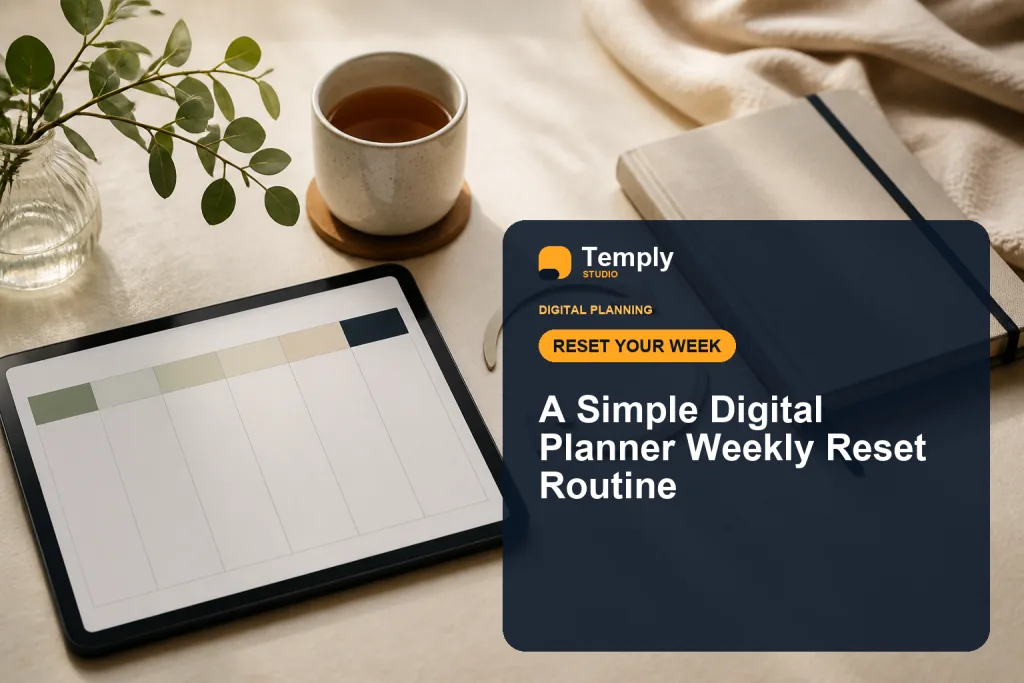
Quick answer: A digital planner weekly reset is a short review that closes the previous week and prepares the next one. Collect unfinished tasks, check fixed commitments, choose a small number of priorities, place those priorities into realistic time blocks, and clean up your planner so the next week starts with a clear view.
The reset works best as a decision routine, not a decorative ritual. You do not need to redesign your planner, fill every tracker, or copy a large template every Sunday. The goal is to decide what matters, what moves forward, and what can be removed.
What a weekly reset should accomplish
By the end of the reset, you should be able to answer four questions: What is already committed? What unfinished work still matters? What are the main outcomes for the next week? Where is there realistic time to do them?
If your planner cannot answer those questions, adding more sections usually creates more maintenance rather than more clarity.
1. Close the previous week first
Open the last weekly view and scan appointments, tasks, notes, and reminders. Mark completed items. For everything unfinished, make one decision: move it, delegate it, schedule it, store it for later, or delete it.
Avoid copying every unchecked task automatically. Repeatedly carrying low-value tasks forward can make a planner feel permanently behind.
2. Capture commitments from other places
Check the sources that actually create obligations for you, such as a calendar, school portal, project board, or personal notes. Transfer only the commitments that need to influence your weekly plan. Do not duplicate entire systems into the planner if a short reference is enough.
3. Choose three weekly outcomes
Select up to three outcomes that would make the week meaningfully complete. An outcome is more useful than a vague category. “Send proposal to client” is clearer than “client work.” “Finish chapter notes for exam” is clearer than “study.”
Smaller supporting tasks can sit beneath each outcome or in a separate admin list.
4. Check the monthly view
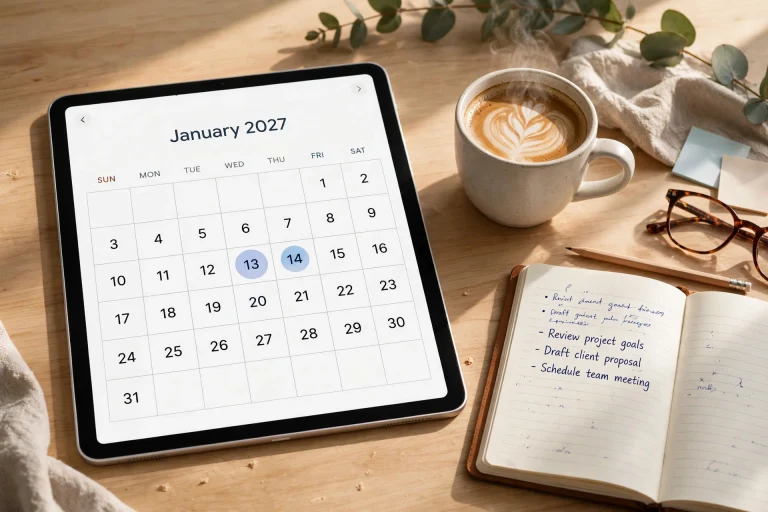
A monthly view helps you see deadlines, travel, appointments, and other events that may change the shape of the week. A weekly view then helps you decide how to respond. If you are choosing between these layouts, the monthly vs weekly digital planner comparison explains their different planning horizons.
5. Protect fixed events before adding tasks
Place work shifts, classes, appointments, meetings, pickup times, meals, and other commitments that are difficult to move. This reveals the real amount of flexible time instead of planning against an imaginary empty week.
6. Schedule focused work in realistic blocks
Use the remaining time for the few tasks that need concentration. Avoid filling every open hour. Leave room for transitions, delays, and unexpected requests. The daily planner time-blocking guide gives a more detailed method for turning priorities into flexible blocks.
7. Add a small admin batch
Group short tasks such as replies, invoices, forms, file naming, and routine follow-ups into one or two admin periods. Batching can reduce the number of times you switch attention, but it is only useful when those tasks genuinely belong together.
8. Review goals without rewriting them
Look at active goals and ask which one, if any, should influence this week. You do not need to rewrite a full goal page every seven days. Pull one milestone or next action into the week. For a more structured approach, see the digital planner goal setting system.
9. Clean the planner, not just the task list
Archive stray screenshots, rename confusing files, move loose notes to the right section, and remove duplicate pages you no longer need. A few minutes of file hygiene can make the planner easier to navigate during the week.
10. Write a short Monday-start note
Finish with a one- or two-sentence note that tells you what to do when the week begins. For example: “Monday: finish proposal draft before checking non-urgent messages.” This creates a clear first action without requiring a complicated morning ritual.
A 20-minute weekly reset example
| Minutes | Action |
|---|---|
| 0–4 | Close last week and decide what happens to unfinished items. |
| 4–8 | Check calendar and capture fixed commitments. |
| 8–12 | Choose up to three weekly outcomes. |
| 12–16 | Place focus blocks and one admin batch. |
| 16–20 | Tidy notes/files and write the first next action. |
The exact duration is not important. A shorter reset you repeat is more useful than a long system you avoid.
Common weekly-reset mistakes
- Moving every unfinished task forward without deciding whether it still matters.
- Scheduling priorities before fixed commitments.
- Filling every open hour with tasks.
- Maintaining trackers that never affect a decision.
- Turning the reset into a full planner redesign.
- Keeping multiple active copies of the same weekly plan.
Frequently asked questions
What day should I do a weekly reset?
Choose a time close enough to the next week that your commitments are reasonably current. Friday, Sunday, or Monday can all work depending on your schedule.
Do I need both monthly and weekly pages?
No. Use both only if the monthly view helps you see longer-term commitments and the weekly view helps you act on them.
How many priorities should I choose?
Start with one to three outcomes. If you consistently finish them early, you can add more later.
Should I copy unfinished tasks automatically?
No. Decide whether each task still matters before moving it forward.
Build a repeatable planning rhythm
A weekly reset should make the next week easier to understand, not more complicated. Browse the Temply Studio digital planner collection only after checking the exact product files, layouts, navigation, software requirements, delivery, and license for your intended workflow.
Keep the reset visible during the week
Do not bury the three weekly outcomes on a page you never reopen. Put them on the weekly view, a dashboard, or another page you genuinely check. If a planning element is not visible when decisions are made, it is unlikely to influence the week.
Use capacity instead of an idealized schedule
Look at how many focused hours are realistically available after fixed commitments, travel, care responsibilities, meals, and routine admin. If the week has only three strong work blocks, plan the three most important pieces of work rather than pretending there are ten. Capacity planning is especially useful during busy school, launch, or client weeks.
Separate maintenance from progress
Some tasks keep life or work running but do not move a project forward. Keep maintenance visible, but do not let it consume the entire priority list. A simple weekly page can separate recurring admin from milestone work so both types of responsibility are acknowledged.
Use the reset to reduce open loops
Loose notes, unfinished decisions, and vague reminders create friction because they require interpretation every time you see them. During the reset, convert each open loop into a next action, a scheduled event, a reference note, or a deliberate deletion. This makes the planner easier to scan during the week.
Adapt the reset during unusually busy weeks
When capacity drops, shorten the reset rather than skipping it entirely. Review fixed events, choose one primary outcome, capture urgent admin, and identify the first next action. A five-minute version can preserve continuity until a fuller review is possible.
End with a realistic fallback plan
Choose the minimum version of the week that would still protect the most important responsibilities if plans change. That might be one client deadline, one study block, and essential appointments. A fallback plan prevents the weekly layout from becoming useless after the first disruption and makes reprioritization faster.
Final quality check
Before relying on the workflow, reopen the file or page and verify the result in the context where it will actually be used. Confirm labels, links, dates, filenames, layout, and any output that matters. Keep the source copy separate so a failed experiment remains reversible.
Temply Studio
Stop chasing your goals with sticky notes and scattered notebooks. Our premium digital planners and Canva templates are designed to help you plan with intention, stay consistent, and actually enjoy the process.


Questions about this guide?
Ask about the planner, share how you use it, or tell us what to cover next. Your email stays private.