




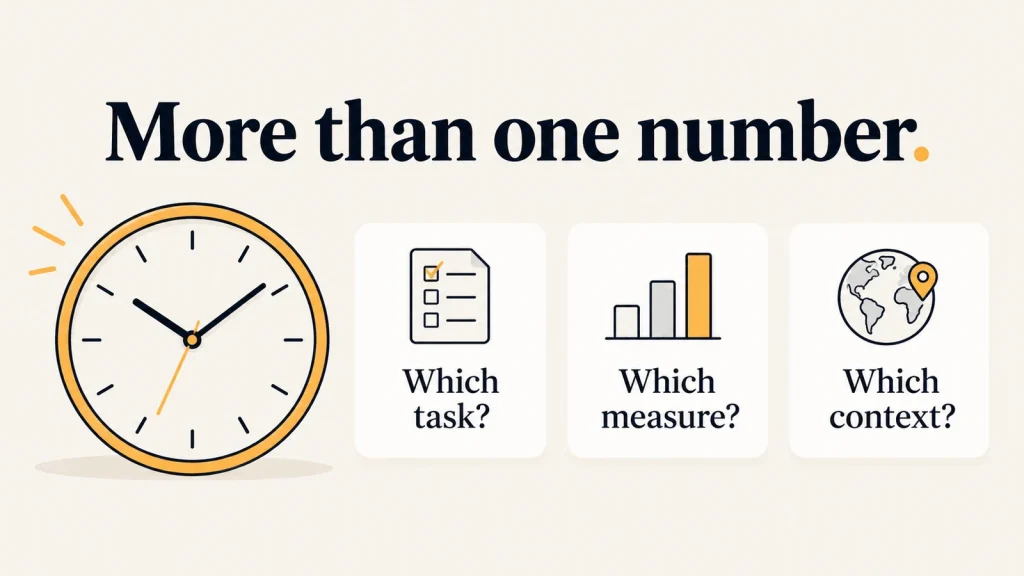
ADHD attention span cannot be reduced to one number that applies to every adult. A claim about minutes of concentration is only meaningful when you know who was studied, what task they performed, and what the researchers measured. The studies discussed here do not provide a universal timer setting or a home test for ADHD.
This guide explains attention-duration claims and research limits. It is not a diagnostic assessment, a focus-training program, or medical advice. The observation note below is an original way to describe an ordinary situation, not a scored instrument.
Quick answer: ADHD attention span is not a universal time limit. To interpret a number, check the studied group, task, measure and authors’ conclusion; use a work interval only as a planning choice.
Table of Contents
Ask what “attention span” is supposed to measure
Someone might use the phrase to mean how long they read before looking away, how long they stay on a webpage, how consistently they respond during a test, or how long they can work before choosing a break. Those are not interchangeable measurements.
Consider a person who leaves a document after a few minutes because a required attachment is missing. The time spent in the document does not tell you their maximum capacity to concentrate. It tells you when they stopped working in that particular situation.
Likewise, moving between a document and a reference can be part of the task rather than evidence of distraction. Before interpreting a number, identify what counted as being on task, what counted as an interruption, and whether the measure captured understanding or only observable behavior.
What a sustained-attention study actually tested
In a study by Tucha and colleagues, 29 adults with ADHD and 30 comparison participants completed four 20-minute attention tests. The tasks assessed different aspects of attention, and the researchers examined changes in performance over time. Several measures showed greater difficulties or deterioration in the ADHD group. The paper first appeared online in 2015 and was included in a 2017 journal issue.
The 20-minute duration was part of the study design. It was not a finding that adults with ADHD can concentrate for exactly 20 minutes, nor a recommendation that every work session should have that length. A group comparison on structured tasks cannot specify an individual’s attention limit across everyday activities.
This distinction matters whenever an article turns a research method into a lifestyle prescription. Ask whether the number describes how a study was conducted or an outcome the researchers actually established.
Why an attention test is not a standalone diagnosis
A 2024 systematic review by Varela and colleagues examined 69 articles about continuous performance tests in adults with ADHD. The authors found substantial differences between studies, frequent risk-of-bias concerns, and inconsistent performance profiles. They concluded that these tests should not be used alone for diagnosis, although they may contribute to a comprehensive assessment.
That does not mean every attention measure is useless. It means its purpose and limits matter. A test used by a professional within an assessment is different from an online countdown presented as a definitive answer about your health.
The CDC’s diagnosis guidance, written mainly for parents, also cautions that there is no single ADHD test and that other problems can produce similar symptoms. For adult readers, the adult-specific review above is the relevant evidence against using one score alone. Neither source supports diagnosing yourself from the length of a work session.
ADHD attention span claims need a defined measure
When a post promises an average ADHD attention span or a formula for the ideal focus block, inspect the source rather than repeating the number.
| Question | What to look for |
|---|---|
| Who was studied? | Adults or children, clinical sample or general population, and sample size |
| What was the task? | Reading, a laboratory response task, browsing, or another specific activity |
| What was measured? | Accuracy, response variability, task switching, self-report, or elapsed time |
| What does the number describe? | A test duration, an average result, a range, or a suggested schedule |
| What can the result support? | The authors’ actual conclusion, not a stronger headline |
This is a source-reading checklist, not a quality score for medical research. If the post does not identify a study or define its measure, do not treat its number as a clinical norm.
Be especially cautious about formulas that turn a diagnosis label into a precise daily productivity target. The evidence summarized here does not validate that use.
Separate planning a session from measuring ability
You can still choose a work period without believing it is your biological limit. A session length can be a logistical choice based on the available time, task, and next commitment.
For instance, if a meeting begins soon, you might use the available interval to review one section rather than open an entire new project. That is a planning decision. It does not establish that your concentration ends when the calendar interval ends.
Temply Studio’s daily planner for time blocking guide covers arranging work around real commitments. Use it for scheduling, not for interpreting attention-test results or calculating an ADHD score.
Make a context note without turning it into a self-test
If you want to understand an ordinary work difficulty more clearly, record the situation rather than rating your attention span. You do not need to time every minute.
| Note field | Example of useful detail |
|---|---|
| The intended task | Read the instructions and identify the required file |
| What happened | I opened another page to look for a missing example |
| What was unclear or unavailable | The instructions named two different versions |
| What changed the task | A new message arrived with revised instructions |
| The next question | Which version should I use? |
Do not label the example a failure to sustain attention. The immediate issue may be version confusion. The note identifies a question that can be answered without diagnosing its cause.
Keep such notes private when they contain personal or workplace information. An employer, friend, or partner should not use an informal log to make clinical conclusions about someone else.
Worked example: two reading sessions that look different
Imagine a fictional reader, Avery, reviewing two sets of instructions on different days. In the first session, the required example is beside the text. In the second, the example is missing, so Avery opens several pages to find it.
A browser log might show more switching in the second session. Without the task context, it would be easy to call this worse concentration. With the context, there is a clear information problem to investigate first.
Avery asks for the correct example and notes whether the instructions then become easier to follow. This is a small organizational adjustment, not proof that attention capacity improved. Other circumstances may also differ between the sessions.
The lesson is not that every attention difficulty is caused by poor instructions. It is that a number without context can hide a practical question.
What to discuss when difficulties keep affecting daily life
If attention difficulties are persistent and interfere with important parts of life, consider speaking with a qualified healthcare professional. Describe the situations and their impact rather than trying to match an online minute range.
Bring uncertainty into the conversation: what you noticed, when it happens, what you do not remember clearly, and what other circumstances may matter. You do not need a perfect record before asking for help.
A professional may decide whether additional assessment is appropriate. Do not change prescribed treatment or interpret an individual test score using this article.
Common questions about ADHD attention span
Does completing a long enjoyable activity rule out ADHD?
No single activity establishes or excludes a diagnosis. The adult-specific review describes attention testing as one possible part of a comprehensive assessment. A favorite activity is not a substitute for that process.
Is taking a break evidence that my attention failed?
Not by itself. A break may be planned or connected to another responsibility. Describe why the activity stopped before treating the interval as a measurement of ability.
Should I keep timing myself?
Only use an ordinary planning log when it serves a useful question. It is not necessary to turn daily activities into repeated tests, and the log cannot produce a diagnosis.
Use the next session to answer a practical question
Choose a task and identify what would make its instructions, materials, or stopping point clearer. Review the result without converting it into a universal attention-span number.
A weekly planning review can hold that observation, or you can use a single note. Explore the planning guides for logistical methods, keeping those methods separate from health assessment.
Sources: Tucha et al., Sustained attention in adult ADHD; Varela et al., systematic review of continuous performance tests; CDC, Diagnosing ADHD.
Publisher: Temply Studio. Examples and note fields are original, nonclinical illustrations. This article is not medical advice.
Temply Studio
Stop chasing your goals with sticky notes and scattered notebooks. Our premium digital planners and Canva templates are designed to help you plan with intention, stay consistent, and actually enjoy the process.

Questions about this guide?
Ask about the planner, share how you use it, or tell us what to cover next. Your email stays private.