




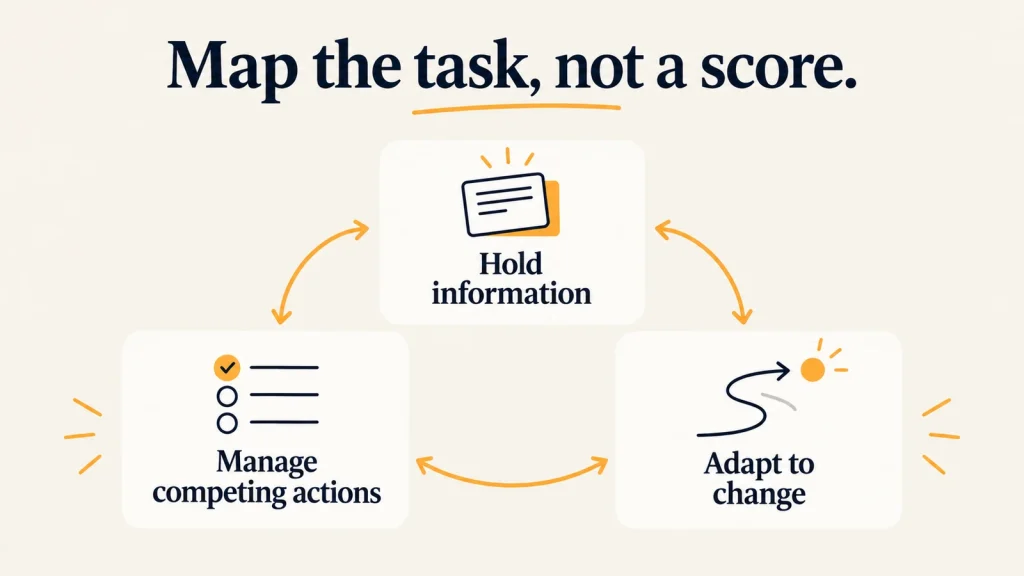
Executive skills and ADHD are related, but they are not interchangeable terms. Executive functions help a person hold a goal in mind, manage competing responses, and adapt when the situation changes. Learning the vocabulary can help you describe a task’s demands; it cannot diagnose ADHD or reduce someone to a list of deficits.
This article explains a research framework and then offers an original, nonclinical task-mapping exercise. It does not assess your cognitive abilities, score symptoms, or claim that a planning worksheet trains executive function.
Quick answer: Executive skills describe how people manage information, actions and changes while working toward a goal. A task map can identify support needs; it cannot diagnose ADHD or assess ability.
Table of Contents
Why different executive-skills lists use different numbers
You may encounter lists with three, seven, or more executive skills. Before treating them as contradictory, look at what each author is grouping together. A broad cognitive process and a practical behavior such as organizing a project are not necessarily being counted at the same level.
In her 2013 review, Executive Functions, Adele Diamond describes three core functions: inhibition, working memory, and cognitive flexibility. Higher-order activities such as planning and reasoning draw on these functions. This is the framework used below, not a claim that every other model is invalid or that there is one official checklist for daily life.
When comparing sources, preserve the author’s definitions. A list developed for a school setting, a research task, and a workplace coaching resource can serve different purposes. None becomes a diagnostic instrument simply because it has numbered items.
Understand the three core functions through ordinary examples
| Function | Plain-language meaning | Illustrative task demand |
|---|---|---|
| Working memory | Keep information available while using it | Compare a document with several requirements |
| Inhibition | Manage a competing response or distraction | Pause before replacing an agreed task with a new request |
| Cognitive flexibility | Adjust when a rule, perspective, or situation changes | Revise the plan after the required format changes |
The meanings above summarize Diamond’s framework; the examples are Temply Studio illustrations. They are not tests. Struggling with a document might reflect an unclear brief, missing information, fatigue, unfamiliar software, or another factor rather than identifying a particular cognitive weakness.
Planning can require several functions at once. A person preparing a submission may need to remember the purpose, resist unrelated additions, update the plan, and check whether the result meets the requirement. A practical task rarely isolates one function as neatly as a laboratory experiment tries to.
What is the relationship to ADHD?
A 2005 meta-analysis by Willcutt and colleagues examined 83 studies and found group-level executive-function weaknesses associated with ADHD. The authors also emphasized that these difficulties were not universal and did not explain every case. It is historical research across ADHD samples, not an adult-only diagnostic rule.
The NIMH adult ADHD overview describes everyday difficulties that can include planning, organization, following instructions, and finishing projects. It also explains that assessment considers symptoms, history, impact, and possible alternative explanations.
Two useful boundaries follow. Having difficulty planning does not by itself establish ADHD, and showing a strength on one task does not by itself rule ADHD out. A research association between groups is not a verdict about an individual.
Map the task instead of rating yourself
Choose one ordinary task with a clear outcome. Write the instructions or requirements where you can inspect them. Then ask what the task is asking you to manage.
Start with the information: what needs to remain available while you act? Next, look at competition: what unrelated request or tempting addition could change the scope? Finally, identify change: what would make the plan need revision?
This is a task description, not a score. You are identifying where a note, a decision, or a clearer requirement could help. Avoid columns labelled “my deficit” or “my mental age”; they imply an assessment this exercise does not provide.
For a larger outcome, the digital planner goal-setting guide covers milestones and completion criteria. The task map here concerns the demands within one part of that work.
Worked example: preparing a short document for review
Imagine a fictional designer, Ellis, preparing a two-page information sheet. The request names an audience, several required facts, a file format, and a review deadline. Later, the requester changes the required order of the sections.
| Demand in the task | Information to make visible | Possible support |
|---|---|---|
| Keep requirements available | The current brief and required facts | One short checklist linked to the original brief |
| Avoid unagreed extra work | The agreed two-page scope | A separate note for optional additions |
| Respond to the change | Which instruction changed and which did not | A dated revision note and confirmation |
| Check the result | What the reviewer needs to receive | An explicit file-format and completeness check |
Ellis does not need to know which executive function explains every difficult moment. Keeping the current brief available and confirming the change can clarify the work regardless of the cause.
Nor does the example establish that a checklist is always sufficient. If the facts are missing, Ellis still needs an answer from the requester. Making a requirement visible is different from supplying information that does not yet exist.
Distinguish an external support from a training claim
A checklist stores instructions outside your memory. A calendar records commitments. A labelled folder makes a file easier to identify. These are descriptions of what the tools do, not proof that they improve a person’s underlying executive-function capacity.
Claims about brain training, symptom reduction, or lasting cognitive change require evidence that matches that claim. A before-and-after feeling from one work session is not enough to establish it.
When considering a course or service, ask what it actually offers: education, organizational support, assessment, or treatment. Check the provider’s role, the limits of the service, and the evidence behind any promised outcomes. This article does not recommend a provider or certify a professional qualification.
Choose one support and observe the task outcome
Use a question that can be answered without grading your brain: “Was the current instruction easy to find?” or “Did I identify the missing information before beginning the final version?”
Try a small support in an ordinary, low-risk setting. Keep the underlying task similar enough that the comparison is meaningful to you. Record what changed in the environment, instructions, or available help.
A successful attempt can justify keeping a useful arrangement. It does not establish a medical effect. An unsuccessful attempt may reveal a different problem, such as a deadline that does not fit the work or a requirement that needs clarification.
For a place to review those decisions, the weekly reset guide offers a separate organizational workflow. Do not turn every difficulty into another tracking obligation.
What a task map should leave out
Do not add diagnostic cutoffs, invented age equivalents, personality labels, or claims about a person’s intelligence. Avoid assigning a family member or colleague a deficit because they handled one task differently.
Keep sensitive information out of shared examples. You can say “instructions changed after work began” without recording a person’s diagnosis or private health history.
Also preserve actual safety and approval requirements. A simplified reminder is not a replacement for a required procedure, and a completed planning card does not authorize publication, spending, or another consequential action.
Questions to bring to a professional
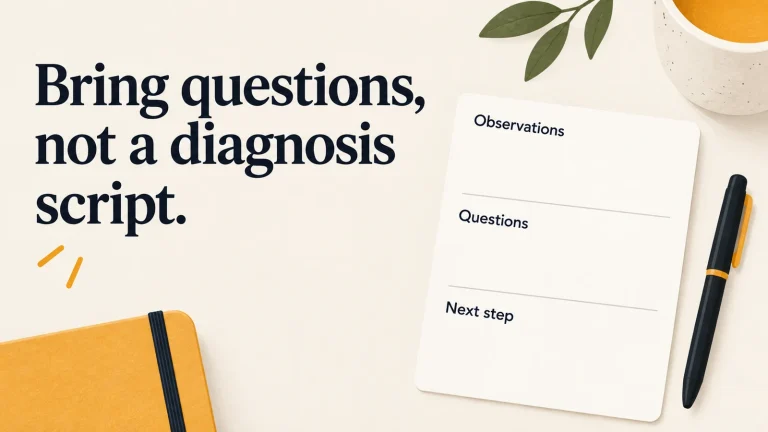
When persistent difficulties interfere with daily life, a professional can help consider the broader picture. A neutral observation may be more useful than arriving with a self-assigned executive-function label.
Examples of questions include: “What information would help you understand these recurring problems?” and “How should I distinguish a practical support need from something that requires assessment?” The answers depend on the person’s history and circumstances.
Do not delay seeking help while trying to produce perfect records. A few honest examples and an explanation of their impact can be a starting point.
Use the vocabulary to make a request clearer
The practical value of this framework is a better description of the work. Instead of “I need to fix all my executive skills,” you might identify one need: keep requirements available, make competing priorities explicit, or record what changed.
A planning file is optional. Compare the actual layouts in Temply Studio’s planner-format guide only after deciding what information you need to see. The format supports the task; it does not provide an assessment or treatment.
Sources: Diamond, Executive Functions; Willcutt et al., executive-function meta-analysis; NIMH, ADHD in Adults.
Publisher: Temply Studio. The task map is an original organizational example, not a validated clinical instrument. This is not medical advice.
Temply Studio
Stop chasing your goals with sticky notes and scattered notebooks. Our premium digital planners and Canva templates are designed to help you plan with intention, stay consistent, and actually enjoy the process.
Questions about this guide?
Ask about the planner, share how you use it, or tell us what to cover next. Your email stays private.