




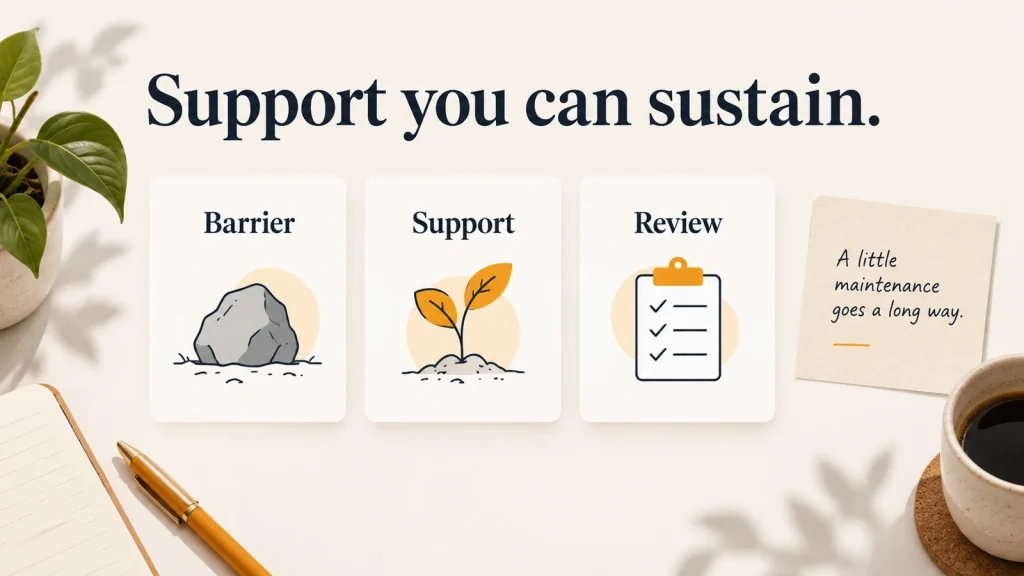
ADHD coping mechanisms are most useful to evaluate against a specific difficulty, not as a checklist you must complete. Describe the pressure you are trying to manage, choose one practical support, and check both its benefit and the work required to maintain it. A strategy that helps once is worth noticing; it is not automatically the right system for every situation.
This guide concerns choosing and reviewing ordinary organizational supports for adults. It is not a treatment plan, a diagnosis tool, or a substitute for professional care. The review questions and examples are original Temply Studio planning aids, not clinically tested exercises.
Quick answer: ADHD coping mechanisms should address a specific pressure and have a workable maintenance cost. Choose one ordinary support, observe whether it helps, and keep, adjust or stop it as needed.
Table of Contents
What ADHD coping mechanisms mean in this guide
In this article, a coping mechanism means something you do to handle a recurring demand or difficulty. It might be a way to record a commitment, arrange information, ask for clarification, reduce an avoidable interruption, or agree on help. The label does not tell you whether the approach is effective, safe, affordable, or sustainable.
For example, copying the same appointment onto several calendars might make it more visible, but it also creates several places to update if the time changes. You need to examine the actual arrangement, not simply count the number of reminders.
Separate the need from the tool: remembering a commitment is the need; a calendar is one possible tool. This keeps the discussion open when the first tool does not fit.
What research can and cannot tell you
A 2017 qualitative study by Canela and colleagues examined interviews with 32 adult outpatients at a specialist service. Participants described strategies they had developed before diagnosis and treatment, with different experiences of usefulness. These accounts show a variety of ways people adapt; they do not establish which strategy is most effective or prove that a self-created system replaces care.
ADDA’s coping-mechanisms guide offers practical ideas including external reminders, changes to the work environment, and smaller task steps. Treat such a resource as a menu to examine, not a requirement to adopt every suggestion.
There is also a difference between a personal report, an organization’s general guidance, and evidence from a controlled study. Before sharing a strong claim about a method, check which kind of source supports it and whether the outcome studied matches the benefit being promised.
Describe the pressure before choosing the response
Choose a recent ordinary situation and finish this sentence: “The difficult part was…” Be precise enough that a change could address the issue.
| Broad description | More useful detail | Possible question |
|---|---|---|
| My week is unmanageable | Two people assigned conflicting deadlines | Who can decide which commitment takes priority? |
| I forget everything | A verbal request never reached the place I review | Where should this type of request be recorded? |
| I cannot get started | The brief does not specify the required output | What needs clarifying before work begins? |
| My system takes too much time | I rewrite the same items in several tools | Which record should be the current one? |
These are possible interpretations of the examples, not explanations of a particular person’s ADHD. A difficulty can involve unclear information, competing responsibilities, a health concern, or several things together.
When the problem is an unrealistic workload, a more detailed personal checklist does not decide which commitment can move. That decision may need a conversation.
Choose the level of support the situation needs
It can help to distinguish three levels: getting through the immediate moment, changing a recurring arrangement, and seeking professional support. They can coexist.
An immediate organizational step might be writing down the next appointment before closing the message. A recurring change might be agreeing that all appointment changes go into one calendar. A clinical concern belongs in a conversation with an appropriately qualified professional rather than a new planner template.
The NHS adult ADHD guidance describes several forms of support, including workplace changes and clinical care. Written instructions and a more suitable workspace are examples of adjustments it discusses; they are not a promise that every person needs the same arrangement.
You do not have to exhaust every organizational idea before asking for help. Equally, using an ordinary practical support does not require you to diagnose the reason you need it.
Check the maintenance cost as well as the benefit
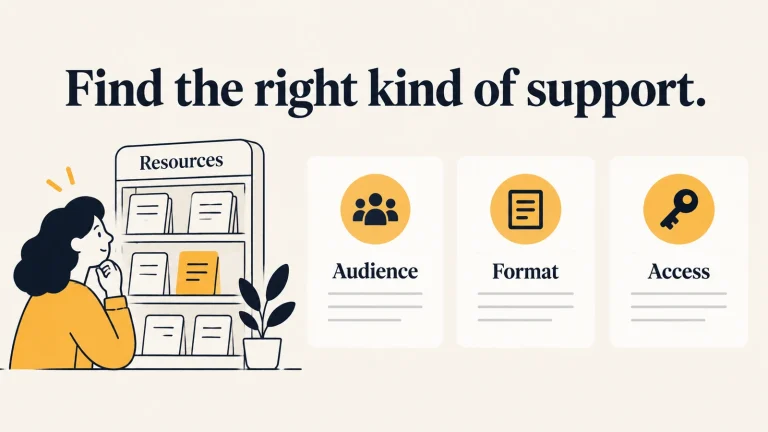
A useful support should be possible to find, use, update, and return to. Ask what it demands on an ordinary day rather than only during setup.
- Access: Is it available where the task happens?
- Maintenance: What must be updated, copied, charged, or reviewed?
- Privacy: Does it expose information that should remain private?
- Dependence: Does another person need to participate, and have they agreed?
- Return: Can you resume after a gap without reconstructing everything?
A reminder sent by a friend can be a small, agreed form of help. It becomes a different arrangement if the friend is expected to monitor every response. Discuss the boundaries rather than assuming that more involvement is better.
For a planning file, compare the actual format and software requirements in the digital planner template guide. This is an optional tool decision, not evidence that buying a planner will change symptoms.
Worked example: preparing for a volunteer shift
Consider a fictional adult, Morgan, who volunteers at a weekend event. Changes to arrival instructions come through several messages. Morgan has been repeatedly checking the whole conversation because it is difficult to tell which message is current.
One possible response is another reminder to check messages. But that does not resolve the version problem. Morgan instead asks the coordinator to confirm the final arrival details in one place and keeps a link to that confirmation with the calendar entry.
The trial is narrow: can Morgan find the current instructions without searching through several threads? It does not require a new task app, a symptom score, or a claim about why the problem occurred.
After the event, Morgan notices that the link was helpful but the calendar label was vague. The next adjustment is to rename the entry so the confirmed instructions are easy to identify. There is no need to replace the entire calendar.
Use a short strategy review
Write five lines before testing a low-risk organizational change:
- The difficulty I am addressing.
- The one support I will try.
- The result that would make it useful.
- The effort, access, privacy, or coordination it requires.
- When I will decide to keep, change, or stop it.
Use an appropriate ordinary opportunity rather than a fixed challenge or perfect streak. “After the next planning meeting” may be more useful than choosing an arbitrary number of days.
Do not run informal experiments with medication, essential safety procedures, driving, hazardous equipment, or other high-consequence activities. The examples here concern low-risk information and task organization.
Know when to change the arrangement
Keep a support when it makes the intended decision clearer at an acceptable cost. Change it when a specific part is confusing. Stop an optional method when maintaining it adds more work than it resolves.
Forgetting to use a new system once does not prove that the idea is useless. Repeatedly being unable to access it in the relevant setting, however, is a reason to reconsider its design.
A weekly review can provide a place to make that decision, but it need not become another obligation. A single note after the relevant event may be sufficient.
When practical changes are not enough
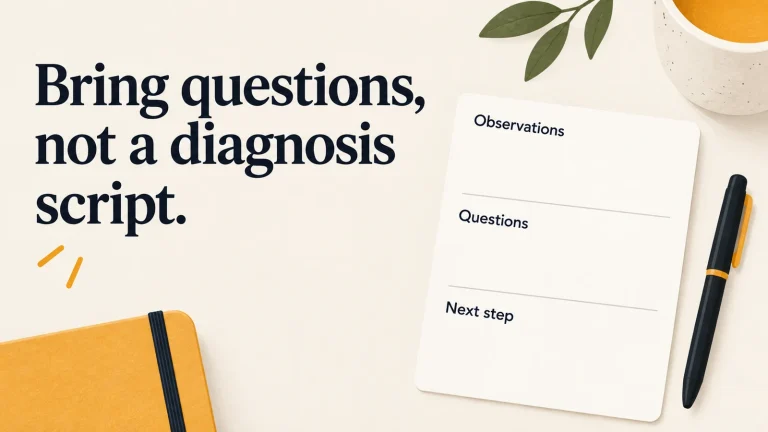
If difficulties persist and substantially affect work, study, relationships, or daily life, consider discussing the impact with a healthcare professional. NHS guidance recommends seeking support when ADHD symptoms affect those areas. Bring concrete observations, including what you tried and what remained difficult, without presenting your notes as a diagnostic test.
It is possible to value a coping strategy and still need other support. You do not have to demonstrate perfect organization to deserve help, and an unhelpful planner is not a verdict on your effort.
Start with one pressure, not nineteen new habits
Choose the situation that matters now, identify the missing support, and test a small change that you can evaluate. Keep the outcome and maintenance cost visible. For related nonclinical workflows, explore Temply Studio’s productivity and planning guides, selecting only the guide that answers your next question.
Sources: Canela et al., Skills and compensation strategies in adult ADHD; ADDA, ADHD coping mechanisms; NHS, ADHD in adults.
Publisher: Temply Studio. Original examples are illustrative. This article provides general organizational information, not medical advice.
Temply Studio
Stop chasing your goals with sticky notes and scattered notebooks. Our premium digital planners and Canva templates are designed to help you plan with intention, stay consistent, and actually enjoy the process.
Questions about this guide?
Ask about the planner, share how you use it, or tell us what to cover next. Your email stays private.