




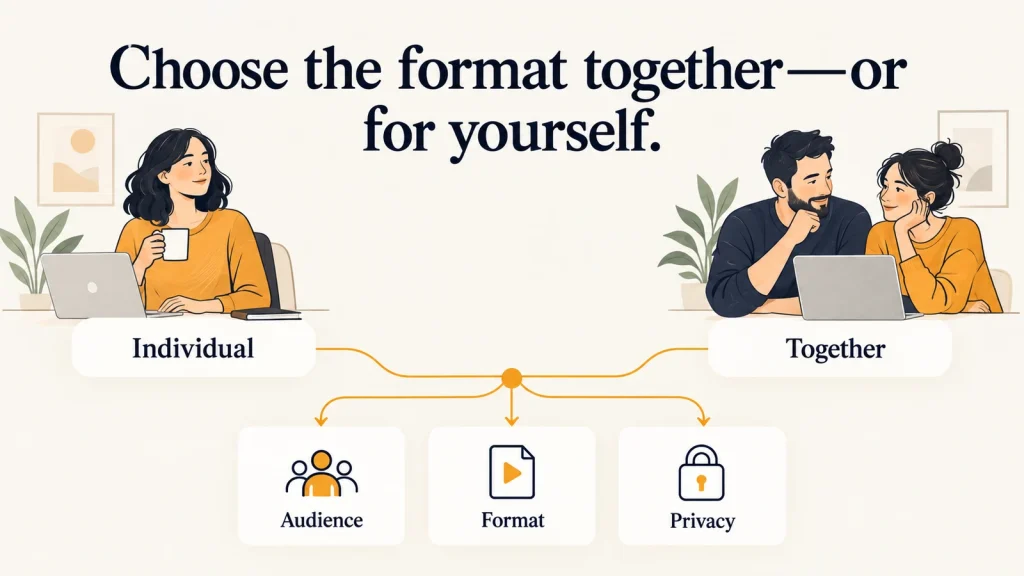
Choosing an ADHD spouse support group starts with deciding who wants to attend: you individually, your partner individually, or both of you together. Then check the programme’s intended audience, facilitator role, privacy rules, and current enrolment details. Partner-only discussion, couples support, and therapy are not interchangeable descriptions.
This guide helps adults compare resource listings. It does not assess your relationship, diagnose either partner, or recommend a particular treatment. Temply Studio does not run the programmes discussed here and has not attended or evaluated their outcomes.
Quick answer: An ADHD spouse support group may serve partners individually or couples together. Verify the intended audience, format, facilitator and privacy terms before enrolling or sharing personal details.
Table of Contents
Decide whose support need the group should meet
A person may be looking for space to discuss their own experience as a partner. A couple may want a shared setting to learn about a topic. An adult with ADHD may prefer a group focused on their own relationships and experiences.
Those are different participation decisions. Do not assume that a group labelled “ADHD partners” is intended for the partner without ADHD, or that a couples programme permits one person to attend alone. Read the audience description rather than relying on the title.
When both partners have ADHD, ask how the programme describes eligibility. This article does not assign roles based on a diagnosis or assume that one partner is responsible for managing the other.
Compare the format before comparing the provider
| Possible format | Main fit question | What to clarify |
|---|---|---|
| Partner-only group | Do I want a setting for my own experiences as a partner? | Which partners the group accepts and whether anyone else may attend |
| Group for partners who have ADHD | Does the group address the experience I want to discuss? | Eligibility and whether relationship status matters |
| Couples support or education | Do we both want to participate in the same programme? | Whether both people must attend and what participation involves |
| Clinical therapy group | Am I seeking professional treatment rather than peer discussion? | Provider qualifications, assessment, consent, and service arrangements |
These questions are a comparison aid, not an assertion that every organiser uses these categories. A programme can combine discussion and education; ask what its actual service includes before registering.
First-party programme pages to investigate
ADDA’s Loving and Living with ADHD programme describes relationship-focused support for couples. Use its current page to ask about the intended attendees, membership access, and whether both partners should participate.
The ADHD & Marriage support-group directory distinguishes groups for non-ADHD partners, partners with ADHD, and couples. Its non-ADHD partner page provides that programme’s own description and current terms.
These are factual starting points from the providers, not a ranking or a recommendation to purchase services. No prices, meeting dates, available seats, refunds, insurance coverage, or facilitator credentials are guaranteed by this article. Verify the specific programme you are considering.
Do not rely on an old event repost
Search results may lead to past registration pages, old reviews, or a programme that has changed its organiser. Save the current official page and check the session dates rather than assuming an older description still applies.
If a directory and registration page differ, ask the provider before paying or arranging attendance. Confirm the exact programme name, organiser, access requirements, and contact method.
When a programme is full or no current date is shown, an enquiry can establish whether there is a waiting list or another format. The existence of a page alone is not confirmation that enrolment is open.
Ask who facilitates and what help is offered
A facilitator may be a peer, coach, educator, clinician, or another professional. Ask which role they are performing in this particular group. A professional qualification does not, by itself, establish that the programme is providing therapy.
Useful questions include whether the group is structured around a curriculum, participant-selected topics, discussion, or practice between sessions. Ask what happens when a question is outside the group’s scope.
If you are seeking professional mental healthcare, use a suitable care pathway rather than treating a resource listing as a referral. The NIMH finding-help resource distinguishes professional and urgent support options from general information.
Protect privacy without turning the group into a secret investigation
You can discuss your own feelings and experiences while limiting identifying details about someone who is not present. Before joining, ask about recording, screenshots, retained chat messages, automatic transcripts, participant lists, and confidentiality rules.
Do not upload your partner’s health records, private messages, or workplace documents to a group to obtain opinions about them. A resource group should not become a way to crowdsource a diagnosis of an absent person.
Ask the facilitator how the group handles disclosures involving another participant, disrespectful discussion, or advice outside its scope. Privacy rules are important, but this guide cannot guarantee that any online conversation will remain confidential.
Use a focused enquiry before committing
Here is an original message you can adapt:
“Hello, I am looking for support for myself as a partner of an adult with ADHD. I am not currently looking for a programme that requires both of us to attend. Could you confirm which group matches that situation, who facilitates it, and where I can read the current cost, participation, and privacy terms?”
For a shared programme, change the purpose: “We are considering attending together. Does the programme require both people at every session, and what happens if one of us cannot attend?”
These messages seek practical information without providing a detailed history or assuming the provider can offer a particular service. Use the provider’s appropriate contact route and decide what information you are comfortable sharing.
Plan logistics without giving someone control of your account
Check the time zone, access link, device needs, and available accessibility options. Ask whether captions, breaks, or alternative ways to contribute are offered; do not infer them from the meeting platform alone.
If participation affects a shared household commitment, agree on the practical arrangement without requiring anyone to share the content of their discussions. Separate “who will cover this task during the meeting?” from “what exactly did you tell the group?”
An optional weekly planning review can hold agreed logistics. It is not a reason to monitor attendance or demand access to a partner’s messages.
A fictional example: avoiding the wrong enrolment
Imagine Riley wants a place to reflect on their own experience in a relationship. They find one general adult ADHD group, a couples programme, and a partner-specific listing.
Instead of buying the first option with a familiar name, Riley checks the audience descriptions. They ask the partner-group organiser whether individual attendance matches the programme, how discussion is moderated, and what current terms apply.
Riley’s partner does not want a joint programme at present. Riley does not register both people anyway or treat that preference as a diagnosis or a prediction about the relationship. The immediate decision is simply which format Riley wants to explore for their own support.
Review fit after a session
Consider whether the meeting matched its description, whether participants were treated respectfully, and whether the facilitator explained the boundaries. Notice whether there was room for different experiences rather than an assumption that every relationship follows one pattern.
Decide what belongs in a private reflection note, what might be discussed with your partner by mutual agreement, and what needs professional guidance. Do not turn another member’s account into evidence about your own partner.
A notebook or other planning-note format can hold your own questions. No special Temply product is required, and sensitive material should not be kept in a shared file simply because it is convenient.
Know when a group is not the right next step
A peer or educational group should not be assumed to address immediate danger, urgent mental health needs, or a situation requiring individualized clinical care. Use appropriate local professional or emergency support when those needs arise rather than waiting for a scheduled meeting.
It is also reasonable to decide that a particular group is not a fit. You can ask questions, change formats, or pause participation without treating the decision as a failure of the relationship.
Common questions about ADHD spouse support groups
Must both partners attend?
That depends on the programme. Confirm whether it is individual partner support, couples support, or another format. Do not register another adult without their agreement.
What if both partners have ADHD?
Ask about eligibility directly. Do not assume that a group’s labels describe your relationship or that one person’s support needs must fit a predetermined role.
Is a support group a replacement for couples therapy?
Do not assume equivalence. Ask what service the group provides and consult an appropriate professional when seeking assessment or treatment. This guide does not predict which option will produce a particular relationship outcome.
Publisher: Temply Studio. Provider pages checked October 2, 2026. Descriptions are provider-supplied; no group-attendance test, outcome evaluation, or clinical recommendation is claimed. This is resource-navigation guidance, not medical advice.
Temply Studio
Stop chasing your goals with sticky notes and scattered notebooks. Our premium digital planners and Canva templates are designed to help you plan with intention, stay consistent, and actually enjoy the process.

Questions about this guide?
Ask about the planner, share how you use it, or tell us what to cover next. Your email stays private.