




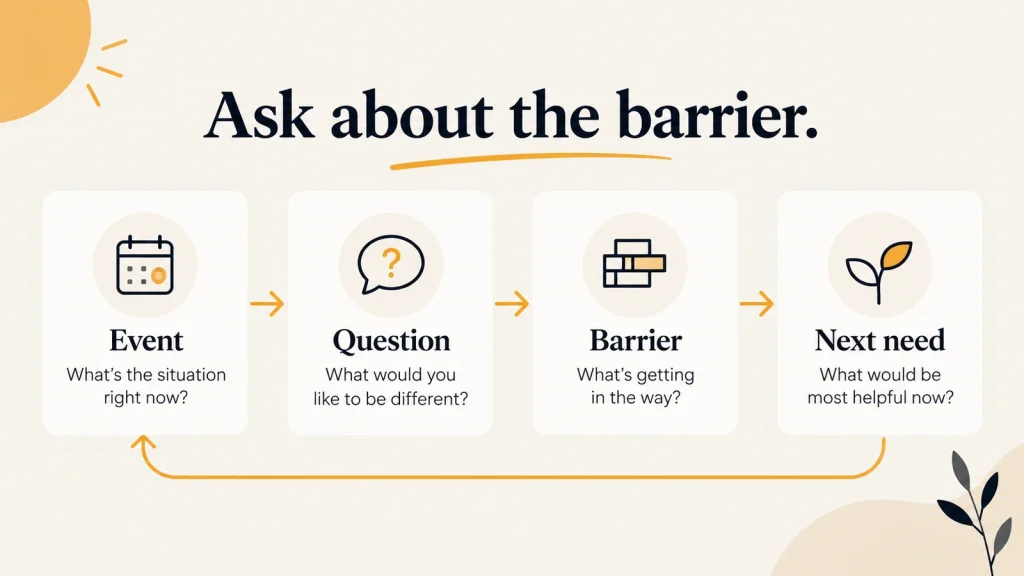
ADHD and “lazy” labels should not be treated as competing diagnoses. Calling someone lazy does not explain why a task was missed, and struggling with a task does not by itself establish ADHD. A more useful starting point is the observable event, its impact, and the information or support needed for the next decision.
This article is for adults questioning the label in their own lives or in a conversation with someone else. It is not an ADHD self-test, a performance assessment, or medical advice. The examples are fictional and do not identify the cause of any reader’s difficulties.
Quick answer: A search for “ADHD lazy” does not establish a diagnosis or explain a missed task. Start with the event, what affected it, and what support or information may help next.
Table of Contents
The “ADHD lazy” search phrase does not explain an event
The Cambridge University Hospitals ADHD resource explicitly identifies being described as lazy or uncaring about work among misconceptions people encounter. That is a reason to question the stereotype, not permission to diagnose another person whenever work is unfinished.
“The document was not sent” describes an event. “You did not care enough to send it” adds an interpretation of motive. Before accepting that interpretation, ask what is actually known.
Perhaps the person misunderstood who was sending the document, did not have the final file, forgot the commitment, or encountered another problem. Perhaps they chose not to do it. The visible outcome alone does not settle which explanation is correct.
Separate observation, interpretation, and the next need
Use four parts to make the conversation clearer. This is an original communication aid, not a psychological assessment.
| Part | Illustrative statement |
|---|---|
| Observation | The agreed file did not arrive before the review |
| Interpretation to check | I assumed you had decided not to send it |
| Question about the barrier | What happened between finishing the file and sending it? |
| Current need | We need to confirm the version and agree on the next review time |
You do not need to ignore disappointment or inconvenience. Stating the impact clearly can be more useful than making a broad judgment about character.
When a task affects someone else, the next step may include repairing a missed commitment. Discussing a possible barrier and acknowledging that impact are compatible actions.
What ADHD information can clarify
The NIMH adult ADHD overview describes difficulties that can involve organization, planning, and completing projects. It presents diagnosis as an assessment of a broader pattern and its impact, not a conclusion drawn from one unfinished task.
Use that distinction when reading “ADHD versus laziness” lists. A checklist about feeling guilty, liking a hobby, or occasionally doing well at work is not enough to establish what explains someone’s difficulties.
If you are unsure whether you may have ADHD, take the concern to an appropriately qualified professional rather than using a moral label or a social-media quiz as the answer.
Why guilt or enjoyment is not a shortcut to an answer
It may feel tempting to reason, “I feel bad about not doing it, so it must be ADHD,” or, “I spent time on something enjoyable, so it cannot be ADHD.” Neither statement provides the history, context, and assessment needed for a clinical conclusion.
A person can describe an experience honestly without turning it into a diagnostic rule. “I wanted to finish the form but kept returning to another activity” is information to discuss. It does not settle the explanation on its own.
Likewise, somebody observing the situation from outside may not know which parts were unclear, what support was available, or what else was happening. Avoid using one contrast between a hobby and an obligation as proof about a person’s health or values.
What stigma research adds—and does not prove
A study of 104 adults with ADHD, first published online in 2018, examined internalized stigma, expected discrimination, and perceived public stereotypes. The researchers reported associations between stigma-related measures and aspects of distress and functioning. The paper appeared in a 2019 journal issue.
The study supports taking stigma seriously. It does not show that a particular label caused a particular person’s difficulties, and its sample cannot supply a prevalence estimate for every adult with ADHD. Avoid turning a research association into a claim about an individual relationship.
You can choose respectful, specific wording without claiming to know the full cause of a problem. Respect does not depend on proving that one explanation is correct.
Worked example: a missed community booking
Imagine a fictional situation in which Riley agreed to confirm a room booking for a community activity. The confirmation was not sent, and the organizer had to postpone a planning decision.
A broad response would be, “You are lazy and unreliable.” A more specific opening is, “We did not have the confirmation when we needed it. Can we check what is still missing and decide who will contact the venue?”
Riley explains that the venue requested another person’s approval, and the task was left waiting without a follow-up note. The group can now decide whether that approval is available and who is responsible for the next contact.
This example is not evidence that a missed booking indicates ADHD. It illustrates how a question can reveal an actionable issue that a character label does not describe.
Riley still acknowledges the missed handoff. The organizer still has a legitimate need for clear communication. Neither person has to pretend the delay did not matter.
Keep shared responsibility specific
A practical agreement should say what will happen, who has agreed to it, and when a change needs to be communicated. Avoid automatically assigning every unfinished task to a partner, friend, or colleague.
Where the plan is too large for the available time, a useful change may be reducing scope or negotiating a different deadline. Temply Studio’s goal-setting workflow can help separate the desired outcome from the next workable part. It cannot decide another person’s obligations or guarantee a result.
When time is the practical issue, use the time-blocking guide to make commitments visible. Do not use a full calendar as a test of effort, worth, or whether someone deserves support.
Rest and boundaries are not evidence to diagnose
Someone may choose to rest, decline optional work, or set a limit on what they can take on. You do not need to convert that choice into a statement about ADHD or laziness.
Keep the distinction between an optional request and an existing agreement visible. Declining a new task is different from leaving another person unaware that a previously agreed task will not happen. Both situations can be discussed without reducing the person to a label.
For your own plans, avoid filling every available space merely to disprove an accusation. A schedule should represent real commitments and capacity, not function as evidence in an argument about character.
Replace a self-label with one useful question
When “I am lazy” is the only explanation on the page, it offers little direction. Try asking one bounded question instead:
- Was the result I needed to produce clear?
- Was a required item, answer, or permission missing?
- Did I agree to more work than the available time supported?
- Did the task change without the plan being updated?
- Is this a recurring difficulty that I want professional help understanding?
The questions do not promise to uncover the cause. They separate issues that may need clarification, coordination, or qualified support. Stop the exercise when it becomes another form of self-criticism rather than a way to identify a next step.
When to seek another kind of support
If persistent difficulties are disrupting important areas of daily life, consider discussing them with a healthcare professional. Bring examples of what happened and what remained difficult, not a demand to confirm a diagnosis you reached from a label.
In a relationship or workplace, recurring conflict about responsibilities may also need a separate conversation with an appropriate adviser or professional. A planning article cannot resolve every conflict, establish legal entitlements, or assess another person’s intent.
There is no requirement to become perfectly productive before raising a concern. Equally, a diagnosis should not be used to make unsupported claims about everything a person can or cannot do.
Talk about the event, not a fixed identity
The next useful sentence is usually more specific than “lazy.” Describe the event, check the uncertain explanation, and agree on the next need. Where clinical questions remain, leave them to a proper assessment.
For ordinary planning methods, explore the productivity and planning guides. Use a method because it helps with a task, not as a way to prove or disprove a moral judgment.
Sources: Cambridge University Hospitals, ADHD resource; NIMH, ADHD in Adults; Masuch et al., internalized stigma and discrimination in adults with ADHD.
Publisher: Temply Studio. This article provides general educational information and original discussion examples, not medical advice.
Temply Studio
Stop chasing your goals with sticky notes and scattered notebooks. Our premium digital planners and Canva templates are designed to help you plan with intention, stay consistent, and actually enjoy the process.


Questions about this guide?
Ask about the planner, share how you use it, or tell us what to cover next. Your email stays private.