




Quick answer: A wedding budget checklist works when you split the total into venue, food and drink, attire, photography, decor, transport and contingency, then track every category in three columns — estimated, quoted and paid. Most couples also keep a 5–10% contingency line because small overruns stack up fast.
Decide your total and your top priorities first
Before listing categories, agree on the number you are actually willing to spend and the two or three items that matter most to you — for example the venue and the photographer. Everything else gets adjusted around those anchors. This one conversation prevents most budget blow-ups later, because it tells you which quotes can flex and which cannot.
The core wedding budget categories
| Category | What it usually covers | Track |
|---|---|---|
| Venue | Ceremony and reception hire, staffing, insurance, cleanup | Estimated / quoted / paid |
| Food and drink | Catering, cake, bar service, tasting fees | Estimated / quoted / paid |
| Attire | Outfits, alterations, shoes, accessories | Estimated / paid |
| Photography and video | Hours covered, albums, edits, travel fees | Quoted / deposit / balance |
| Decor and flowers | Bouquets, ceremony pieces, table styling, rentals | Estimated / quoted / paid |
| Music and entertainment | DJ or band, ceremony musician, photo booth | Quoted / paid |
| Stationery | Invitations, save-the-dates, signage, postage | Estimated / paid |
| Transport | Couple and guest transport, parking | Quoted / paid |
| Rings and gifts | Wedding bands, party favors, thank-you gifts | Estimated / paid |
| Contingency | 5–10% buffer for overruns and last-minute additions | Reserved |
Track three numbers per category, not one
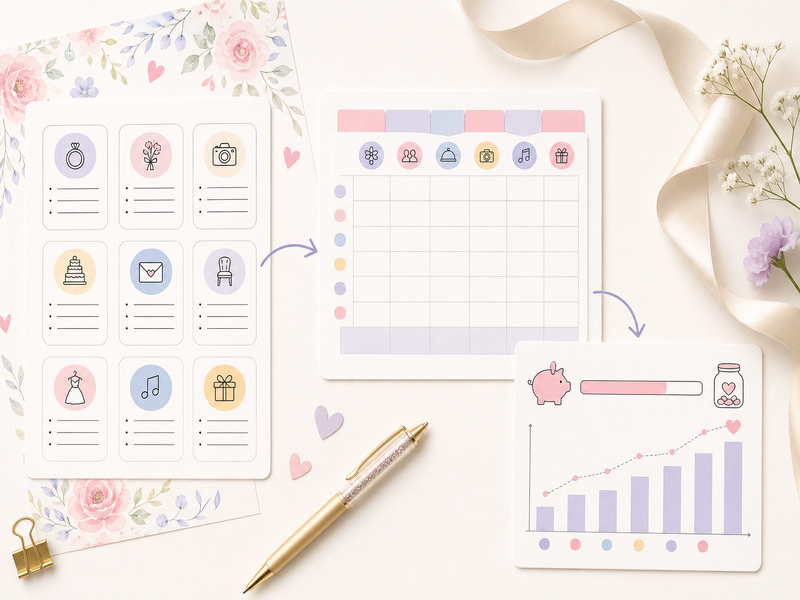
A budget that only lists a single figure per category hides whether you are on track. Use three columns: estimated (your early guess), quoted (what the vendor actually offered) and paid (what has left your account, including deposits). When a quote lands above the estimate, decide immediately which other category absorbs the difference — do not wait until everything is booked.
A worked mini-example
Say your total is $20,000 and your anchors are venue and photography. You might reserve $10,000 for the venue and catering combined, $3,000 for photography and video, $1,500 for attire, $1,200 for decor and flowers, $1,000 for music, $500 for stationery, $400 for transport, $300 for rings and gifts, and a $2,100 contingency — the lines add back to the full $20,000. When the caterer quotes $11,000 instead of $10,000, you know the extra $1,000 comes out of decor or contingency — the categories make that decision for you.
Treat the percentages above as an illustration only. Your allocation should follow your own priorities and local quotes, not a universal ratio.
Keep it printable and reviewable
A checklist only helps if you can see it. Keep categories on one page, mark each line when a deposit is paid and the balance due date, and review it together weekly in the last two months. A printable one-page layout is usually easier to keep updated than a sprawling spreadsheet nobody opens.
Put payment dates on the timeline
Once a deposit is paid, add the next payment due date to your wedding planning timeline. Put a reminder a week before each deadline to check the updated guest count, quote, or contract.
Frequently asked questions
How much should we keep as contingency?
Five to ten percent of the total is the common working buffer. If your venue or date is fixed and quotes are already in hand, the lower end is usually enough; if many vendors are still unpriced, hold closer to ten.
Should we track deposits separately?
Yes — record deposits inside the "paid" column with the balance due date noted, so a fully booked month does not surprise you when final payments land together.
What if a quote exceeds the estimate?
Decide immediately which category gives up the difference. If nothing can flex, that is a signal the total or the anchor priorities need revisiting, not a signal to absorb it silently.
Conclusion
Pick the total, choose your anchors, split into the categories above, and track estimated, quoted and paid side by side. The checklist that keeps you honest is the one reviewed weekly — the template matters less than the habit.
Temply Studio
Stop chasing your goals with sticky notes and scattered notebooks. Our premium digital planners and Canva templates are designed to help you plan with intention, stay consistent, and actually enjoy the process.



Questions about this guide?
Ask about the planner, share how you use it, or tell us what to cover next. Your email stays private.