



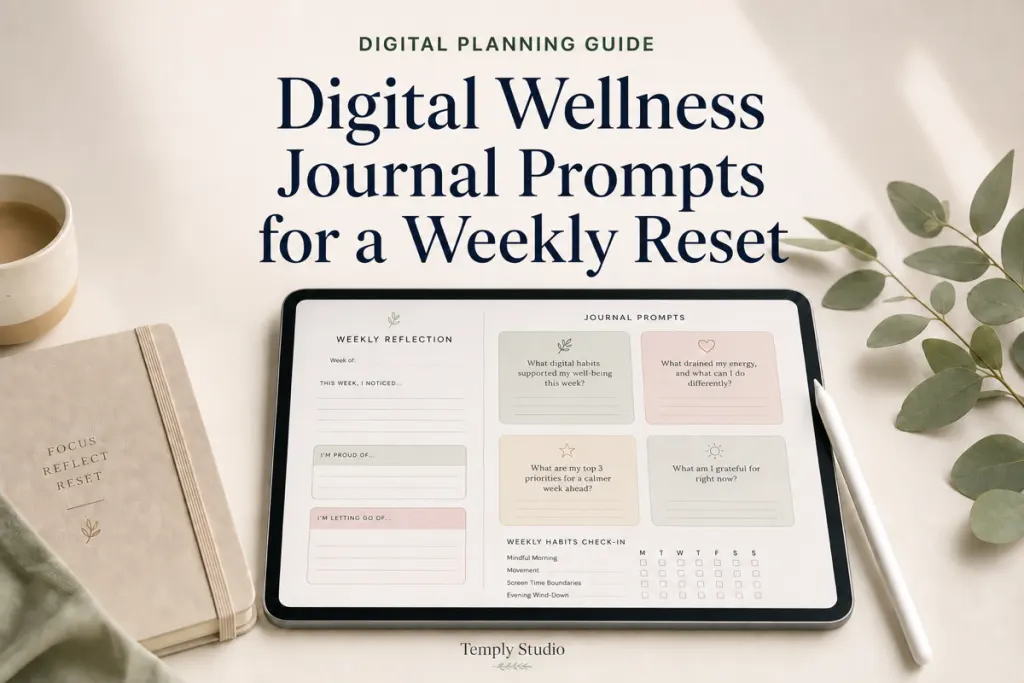
Quick answer: choose three to five digital wellness journal prompts, answer them in plain language, and end with one realistic next step. A weekly reset should help you notice patterns and make a small decision—not turn reflection into another performance target.
These prompts support general self-reflection. They are not therapy, diagnosis, crisis support, or medical advice. If difficult feelings are persistent, overwhelming, or interfering with daily life, contact an appropriate qualified professional or local support service.
How to use digital wellness journal prompts
- Choose a consistent but flexible time, such as the end of the week.
- Pick only the prompts that match what you need today.
- Write short, specific answers rather than polished essays.
- Separate observations from judgments.
- End with one action, boundary, conversation, or support step.
- Skip any prompt that feels unsafe or unhelpful.
The NIH Emotional Wellness Toolkit encourages practices such as noticing good moments, setting priorities, showing self-compassion, maintaining supportive relationships, and asking for help when needed. The prompts below translate those broad ideas into a gentle review routine without claiming a medical outcome.
A simple weekly reset structure
| Stage | Purpose | Choose from |
|---|---|---|
| Notice | Describe what happened | Prompts 1–5 |
| Energy | Review capacity and rest | Prompts 6–10 |
| Boundaries | Identify pressure and support | Prompts 11–15 |
| Gratitude | Record what mattered | Prompts 16–20 |
| Habits | Learn from routines | Prompts 21–25 |
| Next week | Choose realistic priorities | Prompts 26–30 |
30 digital wellness journal prompts
Prompts for noticing your week
- What moment from this week keeps returning to my attention?
- What felt easier than I expected?
- What felt heavier than it looked from the outside?
- When did I feel most present?
- What am I assuming about the week that I have not checked?
Prompts for energy and capacity
- Which activities gave me energy, and which used more than expected?
- What signs told me I needed a pause?
- Where did I leave too little transition time?
- What helped me rest without turning rest into another task?
- What can I make smaller, slower, or simpler next week?
Prompts for priorities and boundaries
- Which commitment truly needed my attention?
- What could have waited?
- Where did I say yes before checking my capacity?
- What boundary would protect an important responsibility?
- What kind of help, clarification, or conversation would reduce uncertainty?
Prompts for gratitude and self-trust
- What small moment am I grateful I noticed?
- Who supported me, and how can I acknowledge it?
- What did I handle with more care than I usually give myself credit for?
- What ordinary resource made the week easier?
- What decision showed that I can trust my judgment?
Prompts for habits and routines
- Which habit worked because the environment supported it?
- Which routine asked for too many steps?
- What reminder was useful, and what reminder became noise?
- What would make the helpful habit easier to repeat?
- Which habit can I pause without treating the pause as failure?
Prompts for planning the next week
- What are the three commitments I most need to protect?
- What can I prepare before the week becomes busy?
- Where should I leave buffer?
- What enjoyable or restorative activity deserves a real place on the calendar?
- What is one kind action I can take for my future self?
Turn reflection into one small decision
After answering the prompts, underline one sentence that changes what you will do next. The decision might be practical: move a deadline, ask a question, prepare a meal, reduce a task, make an appointment, or leave a free evening. These digital wellness journal prompts work best when one answer leads to a concrete next step.
A reset is more sustainable when it produces a short plan. The digital planner weekly reset routine shows how to carry a reflection into calendar and task decisions.
Keep the language observable
Replace broad labels such as “bad week” with details you can use: “I scheduled three demanding tasks on consecutive evenings” or “I felt calmer when I prepared the next morning before bed.” Observable language makes it easier to adjust a routine without judging your whole week. Applying this to digital wellness journal prompts keeps the reflection honest and usable.
The CDC’s current emotional well-being guidance includes checking in with feelings, keeping a journal, expressing gratitude, caring for physical health, and seeking support when stress or difficult emotions interfere with everyday life.
Use prompts without tracking everything
You do not need a score for every mood, habit, meal, task, or hour. Track only information that helps you make a decision. If a tracker creates pressure without useful insight, reduce the frequency or remove it. The digital wellness journal prompts above are designed to work without any scoring system.
For a more practical approach to repetition, read the digital planner habit tracker guide. It separates helpful cues and review from perfection-focused streaks.
Protect privacy in a digital journal
- Avoid storing passwords, payment details, medical records, or confidential work information in a general journal.
- Review cloud-sync, account, device-lock, and export settings for the app you use.
- Use neutral labels when a note involves another person’s private information.
- Inspect screenshots and exports before sharing them.
- Keep an untouched source file separate from the working journal when applicable.
When a prompt is not the right tool
Pause if a prompt increases distress, encourages rumination, or makes you feel pressured to disclose more than you want. Choose a grounding practical task, contact someone you trust, or seek qualified help. A digital journal should not be used as a substitute for professional assessment or urgent support. If digital wellness journal prompts feel overwhelming, step back and choose a simpler reset activity.
The NIH Emotional Wellness Toolkit includes broader checklists for resilience, stress, sleep, mindfulness, grief, and social connection, along with guidance to seek help when coping becomes difficult.
A verified 2026 wellness journal option
Temply Studio’s 2026 Digital Wellness Journal PDF is delivered as one ZIP containing a Monday-start PDF and a Sunday-start PDF. Each verified file has 488 pages and includes gratitude, self-care, fitness, habit, and reflection sections. For a guided 2027 alternative, the 2027 Candle Guided Planner offers structured digital wellness journal prompts for daily reflection.
The package provides pages for writing and planning; it does not diagnose, treat, prevent, or cure a condition. Review the product page for current file and delivery details before purchase.
Frequently asked questions
How many prompts should I answer?
Three to five is enough for most weekly resets. Use fewer when you are tired or short on time. All 30 digital wellness journal prompts can be reused across many weeks.
Do I need a special journaling app?
No. You can use a compatible PDF notebook, a notes app, or a simple document. Check the privacy, backup, export, and file requirements of the tool you choose. The digital wellness journal prompts work in any app that handles PDFs or plain text.
Can I reuse the same prompts?
Yes. Repeating a small set can make patterns easier to notice. Change a prompt only when it stops helping you make a useful decision.
Is a wellness journal therapy?
No. It is a self-reflection tool. Seek qualified support when feelings or stress are persistent, overwhelming, unsafe, or affecting daily life.
End with a realistic next week
A helpful journal entry does not need to solve everything. Notice the week, name what mattered, choose one boundary or support step, and protect a few realistic priorities. Then close the journal and return to the rest of your life. These digital wellness journal prompts are a starting point, not a complete system.
Browse the digital planner collection for current planning and reflection resources with verified file details. If you prefer a simple daily layout for brief check-ins, the Minimalist Daily Planner is a flexible option. These digital wellness journal prompts work in any planner you choose.
Temply Studio
Stop chasing your goals with sticky notes and scattered notebooks. Our premium digital planners and Canva templates are designed to help you plan with intention, stay consistent, and actually enjoy the process.


Questions about this guide?
Ask about the planner, share how you use it, or tell us what to cover next. Your email stays private.