




Quick answer: A useful digital planner goal setting system connects one clear outcome to a small set of milestones, then turns the next milestone into weekly and daily actions. The planner should show what you are trying to change, what “done” looks like, what comes next, and when you will review progress.
You do not need dozens of goal pages or a complicated dashboard. A lightweight system is often easier to maintain because every section has a specific job.
Quick answer: a useful digital planner goal setting system connects one clear outcome to milestones, weekly actions, calendar time, and a short review loop. The planner should make the next useful action visible and help you adjust when real life changes the plan.
Add if-then plans for predictable obstacles
An if-then plan links a situation to a prepared response: if X happens, then I will do Y. A 2021 meta-analysis of mental contrasting with implementation intentions found a small-to-medium overall effect on goal attainment, while also noting variation and possible publication bias. Use this as a planning technique, not as a guarantee of success.
- If a meeting takes my planned work block, then I will move it to tomorrow morning before opening email.
- If I miss a weekly review, then I will run a ten-minute reset instead of abandoning the week.
- If a task stays unfinished for two weeks, then I will shrink, delegate, reschedule, or remove it.
Goal-setting research also emphasizes feedback and adjustment. For the underlying research, see Locke and Latham’s goal-setting review and the 2021 implementation-intentions meta-analysis. These sources support the planning concepts here, not a guaranteed productivity outcome.
Start with one outcome, not a long wish list
Write the result you want in a way that can guide decisions. “Improve my portfolio” is broad. “Publish three case studies that show my role, process, and result” gives you something concrete to plan.
If the outcome depends heavily on factors you cannot control, define the part you can influence. A planner can organize actions; it cannot guarantee grades, sales, health outcomes, hiring decisions, or other external results.
Define what completion looks like
Add a short definition of done. For a course goal, that might be “submit all required assignments and complete the revision checklist.” For a home project, it might be “organize the storage area and label the final containers.”
This prevents the goal from expanding indefinitely.
Break the outcome into milestones
Use three to five milestones that represent meaningful progress, not every small task. A milestone should tell you that a stage is complete. For example:
- Collect source material.
- Create the first draft or prototype.
- Review and revise.
- Finish the final deliverable.
Smaller actions belong in weekly or daily pages.
Choose the next milestone only
You can keep the full roadmap visible, but planning works best when the current milestone receives most of the detail. Ask: What has to happen next before the rest matters? This reduces the temptation to schedule work for later stages too early.
Turn the milestone into weekly actions
At the start of each week, choose one to three actions that move the active milestone forward. Place them alongside existing commitments. The weekly reset routine can be used to connect goal actions to a realistic week.
Give important actions calendar time
A task list records what you could do. A time block reserves a realistic window for work that needs attention. Put fixed events first, then place one or two focused blocks around them. Leave buffer time rather than scheduling every available minute.
For a detailed method, use the daily planner time-blocking guide.
Track evidence, not decorative progress
A progress tracker is useful when it reflects something meaningful: pages drafted, workouts completed, applications sent, lessons studied, files reviewed, or milestones finished. Avoid filling bars or percentages that do not correspond to a real observation.
When a goal is qualitative, use a short weekly note instead: what changed, what is blocked, and what the next action is.
Add a review cadence
Use two review levels:
- Weekly: Did I complete the planned actions? What moves to next week? What changed?
- Milestone: Is the milestone actually complete? Does the next milestone still make sense?
A monthly review can help with longer goals, but it should not duplicate the weekly review word for word.
A simple planner structure
| Section | Purpose | Update rhythm |
|---|---|---|
| Goal page | Outcome, definition of done, constraints | When the goal changes |
| Milestones | Major stages | After each milestone |
| Weekly page | Next actions and commitments | Weekly |
| Daily page | Focused work and immediate next actions | As needed |
| Review note | Evidence, blockers, next decision | Weekly or milestone |
What to do when a goal stalls
Do not respond by adding more trackers. Diagnose the blockage:
- Is the next action unclear?
- Is the milestone too large?
- Is there no realistic time reserved?
- Does the goal depend on information or another person?
- Has the goal become less important?
Then adjust the plan. A goal system should make change visible, including the decision to reduce, pause, or stop a goal.
Use constraints to make goals realistic
Write down time, budget, energy, deadlines, or other boundaries that matter. A plan that ignores constraints can look organized while remaining impossible to execute. When a week becomes crowded, protect the most important milestone action and reduce lower-priority work rather than compressing everything.
Connect goals to monthly and weekly planning
A monthly page is useful for milestone dates and major commitments. A weekly page is better for the next actions. If you are unsure how much detail belongs in each view, read the monthly vs weekly digital planner comparison.
Common mistakes
- Tracking too many goals at the same priority level.
- Writing milestones that are actually vague themes.
- Filling progress percentages without real evidence.
- Scheduling goal actions before checking fixed commitments.
- Keeping a goal active after it is no longer relevant.
- Using the planner as proof of progress instead of checking the actual work.
Frequently asked questions
How many goals should I track at once?
Use the smallest number you can actively review. If several goals compete for the same time, choose a primary goal and keep the others at maintenance level.
Do I need a daily goal page?
No. A daily page is useful only when it helps you schedule or complete the next action.
Should every goal have a deadline?
A deadline is useful when one genuinely exists. Do not invent urgency simply to make a planner look structured.
What if I miss a week?
Resume with the next review. Reassess the current milestone and choose the next realistic action instead of trying to “catch up” every missed task.
Choose a planner that supports the system
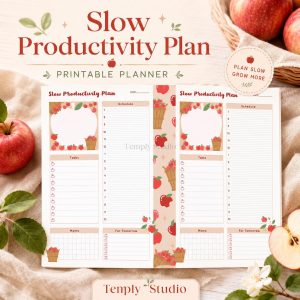
The goal-setting method matters more than the number of decorative goal pages. If you want a ready-made planner, browse the Temply Studio digital planner collection and verify the exact layouts, file format, navigation, software requirements, delivery, and license before choosing.
Keep a short decision log
When a goal changes, record the reason in one sentence. Examples include a deadline move, new information, a resource constraint, or a deliberate change in priority. This prevents the planner from showing a new plan without explaining why the old one disappeared.
Distinguish outcome metrics from activity metrics
Activity metrics count actions such as study sessions, drafts, calls, or applications. Outcome metrics describe a result such as a completed portfolio, a submitted project, or a finished course requirement. Both can be useful, but do not confuse doing more activity with reaching the intended outcome.
Plan for dependencies
Some milestones cannot start until another person responds, a file arrives, or an approval is granted. Mark those dependencies explicitly. While you wait, identify parallel work that can continue so the goal does not become a vague blocked item.
Use a stop rule
Define what would make you pause, redesign, or end the goal. Examples include a changed deadline, a resource limit, a shift in priorities, or evidence that the current approach is not useful. Stop rules make the planner a decision tool rather than a record of endless unfinished intentions.
Review the system, not only the goal
After several weeks, ask whether the planning structure itself is helping. If milestone pages, trackers, or repeated reviews are not changing decisions, simplify them. A goal system should make next actions clearer with less effort over time.
Use a milestone review before starting the next stage
When a milestone appears complete, verify the actual deliverable before moving on. Check whether the required file, decision, submission, practice session, or other result exists. This prevents a progress tracker from advancing simply because time passed or tasks were checked off.
Keep active and someday goals separate
A planner becomes noisy when every idea is treated as an active goal. Maintain a separate someday or later list for ideas that are interesting but not currently receiving time. During a monthly review, promote one only when capacity and priority justify it.
Plan recovery after missed actions
If a planned action is missed, do not automatically double the next day’s workload. Decide whether the action should move, shrink, change method, or be dropped. Recovery planning keeps one disrupted week from creating an unrealistic backlog.
Keep the next review date visible so the system has a clear checkpoint for another decision.
Final quality check
Before relying on the workflow, reopen the file or page and verify the result in the context where it will actually be used. Confirm labels, links, dates, filenames, layout, and any output that matters. Keep the source copy separate so a failed experiment remains reversible.
Temply Studio
Stop chasing your goals with sticky notes and scattered notebooks. Our premium digital planners and Canva templates are designed to help you plan with intention, stay consistent, and actually enjoy the process.


Questions about this guide?
Ask about the planner, share how you use it, or tell us what to cover next. Your email stays private.