


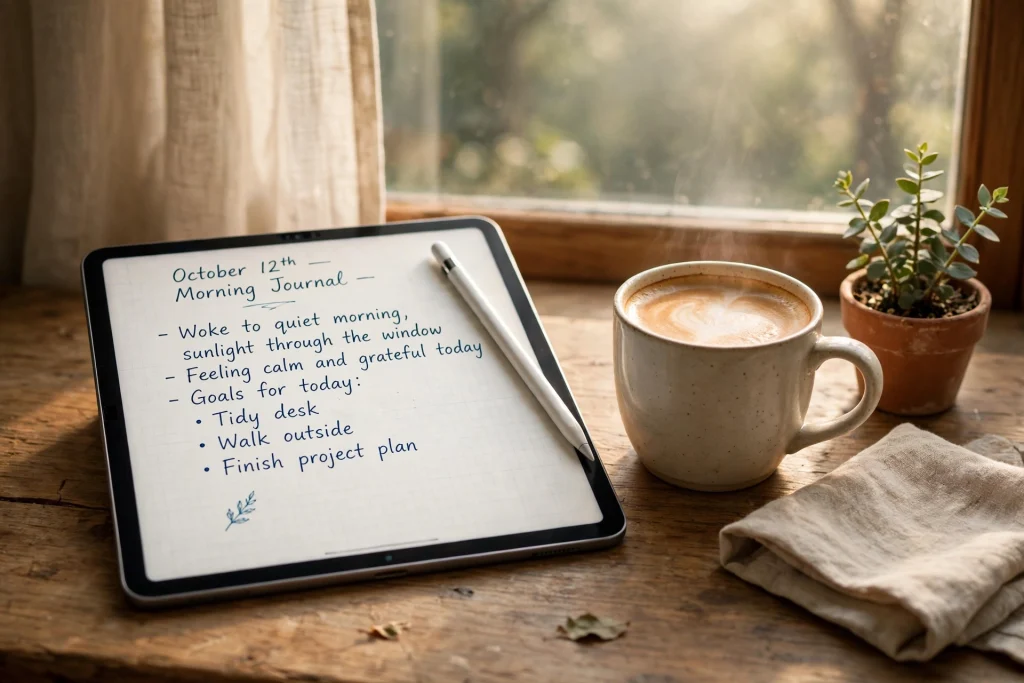
Quick answer: A GoodNotes daily journal works when it is short, structured, and tied to a moment you already have — ten minutes with your morning coffee, using the same five prompts every day. Build one reusable template page, keep entries to a single page, and track your streak in your planner. This guide gives you the prompts, the template, and the habit tricks that carry you past week one.
Almost everyone who starts journaling quits within two weeks, and the reason is rarely lack of interest. It is friction: a blank page that demands too much, a routine with no fixed time, and no structure to fall back on when the day was unremarkable. A GoodNotes daily journal removes most of that friction — your journal is always with you, always searchable, and always exactly one tap away — but only if you set it up for consistency rather than perfection.
This guide shows you how to start a daily journal in GoodNotes that you will actually keep: a simple template, prompts that work even on boring days, and a ten-minute routine designed for real life.
Why GoodNotes Is Ideal for Daily Journaling
Paper journals are beautiful and easy to abandon: they live on a shelf, they run out of pages, and you cannot search them. Notes apps are searchable but feel like typing a report. GoodNotes gives you the best of both:
- Handwriting slows you down just enough. Writing by hand forces reflection in a way typing rarely does, and ten handwritten lines often say more than a typed page.
- One notebook, every day. No hunting for the right book. Your journal is always in the same place, in date order.
- Searchable entries. Looking for what you wrote about a decision last spring? GoodNotes handwriting search finds it.
- Photos, stickers, and colour. Paste in a photo from the day, add a sticker for your mood, or highlight the line that mattered. A journal should feel personal, not clinical.
Step 1: Build a One-Page Daily Template
The single biggest journaling mistake is starting each day with a blank page. A blank page asks “what should I write?” and that question kills momentum. A template answers it for you.
Create one page with these sections, using the text tool for headings:
- Date and one-line mood check. A word, a number out of ten, or a small weather-style symbol. Keep it to five seconds.
- Three good things. Three short lines: something good from yesterday, something you are grateful for, something you are looking forward to.
- Today’s focus. One sentence: the single thing that would make today feel successful.
- Free writing space. The largest section — half the page, left blank for whatever is on your mind.
- End-of-day line. One line filled in at night: how the day actually went, in ten words or fewer.
Duplicate this page for each new day so the original stays clean, or save it as a template. If you prefer a ready-made structure, the 2026 Digital Wellness Journal is built around gratitude and habit prompts and works beautifully as a daily journal base in GoodNotes.
Step 2: The 10-Minute Routine
Ten minutes is the sweet spot: long enough to be meaningful, short enough to survive busy days. Split it like this:
- Minutes 0–2: Fill in the date, mood check, and three good things. Do not overthink them.
- Minutes 2–4: Write today’s focus sentence. If you cannot pick one thing, pick the thing you are most avoiding — that is usually the right answer.
- Minutes 4–9: Free write. Thoughts, plans, frustrations, ideas — whatever is loudest. Stop at nine minutes even if you are mid-thought; the page will be there tomorrow.
- Minute 9–10: Read back the focus sentence and underline it. That underline is a tiny commitment.
In the evening, take thirty seconds to fill in the end-of-day line. That closing loop is what turns journaling from a morning exercise into a real record of your life.
Prompts That Work Even on Boring Days
Some days nothing happens, and those are the days people skip — which breaks the streak and ends the habit. Keep these prompts in your back pocket for exactly those days:
- What is one small thing I could do today that future me would appreciate?
- What am I avoiding, and what is the smallest first step?
- What did I learn this week that I want to remember?
- If today were a chapter title, what would it be?
- What would I tell a friend who felt the way I feel right now?
- What is taking up more headspace than it deserves?
Pick one prompt when the free-writing section feels empty. One answered prompt beats a skipped day every time.
Step 3: Make the Habit Stick Past Week One
Starting is easy. Continuing is the whole game. These four tricks are what carry people past the point where most journals die:
Anchor it to something you already do
Journal with your morning coffee, right after breakfast, or immediately after your workout. A habit attached to an existing routine needs no willpower to remember. A habit floating in “sometime today” needs willpower every single day — and willpower runs out.
Track the streak where you will see it
Mark each journaled day in your planner. A visible chain of marked days is surprisingly motivating, and breaking it feels worse than the ten minutes ever did. The Minimalist Undated Digital Life Planner works well here because its habit-tracker pages sit right next to your daily plans.
Lower the bar on bad days
On a terrible day, the entry can be one sentence: “Bad day. Tired. Will try again tomorrow.” That counts. A one-sentence entry keeps the streak alive; a skipped day breaks it. Protect the streak, not the standard.
Review monthly, not daily
Once a month, flip back through the last thirty entries and note patterns: recurring worries, things you kept postponing, small wins you forgot. This monthly review is where journaling pays off — it turns a pile of entries into self-knowledge. The New Moon Intentions Journal is designed around exactly this kind of monthly reflection cycle if you want a guided version.
Adding Photos, Stickers, and Colour
A daily journal in GoodNotes does not have to be monochrome text. A photo pasted from your day makes an entry instantly memorable, and a small sticker or coloured highlight marks the emotional tone at a glance. Keep it light, though: decoration should take seconds, not turn a ten-minute routine into a thirty-minute craft project. One photo and one colour per entry is plenty.
Privacy: Keeping Your Journal Yours
A journal holds thoughts you would not post anywhere. GoodNotes notebooks are stored on your device and your iCloud account, not on a public server, which is a good baseline. For extra peace of mind, keep your journal in its own notebook (not mixed into a shared work notebook), avoid exporting journal pages to shared folders, and use your device passcode and Face ID. If you share your iPad with family, a separate journal notebook is the simplest boundary.
Common Daily Journaling Mistakes
- Writing too much. Long entries feel productive on day one and exhausting by day five. One page is enough.
- No fixed time. “Later” becomes “never” with remarkable reliability. Anchor it.
- Skipping boring days. Ordinary days are most of life. They are worth recording too.
- Re-reading critically. Your journal is not an essay. Do not edit, judge, or rewrite old entries.
- Starting over after a missed day. A missed day is not a failed journal. Just write the next entry.
FAQ: GoodNotes Daily Journal
How long should a daily journal entry be?
One page is the right target — roughly ten minutes of handwriting. Shorter is fine on busy days; longer is fine when you have something to work through. The streak matters more than the length.
Should I journal in the morning or evening?
Morning is better for setting intention and focus; evening is better for reflection and processing. If you can only pick one, pick morning, and add the thirty-second end-of-day line at night to close the loop.
Can I use GoodNotes journal templates from a planner?
Yes. Many planners include journal or gratitude pages you can duplicate daily. A wellness journal or an undated life planner usually has the best journal layouts — look for gratitude prompts and habit trackers rather than dated diary pages.
Is handwriting search reliable for old journal entries?
Yes for reasonably legible writing, especially for names and distinctive words. For extra safety, date every entry clearly and keep one consistent notebook, so you can also browse by date.
What if I miss a week?
Write one catch-up entry summarising the week in a few lines, then resume daily entries. Do not try to backfill seven entries — that turns a small gap into a chore, and chores are what kill journals.
A GoodNotes daily journal is not about beautiful pages or profound insights. It is about ten honest minutes, every day, in a notebook that is always with you. Build the template once, anchor it to your coffee, and protect the streak on bad days. A year from now, you will have something no app can give you: a handwritten record of a year of your life. Start today with the 2026 Digital Wellness Journal, or set up your own template and write your first entry tonight.
Temply Studio
Stop chasing your goals with sticky notes and scattered notebooks. Our premium digital planners and Canva templates are designed to help you plan with intention, stay consistent, and actually enjoy the process.

Questions about this guide?
Ask about the planner, share how you use it, or tell us what to cover next. Your email stays private.