




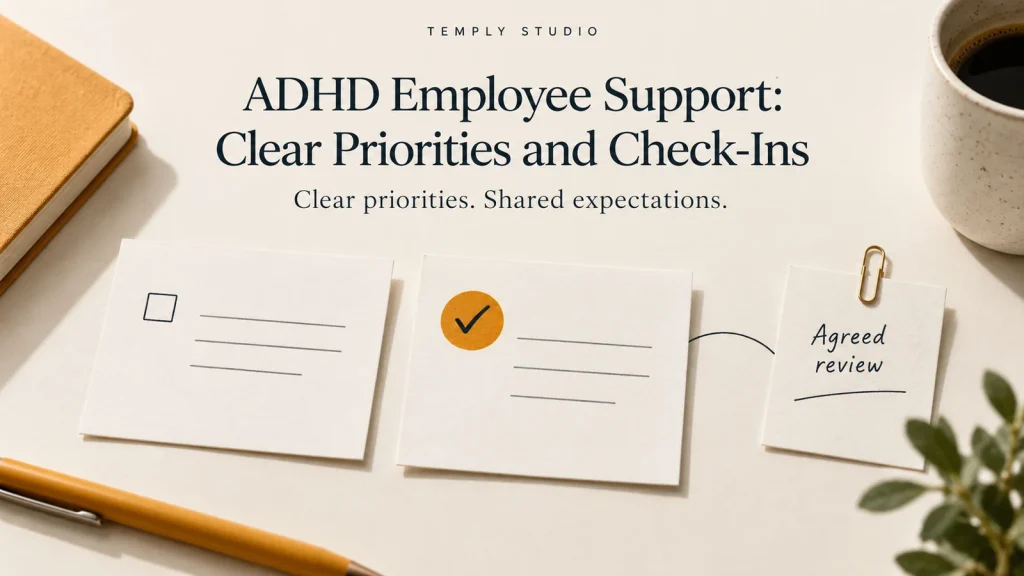
ADHD employee support should start with a conversation about the actual work, not assumptions about a diagnosis. Agree on what needs to be delivered, how priorities will be communicated, where changes will be recorded, and when a useful check-in should happen. Make the arrangement with the employee rather than imposing a system because it carries an ADHD label.
This guide is for everyday manager–employee coordination. It is not a diagnostic tool, an employment-law manual, or a promise that a planning method will improve performance. Formal accommodation, confidentiality, and employment decisions need the appropriate organizational process and current advice for the relevant jurisdiction.
Quick answer: ADHD employee support starts by agreeing on the work outcome, priority, communication format and review point with the employee. Address a concrete barrier without assuming a diagnosis.
Table of Contents
Discuss a work barrier without diagnosing the person
A missed update does not tell a manager why it happened. A request may have changed, a dependency may be unresolved, the deadline may not have been explicit, or the person may need a different communication format.
Begin with an observable situation: “Two versions of the brief were in the thread, and we used different ones. How should we identify the current version next time?” That question can lead to a practical agreement without characterizing someone as careless, unmotivated, or incapable.
The U.S. Job Accommodation Network’s ADHD resource lists examples such as written instructions, meetings about expectations, and help with prioritization. These are possibilities to consider in context, not a checklist that every employee should receive.
Agree on the result before discussing the preferred workflow
Separate the required outcome from the way somebody organizes the work. The result may be a checked draft for review, a reconciled list, a completed handoff, or another concrete deliverable. The employee may use a notebook, calendar, approved task tool, or another suitable method to get there.
For a routine assignment, clarify the deliverable, the actual deadline, the person who reviews it, and any permission needed before it goes further. Do not make a personal planning layout a new requirement merely because the manager prefers it.
Temply Studio’s goal-setting workflow gives a separate way to distinguish outcomes from actions. Use it as an optional planning reference, not as an employee assessment.
Give competing priorities one decision owner
A to-do list cannot resolve conflicting instructions from two managers. Decide who can change the order of work and how the decision reaches the employee.
Consider this fictional situation: Priya is preparing a product-information draft for Morgan, while another colleague requests an urgent layout change. Both requests are reasonable, but they cannot be completed in the same available work period.
Instead of asking Priya to “manage time better,” Morgan confirms which outcome comes first, what can move, and who will notify the colleague. The planning problem is a priority conflict, so the response is a priority decision.
| When this happens | Agree this in advance |
|---|---|
| A new request conflicts with current work | Who decides what moves and where that decision is recorded |
| The employee is waiting for information | Who can answer and when to raise the blocker |
| A deadline changes | Which channel contains the updated commitment |
| An instruction is unclear | How to request a clarification without guessing |
Keep the process proportionate to the job. A small team may need only one named contact and one shared task record, not another meeting or a complex workflow.
Use one accessible place for assignment changes
Discuss where final assignment details will live. A chat message may be useful for a quick heads-up, while the approved task record holds the authoritative change. The important distinction is between announcing a change and preserving it where both people can find it.
For example: “The revised delivery time is in the task record. The original email is no longer the current deadline.” Include enough context that the employee does not have to infer which part changed.
If the arrangement uses written summaries, keep them concise and accessible. Do not quietly start recording meetings, tracking screens, or monitoring personal devices. Those are different actions from clarifying work and require their own authority and safeguards.
Make check-ins about decisions, not constant observation
A useful check-in can answer three questions: What is ready? What is blocked? What needs a decision from someone else? Agree its timing and format so it does not become a stream of surprise interruptions.
An update might say, “The first section is ready. The image approval is still pending. I need a decision on whether to use the text-only version for review.” That is more actionable than “I am working on it,” without requiring a minute-by-minute account of the employee’s day.
The same resource suggests identifying affected tasks, exploring possible options, and following up to review whether a change is useful. Treat it as a starting point for an appropriate, individualized process—not as a promise about symptoms or performance or a legal determination.
Separate an ordinary work note from sensitive information
A shared task record can say what is needed without containing a diagnosis. For example, “Send the final instructions in the task record” can be operationally useful without explaining someone’s health history to colleagues.
Handle medical or accommodation information through the authorized private process rather than a general project board. Do not ask coworkers to speculate about the employee’s condition. A team-wide preference for clear briefs does not need to identify the person who first requested it.
This guide does not determine what information an employer may lawfully request or share. Consult the organization’s appropriate HR or accessibility contact and reliable local guidance for those questions.
Distinguish a support trial from a performance conclusion
A short trial can test a narrow operational question: did the employee receive the correct brief, was the changed priority clear, or was the blocker raised through the agreed route? Decide what will be reviewed before the trial begins.
For an agreed communication change, set a review point and ask whether it made the relevant work clearer. The examples here do not establish that a change improves ADHD symptoms or job performance, and one outcome is not a conclusion about the employee.
Review the arrangement itself. Perhaps the chosen channel is inaccessible during the shift, the check-in conflicts with another responsibility, or the supposed priority owner cannot actually make decisions. Those are reasons to revise the setup, not to add more monitoring.
An ADHD employee support agreement
| Field | Illustrative entry |
|---|---|
| Work situation | Brief changes are arriving through several channels |
| Agreed change | Final changes go into the existing task record |
| Manager responsibility | Identify the priority and notify affected colleagues |
| Employee responsibility | Flag unclear instructions through the agreed route |
| Review question | Could both people identify the same current brief? |
| Review cue | The next agreed project check-in |
This example is a coordination note, not a legal form or clinical record. It should not replace a formal accommodation process where one is relevant.
For personal scheduling around already agreed priorities, the employee may find the daily time-blocking guide useful. A planner cannot resolve a workload conflict that needs a management decision.
What managers should not assume
Do not assume that every employee with ADHD has the same strengths, prefers remote work, needs extra reminders, or wants colleagues to know about their diagnosis. Do not decide that a person is suited or unsuited to a career simply from the label.
Likewise, do not treat being agreeable to a suggested system as consent to wider surveillance or unrestricted sharing of personal information. Keep the scope of the work arrangement explicit and review it with the person involved.
Common questions about supporting an employee with ADHD
What can I do when no diagnosis has been disclosed?
Discuss observable work needs and ask how instructions, priorities, and feedback can be made clearer. Avoid suggesting that an employee has ADHD. Route formal or sensitive requests through the appropriate process.
Does everyone need a new app?
No. First test whether the existing approved record and communication process can do the job. More tools can create more places where instructions diverge.
Should a check-in happen every day?
There is no universal schedule in this guide. Agree a frequency that fits the task, risks, and responsibilities, then review whether it produces useful decisions rather than extra interruption.
Start with one agreed communication change
Choose one recurring point of confusion and agree who will do what differently. A weekly planning review may help an individual revisit their commitments, but the managerial responsibility remains to make expectations and priority decisions clear.
More nonclinical examples are available in the Temply Studio planning guides. No planner purchase, symptom disclosure, or medical conclusion is required to begin a respectful conversation about the work.
Publisher: Temply Studio. General workplace-organization guidance, not medical or legal advice. Examples are fictional, and no employee outcome or effectiveness test is claimed.
Temply Studio
Stop chasing your goals with sticky notes and scattered notebooks. Our premium digital planners and Canva templates are designed to help you plan with intention, stay consistent, and actually enjoy the process.
Questions about this guide?
Ask about the planner, share how you use it, or tell us what to cover next. Your email stays private.