




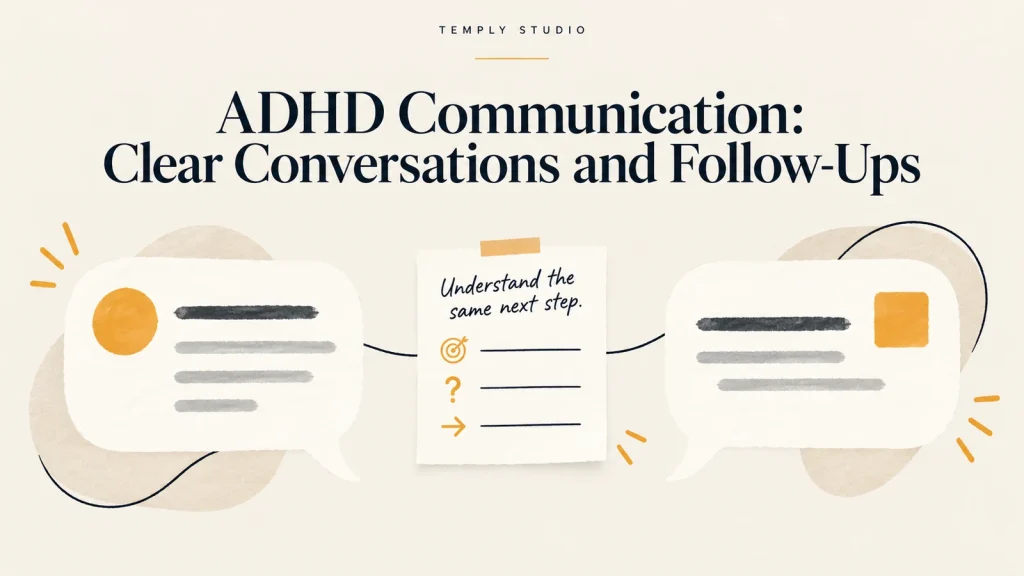
ADHD communication support can begin with a shared question: are we listening, exploring an idea, or making a decision? Agree on the purpose of the conversation, use a channel both people can work with, and leave a brief recap only when there is something to remember or do. The responsibility for clarity belongs to everyone in the conversation.
The NIMH adult ADHD overview includes interrupting others or being very talkative among possible difficulties. People differ, and a communication habit does not diagnose ADHD. The suggestions below are original everyday coordination examples, not speech-language treatment, couples therapy, or a validated ADHD intervention.
Quick answer: ADHD communication is easier to coordinate when everyone agrees whether the conversation is for listening, exploring options or making a decision. Use clarification and a short follow-up, then review the plan together.
Table of Contents
Begin ADHD communication with a shared purpose
Two people can leave a conversation dissatisfied even when they heard the same words. One wanted to be listened to; the other thought they were supposed to solve the problem. One offered an idea; the other understood it as a firm commitment.
Try a brief opening question: “Would it help if I listened, helped think through options, or worked out the next step with you?” The person may not know immediately, and the answer can change during the conversation.
This is not a script everyone must follow. It is a way to make an assumption visible before the discussion becomes a long exchange with different goals.
| Purpose | Useful question | What not to assume |
|---|---|---|
| Listening | Would you like me to stay with you on this topic? | That advice has been requested |
| Exploring | Are these options or a decision? | That a possibility is a promise |
| Deciding | What are we agreeing to do? | That silence means agreement |
| Coordinating | Who is taking the next step? | That both people assigned the task to the same person |
Choose a workable time and channel together
A face-to-face conversation, phone call, written message, or shared note may each fit a different situation. Ask what works for the people involved rather than deciding that everyone with ADHD needs written communication or finds phone calls difficult.
For a nonurgent topic, agree on a time when both people can give it attention. “Can we discuss the weekend plan after dinner?” is different from expecting an immediate reply during work. For a genuine urgent issue, use the communication route that fits the situation.
When the conversation needs a scheduled place in the day, the daily time-blocking guide can help with planning that commitment. Scheduling creates an opportunity; it does not guarantee attention or agreement.
Keep the thread visible without turning talk into a test
For a practical discussion, name the current topic in ordinary words: “We are deciding the collection time, not the whole trip.” When a related issue appears, note it briefly and ask whether to finish the first question or switch topics.
A visible note can help when both people want it, but constant note-taking is not required for every personal conversation. If somebody needs a pause, an example, or a different format, treat that as information about the communication process.
Avoid using eye contact, stillness, or the speed of a response as your only measure of whether the person understood. Ask about the actual point of uncertainty rather than demanding a particular performance of listening.
Repair an interruption without assigning a motive
When you interrupt, a simple repair can return the floor: “I jumped in before you finished. Please continue.” When you lose the thread, try, “I missed the part after the time changed. Could you repeat that part?”
Someone receiving an interruption can also make a clear request: “I want to finish this example, then hear your idea.” These phrases identify the conversational need without declaring that somebody is selfish, disrespectful, or deliberately ignoring the other person.
Repair does not mean the impact never matters. Repeated interruptions can still be frustrating, and both people can discuss what needs to change. An explanation should not be used to dismiss the other person’s experience.
Check meaning, not word-for-word recall
If the discussion leads to a decision, summarize what you believe was agreed and invite correction. “My understanding is that we are keeping Saturday free and deciding about Sunday tomorrow. Did I get that right?”
The invitation to correct is important. A recap is not proof that your interpretation is the final one, and it should not be used to corner the other person into a commitment they did not make.
Keep requests, offers, and promises distinct. “Could you pick this up?” is a request. “I might be able to” is not yet a confirmed handoff. “Yes, I can collect it after work” is a clearer agreement, provided both people understand the details.
Worked example: an idea becomes a clear plan
Consider a fictional conversation between Riley and Jordan about collecting a borrowed projector. Riley says, “Maybe we could do it on Friday.” Jordan assumes Friday is settled and stops considering other times.
A brief check can prevent the assumption from becoming the plan: “Is Friday only an option, or are we confirming it? We still need the owner’s availability.” They agree that Riley will ask the owner, and neither person will treat the collection as confirmed until there is a reply.
| Recap field | Agreed note |
|---|---|
| Decision | Friday is a possible collection day, not confirmed |
| Next step | Riley will ask the owner about availability |
| Still open | Collection time and who can travel |
| Follow-up | Share the answer before either person changes their plans |
The example illustrates a distinction between an idea and an agreement. It is not a case study or evidence that a particular communication method improves ADHD symptoms.
Write a follow-up that contains only what matters
A useful follow-up is usually shorter than a transcript. Record the decision, the next action, and any question still unresolved. Leave personal feelings or sensitive context out of a shared task note unless there is a clear reason and agreement to include them.
For a changed plan, state the change explicitly: “The collection is now Saturday, not Friday.” Avoid adding it as an easily missed extra line in an unrelated message.
When a decision creates an ongoing commitment, a weekly review can be a place to revisit it. Do not automatically turn every conversation into a scheduled task; personal connection is not simply another checklist.
Pause respectfully when the conversation is no longer useful
A pause can be a specific agreement: “I want to continue, but I cannot do this thoughtfully right now. Can we return to the travel question tonight?” Name what remains open rather than suggesting the issue has disappeared.
The NIH Social Wellness Toolkit recommends communicating needs, listening without blame, respectful disagreement, and personal boundaries. That is general relationship guidance, not evidence for an ADHD-specific treatment.
Respect and safety still matter. A communication technique is not a reason to tolerate threats, coercion, or violence, or to take responsibility for another person’s harmful behavior. Seek appropriate support when the problem is unsafe or beyond ordinary conversation repair.
Choose one preference to try, not an entire new personality
Ask each person which single change would make a practical conversation easier. One may want the main question stated first. Another may prefer a short written recap after decisions. Another may need permission to ask for a repeated detail without being criticized.
Try the preference in a low-pressure setting and then discuss whether it was useful. Do not treat one missed recap as failure, and do not turn the experiment into a diagnostic score or a test of caring.
Common questions about ADHD communication
Is written communication always better?
No universal preference is assumed here. Choose the format together, considering the topic, accessibility, privacy, and the need to return to details later.
Does a recap mean somebody was not listening?
No. A recap can reveal different interpretations even when both people were attentive. Use it as a mutual check rather than a test of one person’s memory.
What if we keep having the same disagreement?
A clearer task note may not resolve a disagreement about needs, trust, or responsibility. Consider appropriate professional support when the problem is persistent or significantly affects life, rather than adding more administrative rules.
End with a shared understanding
For the next practical conversation, name its purpose and confirm only the decision that actually happened. Leave unresolved questions visible rather than filling the gap with an assumption.
The Temply Studio planning guides offer other nonclinical ways to record commitments. The aim here is shared clarity, not a purchase, a perfect conversation, or an obligation to use a particular app.
Publisher: Temply Studio. General communication and organizational guidance, not medical advice or relationship therapy. All dialogue examples are fictional.
Temply Studio
Stop chasing your goals with sticky notes and scattered notebooks. Our premium digital planners and Canva templates are designed to help you plan with intention, stay consistent, and actually enjoy the process.

Questions about this guide?
Ask about the planner, share how you use it, or tell us what to cover next. Your email stays private.