




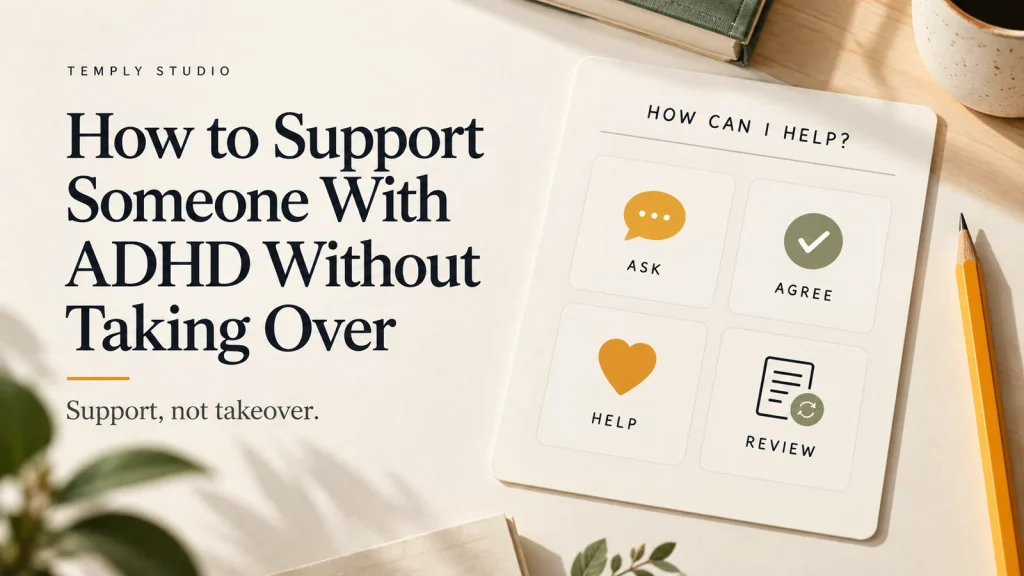
If you’re wondering how to support someone with ADHD, ask what help they want before choosing a system for them. Offer one concrete action, agree on its scope and timing, and leave the person in control of their decisions. Support can be practical and meaningful without turning a friend, partner, or family member into a supervisor.
This guide concerns support between adults. It is not a parenting behavior program, crisis plan, or treatment guide. The NIMH adult ADHD overview explains that adult ADHD can affect daily tasks, work, organization, and relationships. The examples below are optional practical ideas for adults to discuss together; they are not treatment or a promise of a particular outcome.
Quick answer: How to support someone with ADHD starts with asking what help is wanted. Agree on one specific action, keep the other person in charge of their choices, and adjust or stop when it is not useful.
Table of Contents
Start with curiosity rather than an explanation
Someone’s experience may differ from the ADHD stories you have read or watched. Before explaining what you think is happening, ask what the difficult part is for them.
A useful opening might be, “Would you like me to listen, help with one practical step, or leave you some space?” A person may not know what would help immediately. You can make a specific offer without requiring them to produce a complete plan.
Avoid turning an ordinary conversation into a diagnosis discussion. This article assumes you are responding to what the person has chosen to share, not deciding that a friend has ADHD because they were late or forgot something.
Offer help that can be accepted or declined
“Let me know if you need anything” is kind, but a smaller offer can be easier to consider. Try, “Would it help if I carried these boxes while you decide where they belong?” or “Would you like company while you prepare the questions for your appointment?”
The offer should contain a real choice. A refusal is not permission to reorganize the person’s belongings, contact their clinician, or take over their calendar anyway.
| Possible offer | Agree before doing it |
|---|---|
| Send a reminder | What to say, when to send it, and whether a follow-up is wanted |
| Help with an ordinary task | Which part you are doing and what stays with the person |
| Be present while they work | Whether quiet company, conversation, or practical help is preferred |
| Help prepare for an appointment | Whether they want notes, transport, company, or no involvement |
| Help choose a planning format | What problem they want solved and whether a new tool is wanted |
Do not claim that any of these actions will treat ADHD or work for every person. They are offers to discuss, not requirements for a supportive relationship.
Agree on reminders instead of sending more of them
A reminder can feel helpful or intrusive depending on its timing, wording, and whether it was wanted. Ask before making yourself responsible for reminding someone.
A bounded agreement might be, “Please send one text at six about checking the booking. You do not need to ask again afterward.” The supporter can also be honest: “I can send a message today, but I cannot reliably do this every week.”
Use wording that identifies the agreed action rather than judging the person. “This is the booking reminder you asked for” is different from “You always forget, so I am reminding you again.”
A missed response does not automatically authorize more messages, checking private accounts, or contacting other people. Discuss what should happen if the reminder is missed, especially when the task affects a shared commitment.
Keep the person in charge of their own tools
Installing a new app or buying a planner can feel like practical help, but first ask whether a new tool is actually wanted. A system chosen by somebody else may add setup work or remove familiar ways of finding information.
Ask, “Where do you currently look for this kind of task?” Work with that answer before suggesting a replacement. If the person wants to compare formats, Temply Studio’s planner-format guide can support that separate choice. It does not establish that a planner is necessary or that any product treats ADHD.
Do not move belongings, delete reminders, rewrite a task list, or share private documents without permission. The person’s system may have a logic that is not immediately visible to you.
Worked example: helping without taking over
Consider a fictional situation in which Casey is preparing materials for a community workshop. Their friend Devon notices several unfinished tasks and wants to help.
Instead of organizing the whole workspace, Devon asks which part would be useful to share. Casey wants help placing the already approved printed materials into folders, but wants to keep responsibility for the attendee list and final checks.
They agree that Devon will work on the folders for the time available, leave any uncertainty for Casey, and not contact attendees. At the end, Devon says which folders are finished and which remain. Casey can then decide the next step.
The important features are permission, a defined task, and a clear stopping point. The example does not suggest that people with ADHD need their work supervised or that help should be offered only when somebody is struggling visibly.
Make shared responsibilities explicit and mutual
Support does not mean one person silently inherits every unfinished task. When something affects both people, discuss the commitment directly: what needs to happen, who has agreed to which part, and what should happen if circumstances change.
A weekly review can be an optional place to revisit shared commitments, but do not make another person attend a planning ritual they have not agreed to. A short conversation may be enough.
Distinguish kindness from unlimited availability. You can care about someone while being unable to provide a particular kind of help. It is better to make a smaller promise you can keep than to become resentful about an arrangement that was never discussed.
Talk about impact without reducing the person to a label
A missed shared commitment may still create real inconvenience. Describe the event and the next need without turning it into a judgment about the person’s character.
For example: “We missed the collection window, so we need to choose another time and let the owner know.” That wording addresses what happened. It does not decide why it happened, deny the impact, or claim that ADHD excuses every behavior.
The NIH Social Wellness Toolkit emphasizes listening without blame, communicating needs, respectful disagreement, and boundaries. These are general relationship principles, not a validated ADHD support program.
Support access to care only in the role the person wants
An adult may want help finding reliable information, making an ordinary logistics plan, or writing questions for a professional. Ask which part they want you involved in and whether they want company at an appointment.
Do not choose medication, change doses, interpret a screening result as a diagnosis, or present yourself as the person’s clinician. Avoid promises about waiting times, eligibility, or treatment outcomes.
The NIMH adult ADHD resource provides clinical background and links to further support. Use it as information to explore, not evidence that Temply Studio or a friend can provide an assessment.
If someone is in immediate danger, use the appropriate emergency or crisis service where they are. An ordinary help agreement is not an emergency plan, and it should not delay urgent assistance.
Use a support agreement that includes an ending
For a repeated practical arrangement, a few lines can prevent different expectations:
- Help wanted: What specific action has the person requested?
- Permission: What may the supporter access or change?
- Limits: What is outside the agreement?
- Timing: When is the help useful and available?
- Review: How can either person change or stop the arrangement?
This is an optional conversation aid, not a contract or a treatment worksheet. Keep private information out of shared notes unless there is a clear need and agreement.
What to do when your first offer is not helpful
Thank the person for saying so. Ask whether a different kind of help would be better, or whether they would prefer you to stop. You do not need to defend a tool because it helped somebody else.
A support arrangement may also stop fitting when schedules or responsibilities change. That does not mean either person has failed. Review the practical agreement rather than trying to make an unwanted method more forceful.
Common questions about supporting someone with ADHD
Should I keep reminding them if they do not respond?
Follow the reminder arrangement you actually agreed on. For ordinary nonurgent tasks, a missed response is not an invitation to escalate monitoring. Discuss a different approach later when both people can take part.
Can being present help?
Some people ask for quiet company during a task. Offer it as a preference to try, not as a proven treatment or a guarantee of completion. Agree whether talking, helping, or simply sharing the space is wanted.
What if I am becoming overwhelmed too?
Be honest about your limits and consider your own sources of support. Caring about someone does not require being available for every task or becoming their only source of help.
How to support someone with ADHD: begin with one question
Ask, “What would be useful from me right now, and what would not?” Then agree on one action small enough for both people to understand and freely choose.
For optional ways to record everyday commitments, the Temply Studio planning guides provide nonclinical examples. A supportive conversation does not require a purchase, an app, or a perfectly maintained planner.
Publisher: Temply Studio. General information about practical adult support, not medical advice, therapy, or a substitute for qualified care. Examples are fictional and do not report treatment outcomes.
Temply Studio
Stop chasing your goals with sticky notes and scattered notebooks. Our premium digital planners and Canva templates are designed to help you plan with intention, stay consistent, and actually enjoy the process.

Questions about this guide?
Ask about the planner, share how you use it, or tell us what to cover next. Your email stays private.