

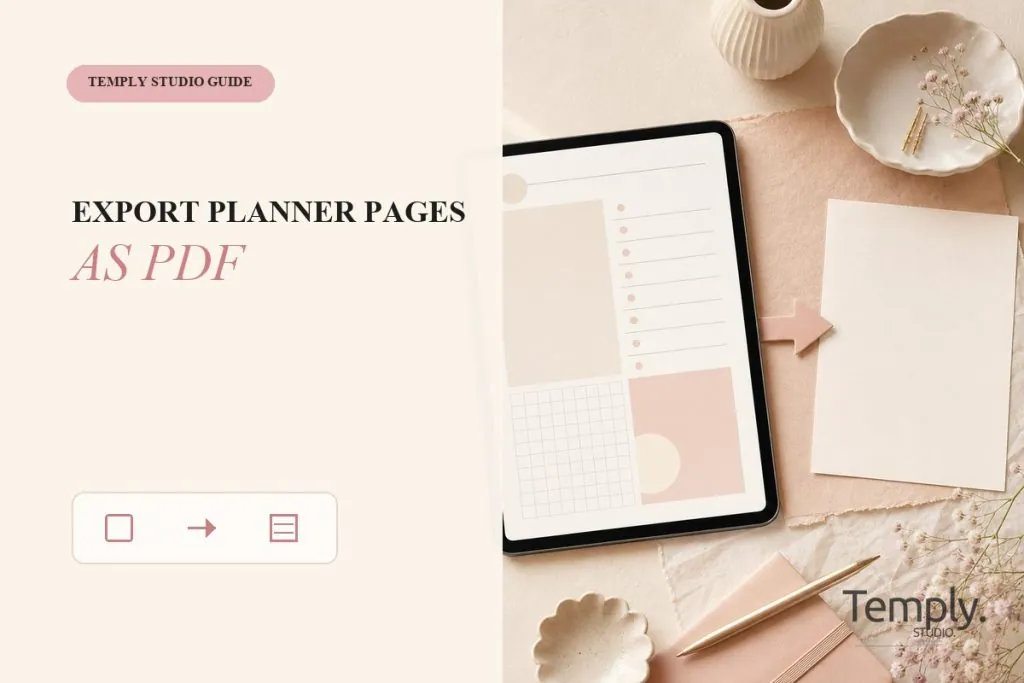
Quick answer: to export Goodnotes planner pages to PDF, first choose the exact page or pages you need, use the current Export command, select PDF, review the PDF options, save the file to a known location, and reopen it to verify the page order, annotations, backgrounds, and any links that matter.
Goodnotes currently supports exporting documents and selected pages as PDF across its supported platforms, although the exact controls differ between iOS/iPadOS and Android, Windows, or Web. If the planner contains hyperlinks that were already embedded in the original PDF, choose Editable PDF when those links or document outlines need to remain available after export.
Choose the pages before you export
Decide the smallest useful export scope first. This keeps the file easier to check and reduces the chance of sharing unrelated planner pages.
- One page: useful for a completed daily page, weekly spread, or printable sheet.
- Several selected pages: useful for a project, meeting, class, or focused archive.
- A page range: useful when consecutive planner pages belong together.
- The full planner: appropriate when you need a complete PDF copy and have enough storage for a larger export.
Before opening the export menu, note the page numbers, section names, or thumbnails you intend to include. After export, compare the PDF against that selection instead of assuming the export notification proves the file is complete.
How to export one Goodnotes planner page on iOS or iPadOS
Goodnotes documents more than one route for a single-page export on iOS/iPadOS. The wording can change between releases, so follow the control visible in your current app.
- Open the planner and navigate to the page you want.
- Use the Share control and choose the option to export the current page, or open the page thumbnails and select that page.
- Choose PDF as the export format.
- Review the available PDF options before confirming.
- Save or share the PDF to a location you can find again.
- Open the saved PDF and verify the result.
If your planner uses linked tabs, read the Goodnotes planner hyperlink guide before troubleshooting an exported file. It helps separate a navigation-mode issue inside the app from an export-format issue.
How to export multiple planner pages
For several pages, use the page thumbnail or sidebar view, select the pages you need, and choose Export. Goodnotes documents selected-page export on iOS as well as Android, Windows, and Web.
- Open the planner’s page thumbnails or sidebar.
- Select the intended pages.
- Check the order of the selected thumbnails.
- Choose Export and select PDF.
- Review the PDF settings and confirm the export.
- Open the finished PDF and compare its first page, last page, and total page count with your selection.
When you only need a copy of an existing page inside the planner rather than a PDF outside the app, use the separate guide to duplicate digital planner pages in Goodnotes.
Exporting on Android, Windows, or Web
Goodnotes’ current documentation describes exporting a notebook as PDF from the library or document view on Android, Windows, and Web. Selected pages can be exported from the document sidebar. Do not assume that every iOS export option or label appears in exactly the same place on another platform.
A reliable cross-platform rule is to verify the final file rather than rely on memory of a particular menu. Open the exported PDF in the viewer or destination where it will actually be used.
Choose Editable or Flattened PDF deliberately
Goodnotes distinguishes between Editable and Flattened PDF exports. The right choice depends on what must survive the export.
| What you need | Start with | Why |
|---|---|---|
| Preserve hyperlinks already embedded in an imported planner PDF | Editable PDF | Goodnotes says original PDF hyperlinks are preserved in Editable exports. |
| Preserve the original PDF outline | Editable PDF | Document outlines are preserved in Editable exports. |
| A simpler viewing or sharing copy | Flattened PDF | Goodnotes recommends Flattened for broader PDF-viewer compatibility. |
| Search recognized handwriting in the exported PDF | Flattened PDF | Handwriting can be searchable when handwriting recognition is enabled during export. |
The hyperlink distinction matters. Goodnotes notes that pre-existing links in an imported PDF are different from links created inside Goodnotes. For an imported hyperlinked planner, choose Editable PDF when preserving those original planner links and outlines is important, then test the saved PDF.
If you want a deeper explanation of planner navigation before exporting, read how digital planner tabs and hyperlinks work.
Include the page background and annotations when needed
If handwriting, typed notes, highlights, stickers, images, or the planner background should appear in the PDF, review the export options before you finish. Goodnotes specifically advises enabling Include Page Background and Include Annotation when those elements need to be present in the exported document.
This check is especially important for planner pages where the useful content is a combination of the original PDF layout and notes added later. A PDF that opens successfully can still be incomplete if an export option excluded content you expected to see.
Verify the exported PDF before sharing it
A dependable export workflow ends with a read-back. Use this short quality check:
- Open the saved file. Confirm it opens outside Goodnotes.
- Check page count and order. Compare the first and last selected pages with the exported PDF.
- Review annotations. Check representative pages containing handwriting, typed text, highlights, stickers, or images.
- Check backgrounds. Confirm planner layouts, colors, lines, and page designs appear as expected.
- Test representative links. If navigation matters, test a tab near the beginning, one in the middle, and another near the end.
- Confirm the filename and destination. Make sure you can distinguish this export from the original working file.
- Review privacy. Remove or protect pages that contain information you did not intend to share.
For a dedicated post-export routine, use the Goodnotes PDF export quality checklist. This page covers the export process; the checklist focuses on validating the finished file.
Common Goodnotes PDF export problems
The planner tabs or outline stopped working
If the links were already embedded in the imported planner PDF, a Flattened export may be the reason they no longer work. Goodnotes recommends using Editable PDF when you need to preserve those original hyperlinks or outlines. Test the source planner first, then test the exported PDF in a separate viewer.
Handwriting or the page background is missing
Return to the export settings and confirm that the page background and annotations are included. Export one representative page as a small test before repeating a large multi-page export.
Images appear in Goodnotes but not in another PDF viewer
Goodnotes documents a compatibility issue where some viewers may not display image data used in exported PDFs. Before assuming the export lost the image, open the PDF in another viewer. Goodnotes also documents re-saving the PDF through macOS Preview or printing it to a new PDF through Chrome as possible workarounds when viewer compatibility is the cause.
The exported PDF is larger than expected
Large page ranges, high-resolution images, handwriting, backgrounds, and annotations can increase file size. Export only the pages you need when a smaller selection will do. Do not remove navigation or content merely to reduce size unless the recipient does not need those features.
The export fails or produces an incomplete file
Try a smaller page selection, check available storage, and repeat the export only after confirming the source document is fully available on the device. Keep the original planner until a verified export exists.
PDF export is not the same as a complete backup
A PDF is useful for sharing, printing, viewing, or archiving readable pages outside Goodnotes. It is not automatically a full replacement for the original planner source, a native Goodnotes document, or a complete library backup.
Keep the working planner and important recovery copies separate. The digital planner backup and file organization guide explains a practical way to separate source files, working copies, and verified exports.
Frequently asked questions
Can I export only one page from Goodnotes?
Yes. Goodnotes documents single-page export on iOS/iPadOS, and selected-page export is also available through the sidebar workflow on other supported platforms. Use the export option shown in your current version and verify the saved PDF.
Should I use Editable or Flattened PDF for a hyperlinked planner?
Use Editable PDF when you need to preserve hyperlinks or outlines that were already embedded in the imported planner PDF. Flattened PDF can be useful for a simpler viewing copy and for searchable recognized handwriting, but it does not preserve the original imported PDF hyperlinks in the same way.
Why are annotations missing from my exported PDF?
Check whether the export options include annotations. Goodnotes advises enabling the annotation option when you want handwriting and other added content to appear in the exported PDF.
Can I use an exported PDF as my only backup?
Only if a readable PDF copy is all you need. If you need native editing or full library recovery, keep the appropriate source or backup separately.
Does exporting remove the original planner from Goodnotes?
No. Exporting creates a copy outside the app; it does not remove the original document from your Goodnotes library.
Export, reopen, and verify
The safest routine is simple: select the right pages, choose the PDF option for your purpose, include the content you need, save the file to a known location, and reopen it. That final verification is what confirms that the PDF is ready to share, print, or archive.
When you are comparing current planning files, browse the Temply Studio digital planner collection and check each product page for the exact included files, software requirements, delivery status, and license before purchase.
Official Goodnotes sources
- Goodnotes Support: Export documents or pages
- Goodnotes Support: Differences between Editable and Flattened PDF formats
- Goodnotes Support: PDF outlines and hyperlinks are missing after export
- Goodnotes Support: Include annotations and page backgrounds in PDF export
- Goodnotes Support: Images missing from exported PDFs
Temply Studio
Stop chasing your goals with sticky notes and scattered notebooks. Our premium digital planners and Canva templates are designed to help you plan with intention, stay consistent, and actually enjoy the process.


Questions about this guide?
Ask about the planner, share how you use it, or tell us what to cover next. Your email stays private.