

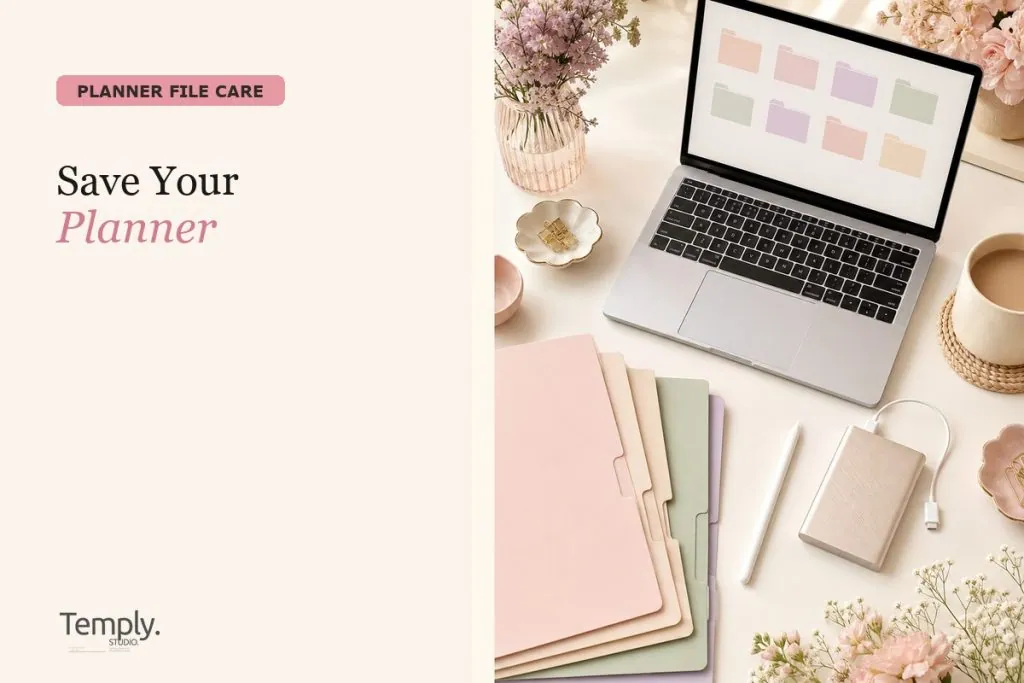
A reliable digital planner backup starts with knowing which file is which. Keep the original download separate from your active Goodnotes document, organize exports by purpose and date, and periodically create a backup or export that you can locate outside the app. Sync, automatic backup, manual library backup, native document export, and PDF export are different workflows. Use the option documented for your platform and verify the resulting file before relying on it.
This guide gives you a simple system for organizing planner files without promising that one cloud service, app setting, or file format is available to every user.
Understand the four file layers
Most planner workflows involve four types of files.
1. Original source
This is the planner you downloaded or received. Keep an untouched copy along with any supplied instructions. It gives you a clean starting point if you need to import again.
2. Active working document
This is the document inside Goodnotes where you add handwriting, images, notes, and other content. It changes over time.
3. Backup or native copy
Goodnotes documents a manual library backup that produces a backup file for restoration through the app’s import process. Goodnotes also supports native-format document exports in some workflows. Follow current official instructions for the type of recovery you need.
4. PDF or image export
An export is useful for viewing, sharing, printing, or archiving selected pages. It is not automatically equivalent to a native editable document or a full library backup.
Keeping these layers separate prevents an exported PDF from being mistaken for the original planner or the current working document.
Build a simple folder structure
Use a structure you can understand without opening every file:
“`text
Digital Planners/
Planner Name/
01 Original/
02 Instructions/
03 Backups/
04 PDF Exports/
“`
If you use several planners, create one folder per product or purpose. Avoid mixing unrelated planner files, stickers, previews, and exported pages in one Downloads folder.
Your folder names do not need numbers, but numbers can keep the sequence stable across file-management apps.
Name files consistently
A useful filename answers three questions:
- What is it?
- What period does it cover?
- Why was the copy created?
Examples:
weekly-planner-original.pdfweekly-planner-backup-2026-07-31.goodnotes.zipweekly-planner-project-pages-2026-07.pdfcollege-planner-semester-1-archive.pdf
Use a date format that sorts consistently, such as YYYY-MM-DD. Avoid filenames such as:
final.pdffinal-new.pdfplanner-copy-2.pdfbackup-latest.zip
If a file contains sensitive information, choose its storage location and sharing settings carefully. This article does not assess the security or privacy of a particular storage provider.
Organize the Goodnotes Library
Goodnotes documents folders, subfolders, sorting, favorites, search, and moving items as Library organization tools.
A small structure might be:
Current PlanningReferenceArchive
Inside Current Planning, keep only the documents you use regularly. Move completed periods to Archive instead of creating many nearly identical active copies.
Use descriptive document names inside Goodnotes as well as in external storage. For a broader workflow, see how to use a planner in GoodNotes.
Keep the original before importing
When you first receive a planner:
1. Save the original file in 01 Original.
2. Save instructions in 02 Instructions.
3. Import the intended document into Goodnotes.
4. Verify the imported pages.
5. Leave the original outside the app.
The GoodNotes import guide covers the current documented import routes and a post-import verification checklist.
Do not repeatedly import uncertain copies. Verify filenames and product instructions first.
Create a manual Goodnotes library backup
Goodnotes’ current support documentation describes manual library backup through the Library menu:
1. Open the Goodnotes menu from the Library view.
2. Open the current Cloud & Backup area.
3. Choose Manual Backup.
4. Start the backup.
5. Keep the app open as instructed while the backup is created.
6. Select a safe destination for the resulting backup file.
Menu labels may change. Follow Goodnotes’ manual backup and restore instructions for the current interface.
After backup:
- confirm the file exists at the destination;
- note the date;
- keep the filename extension intact;
- avoid editing the contents of the backup archive;
- retain an older known copy until the newer one is verified.
A backup is not verified merely because the app displayed a completion message. Make sure you can locate the file.
Export a specific planner or page set
You may not need a complete library backup every time. Goodnotes documents exporting:
- one document;
- multiple Library items;
- a single page;
- multiple selected pages;
- folders.
Choose a targeted export when you want a readable archive or need to share selected pages. Use the GoodNotes PDF export guide for the page-selection workflow.
PDF export settings matter. Goodnotes notes that editable and flattened PDF options can affect the behavior of some pre-existing PDF hyperlinks and outlines. Verify the export in the app where it will be viewed.
Sync and backup are not the same
Sync is generally intended to keep app data available across supported devices or services. Backup creates a separate recovery or archival copy. Availability and behavior depend on the current Goodnotes platform, account, plan, and settings.
Do not rely on an assumed sync setting:
- check the current app settings;
- read the official documentation for your platform;
- keep a separate copy outside the active library;
- confirm the destination file.
This guide does not recommend a specific cloud provider or claim that a provider guarantees recovery.
Verify exported and backup files
For a PDF export:
1. Confirm the filename and destination.
2. Open the PDF outside Goodnotes.
3. Check the first, middle, and last selected pages.
4. Confirm annotations you need are visible.
5. Test required links.
For a native or library backup:
1. Confirm the file exists.
2. Preserve the documented extension.
3. Store the official restoration instructions with your backup notes.
4. Do not perform a destructive reset merely to test a backup.
When restoration is actually needed, use the current Goodnotes support instructions. Avoid guessing or changing the backup archive.
Use a simple backup rhythm
Choose a frequency based on the amount and importance of your work.
After important setup
Create a checkpoint after importing, organizing, and verifying a new planner.
During active use
Create a new backup or export after meaningful work you would not want to reconstruct.
Before major changes
Goodnotes recommends manual backup before events such as resetting or switching devices. Follow the current official instructions and keep the app open for the documented process.
At the end of a planning period
Export completed pages for reference, rename the active document clearly, and move old material to an archive.
Monthly maintenance checklist
- Confirm the original planner file is still present.
- Remove obvious duplicate downloads only after checking them.
- Rename unclear working documents.
- Move completed periods to Archive.
- Create a dated backup or export.
- Confirm the new file exists.
- Open important PDF exports.
- Keep at least one prior verified backup while validating the latest.
- Review current Goodnotes backup guidance before a device change.
Common mistakes
Keeping everything in Downloads
Move originals, instructions, backups, and exports into separate folders.
Overwriting the original
Use a new filename and destination for working exports.
Calling a PDF a full backup
A PDF can be useful for viewing and sharing, but it is not automatically equivalent to a native library backup.
Trusting a destination without checking
Open the file manager or storage location and confirm that the file is present.
Creating many unlabeled copies
Use a consistent date and purpose in each filename.
Continue your planner workflow
If you need to create an external PDF, continue with how to export GoodNotes planner pages. If you are still setting up the planner, return to the GoodNotes planner workflow.
To compare planner formats, browse the Temply Studio digital planner collection and verify each product’s current files and requirements before purchasing.
Official sources
- Back up and restore your library manually
- Export documents or pages
- Organizing Folders and Documents
- Import files into Goodnotes
Updated recovery check: prove that a backup opens
Sync keeps copies aligned in some setups, but it should not be treated as the only recovery plan. The practical test is simple: can you locate the untouched download, open a separate backup or export, and identify which copy is safe to restore? Use the current documentation for your app and storage service because backup controls and file formats vary.
- Choose one working planner and record its current name and period.
- Make a separate export or backup copy without overwriting the original download.
- Close the working file, then open the separate copy from its storage location.
- Check a few pages, annotations, and navigation links.
- Record the date of the check and keep the copy in a different folder or storage location.
For Goodnotes, review the current official Backup & Restore documentation and the app’s own options before choosing a method. An export can be useful for recovery and viewing, but the format may not preserve every feature of the working document.
Use privacy-safe examples
Folder names should identify the planner and period, not a client, patient, employer, or private project. Before sharing a screenshot or test file, remove personal notes and check the visible page content. A tidy backup system is useful only when it also protects the information inside the planner.
When you need to move a clean file into the app again, follow the Goodnotes import workflow and compare the product-specific file details in the current planner collection.
Temply Studio
Stop chasing your goals with sticky notes and scattered notebooks. Our premium digital planners and Canva templates are designed to help you plan with intention, stay consistent, and actually enjoy the process.


Questions about this guide?
Ask about the planner, share how you use it, or tell us what to cover next. Your email stays private.