




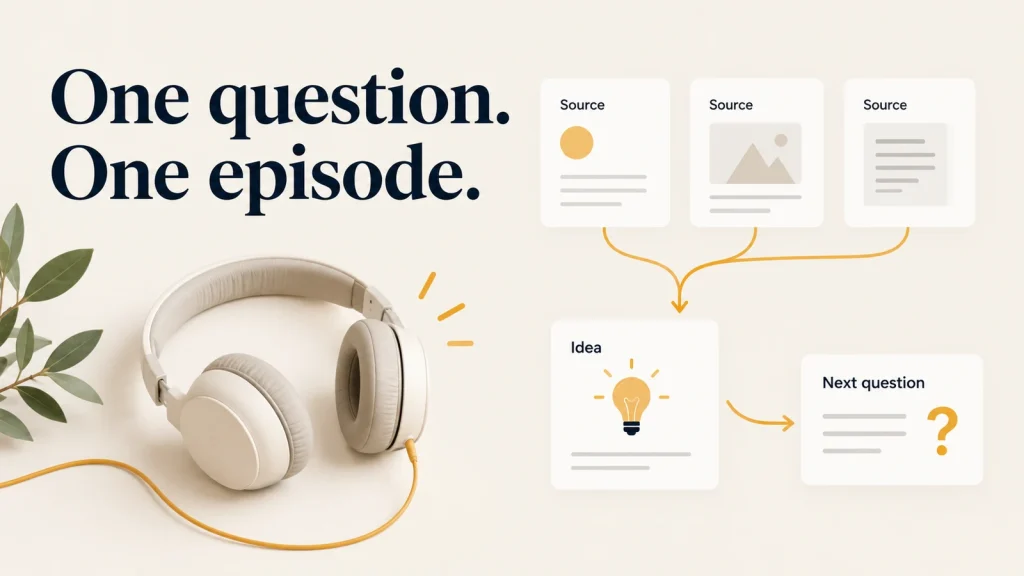
ADHD podcasts can be a starting point for learning, hearing different experiences, and finding a question to explore further. Begin with an official show page, choose an episode that matches your situation, and check who is speaking before treating a suggestion as advice. You do not need to subscribe to a long list or finish an entire archive.
This guide compares three starting points using their publishers’ descriptions, not a listening test or a clinical rating. Temply Studio has not evaluated the effectiveness of their advice. The listening-note examples below are original organizational suggestions, not a treatment program.
Quick answer: ADHD podcasts can introduce perspectives and questions, but they are not a clinical review. Compare an episode’s audience, speaker and sources, then decide what to check next.
Table of Contents
Three ADHD podcasts to explore by purpose
| Show | Publisher’s positioning | What to check before choosing an episode |
|---|---|---|
| All Things ADHD | CHADD’s podcast covering ADHD-related topics across several audiences | Whether the episode concerns adults, parents, education, or professional practice |
| Hacking Your ADHD | A creator-led show presenting practical ADHD-related topics | The episode description, guest background, and distinction between an organizing idea and a health claim |
| Taking Control: The ADHD Podcast | A show hosted by Nikki Kinzer and Pete Wright with conversations about everyday life and ADHD | The topic, speaker, and any paid community or service mentioned alongside the episode |
The order is not a ranking. Check the CHADD podcast page, the Hacking Your ADHD website, and the Taking Control show page for the original descriptions and listening links. These are independent resources, not Temply Studio products or partners.
All Things ADHD: choose the audience before the topic
CHADD describes All Things ADHD as covering subjects relevant to people dealing with ADHD, including adults, parents, educators, and professionals. Its official episode feed includes descriptions that help distinguish those audiences.
For an adult seeking information about work, an episode about classroom support may not answer the immediate question even though both mention ADHD. Read the description first. Decide whether you want a broad introduction, a discussion of a particular situation, or questions to bring to a professional.
Do not assume every episode expresses the same kind of evidence. A guest’s personal story, a clinician’s explanation, and a sponsor’s message have different roles. Keep those roles separate in your notes.
Hacking Your ADHD: check the specific episode, not a format promise
The creator’s media page presents Hacking Your ADHD as a practical, short-form show for people with ADHD and people close to them. Individual episodes may differ, so this guide does not promise a fixed length or release schedule.
Look for one ordinary task you want to understand more clearly, such as maintaining a planning habit or finding a workable starting point. Then decide whether the episode addresses that task or a different subject.
For a suggestion involving medication, supplements, hormones, diagnosis, or treatment, write a question for an appropriate healthcare professional instead of turning the episode into a personal treatment plan. A practical presentation style is not evidence that every health assertion has been independently verified.
Taking Control: use the archive as a menu
The official Taking Control archive identifies its hosts and offers topic-based ways to explore the show. That makes the archive a place to select a question, rather than a course you must complete in order.
Start with the issue you currently want to discuss: a work situation, an organizing decision, or a question about daily responsibilities. There is no requirement to catch up on old episodes first.
Where a show offers coaching, membership, or other services, evaluate those separately. Finding a public episode useful does not establish that a paid service is necessary, appropriate, or available under the same conditions.
Check an episode with four questions
Before listening, ask what you expect to get from this episode. A small selection check can prevent a broad topic from becoming another open-ended research project.
- Audience: Does it address adults in a situation relevant to mine?
- Speaker: Is the person describing lived experience, professional work, research, or a product?
- Support: Are important claims linked to sources or explained with appropriate limitations?
- Next step: Am I looking for information, an ordinary organizing experiment, or a question to discuss with a professional?
This is an editorial selection checklist, not a score for diagnosing misinformation or proving that a show is medically reliable. When a consequential claim is unclear, leave it unresolved until you can check a suitable source.
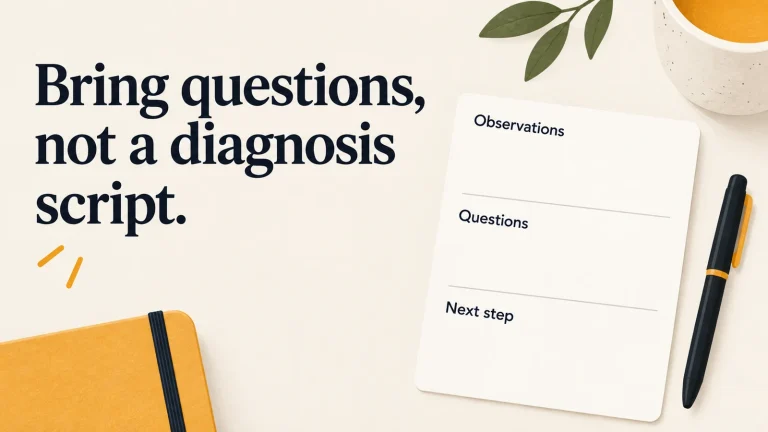
Keep a small listening note
Use a note you can retrieve later, not a transcript of everything said. Record the episode title or URL so the original context is not lost.
| Field | What to record |
|---|---|
| My question | The one thing I hoped to understand |
| Episode and speaker | A source link and enough detail to return to it |
| Idea or claim | A short paraphrase, with uncertainty kept visible |
| What kind of next step? | Check a source, ask a professional, or try an ordinary planning change |
| Review cue | When I will decide whether the note still matters |
A plain note is enough. Temply Studio’s planner-format guide is an optional reference for organizing notes; a paid planner is not required to use this card.
A fictional example: one episode, one planning question
Imagine Alex wants a clearer way to remember the next step in a personal writing project. Alex chooses an episode whose description concerns organizing work, rather than opening several unrelated recommendations.
After listening, Alex records one idea in their own words and checks whether it is an ordinary organizational suggestion. They decide to leave a short next-action note in the working document and see whether it is easy to find during the next session.
The note does not say that the podcast treated ADHD or that the method has been proven effective. It records a limited experiment: whether a particular note was usable in one setting. Alex can keep it, change it, or stop using it without adopting a larger system.
Make the listening format work for you
Check whether the episode provides show notes, a transcript, captions, or another accessible alternative. Do not assume every episode has one. A written summary may suit a particular task better than audio.
Use playback and bookmarking options only where the actual player supports them. Pause at a useful point rather than treating completion as the goal. When driving or doing another safety-sensitive activity, leave note-taking and screen interaction until it is safe.
If the audio format does not work for you, move to a written resource. That is a format choice, not a failure to learn.
Separate education from healthcare decisions
Recognizing part of your experience in a story does not confirm a diagnosis. The NIMH adult ADHD resource describes evaluation by a healthcare professional. Podcasts and personal planning notes cannot replace that process.
Keep descriptions of other people’s experiences attached to their context. Do not turn an episode about one person’s symptoms or treatment into a claim about everyone with ADHD, yourself, or someone you know.
Questions about choosing ADHD podcasts
Which podcast is best for everyone?
This guide does not identify a universal winner. The useful starting point depends on your question, the audience, the speaker, and the format you can use. Try one relevant episode before creating a larger listening queue.
Do I need to listen every week?
No. You can use an archive when a specific question arises. There is no streak to maintain, and this article makes no recommendation about a required listening frequency.
Can I use an idea without adopting the whole system?
For an ordinary low-risk organizing suggestion, you can choose a small experiment and observe whether it is useful. Medical or other consequential advice needs appropriate independent checking; a podcast is not personal professional guidance.
Choose one question and one official episode page
Begin with the source links above, save the episode you actually choose, and keep one question or action in your notes. If useful, revisit it during an existing weekly planning review. Temply Studio’s planning guides cover separate organizational tasks rather than podcast-based treatment.
Publisher: Temply Studio. Official show pages were checked October 2, 2026. No audio-listening test or clinical review is claimed. This article is educational and is not medical advice.
Temply Studio
Stop chasing your goals with sticky notes and scattered notebooks. Our premium digital planners and Canva templates are designed to help you plan with intention, stay consistent, and actually enjoy the process.
Questions about this guide?
Ask about the planner, share how you use it, or tell us what to cover next. Your email stays private.