



Table of Contents
Quick answer
GoodNotes for language learning works because it combines the three things language study needs in one place: a vocabulary notebook you write by hand, flashcards you can test yourself with, and a weekly study plan that keeps you consistent. Set up one notebook per language with sections for vocabulary, grammar, listening notes, and speaking practice, review new words on a spaced schedule, and track your streak. Handwriting the words — rather than typing them — helps you remember them longer.
Why GoodNotes for Language Learning Works So Well
Language learning fails most often on organisation, not motivation. Vocabulary lives in one app, grammar notes in another, listening practice in a third, and the weekly plan in your head. Within a month the system collapses under its own weight and study stops.
GoodNotes solves the organisation problem by being a single, flexible notebook. Everything lives in one place: the new words from Tuesday’s lesson, the grammar pattern you keep forgetting, the phrases you heard in a podcast, and the plan for next week. You can write by hand, which research consistently links to stronger memory than typing, and you can search your own handwriting later — a feature that turns months of notes into a personal dictionary you can actually use.
It also fits how language learning really works. Progress is not one big effort; it is twenty minutes a day, most days, for months. A digital planner keeps that small daily habit visible and honest in a way a scattered pile of apps never will.
Step 1: Set Up Your GoodNotes for Language Learning Notebook
Start with a single notebook for the language you are learning. Inside it, create five sections using GoodNotes outlines or tabbed dividers:
- Vocabulary: new words and phrases, with example sentences.
- Grammar: one pattern per page, with your own examples.
- Listening: notes from podcasts, shows, and videos — words you heard but did not know.
- Speaking: phrases you want to use, pronunciation notes, and scripts for real conversations.
- Weekly plan: what you will study each day, and a simple tracker for what you actually did.
Keep the structure identical across languages if you study more than one. Familiarity is the point: when you open the notebook you should know exactly where things go without thinking. A 12-Tab Digital Notebook for GoodNotes works well here, because its tabbed sections map neatly onto these five areas with room to grow.
Step 2: Build a Vocabulary System That Sticks
Collecting words is easy. Remembering them is the work. The difference is a system.
Capture words with context, never alone
A word without a sentence is a word you will forget. Every time you add a word, write it with the full sentence you found it in, plus a short note on when you would use it. “Serendipity — finding something good by accident” is forgettable. “We met by serendipity at the station” is memorable, because you can picture it.
Write them by hand
GoodNotes shines here. Writing a word by hand forces you to slow down and notice its shape — its spelling, its accents, its stroke order in languages like Japanese or Korean. For character-based languages, handwriting is not a nice extra; it is the learning itself. Use the zoom window to write small, neat characters even on a crowded page.
Use the 1–3–7 review rhythm
Review each new word after one day, after three days, and after seven days. That simple spaced rhythm beats cramming by a wide margin. In practice: when you learn words on Monday, your Tuesday page includes a quick review box for Monday’s words; Thursday’s page reviews them again; the following Monday reviews them a third time. If a word survives all three reviews, move it to a monthly review page. If it does not, keep it in the rotation.
Colour-code by confidence
When you review, mark each word: green if you knew it instantly, yellow if it took effort, red if it was gone. Your next study session starts with the reds, not the greens. This is the whole secret of efficient review — spend time on what you do not know, not on what you already do.
Step 3: Make Flashcards Inside GoodNotes for Language Learning
You do not need a separate flashcard app. GoodNotes has two simple methods, and both work.
Method 1: The cover-and-reveal page
Write the word or question on the left of the page and the answer on the right, then cover the right side with a sticky-note shape or a solid rectangle. Swipe the cover away to check yourself. It is low-tech and it works, because the physical act of revealing the answer creates a small moment of recall.
Method 2: The question page + answer page
Put questions on one page and answers on the next. Test yourself on the question page, then flip to check. This method suits longer answers — translated sentences, grammar explanations, short dialogues — where a sticky note would be too small.
Whichever method you choose, keep decks small: 20 to 30 cards per set. A deck of 200 cards is a deck you will avoid. Small decks get finished, and finished decks get reviewed.

For a ready-made study structure, pair your flashcards with the flashcard method in our GoodNotes revision guide — the same build-test-review loop works for vocabulary as it does for exams.
Step 4: Plan Your Week (20 Minutes a Day Beats 3 Hours on Sunday)
Consistency is the entire game in language learning, and a plan is what makes consistency possible. Here is a weekly shape that works for most learners:
- Monday — new vocabulary: 20 new words from your lesson, textbook, or reading, captured with example sentences.
- Tuesday — grammar: one pattern, studied deeply, with five of your own example sentences.
- Wednesday — listening: a 15-minute podcast or video in the language, with unknown words captured in your Listening section.
- Thursday — review day: no new material. Review the week’s words using the 1–3–7 rhythm and re-test your flashcards.
- Friday — speaking or writing: write a short paragraph or record yourself speaking for two minutes about your week. Mistakes are the point.
- Saturday — immersion: watch a show, read an article, or chat with a language partner. No notebook required — just exposure.
- Sunday — rest or light review: ten minutes of flashcards, or nothing at all. Rest is part of the plan.
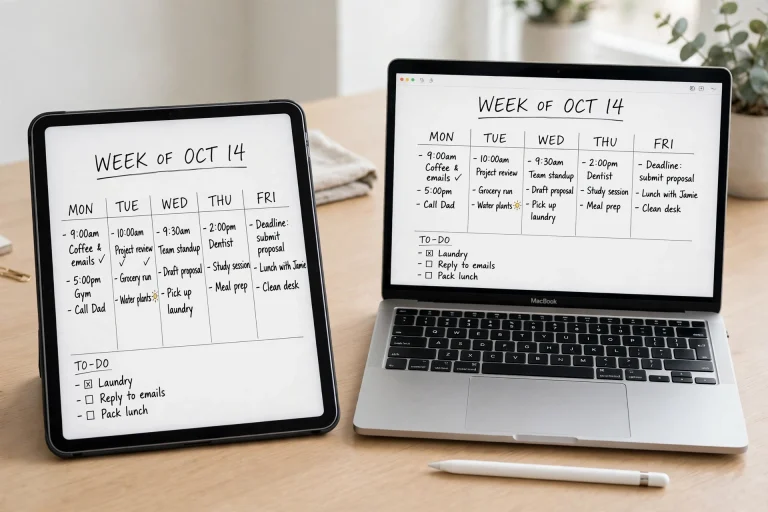
Write this plan into your weekly page each Sunday evening. If a day gets missed, do not double up the next day — just continue. The plan is a rhythm, not a debt.

A Minimalist Undated Digital Life Planner for GoodNotes is a good home for this weekly shape, because its undated weekly spreads let you start any week of the year without wasting pages.
Language-Specific Tips
For character-based languages (Japanese, Chinese, Korean)
Use GoodNotes’ handwriting recognition to check your characters, and dedicate one page per tricky character: write it ten times, note its components, and write a word that uses it. The zoom window is essential here — set it to a comfortable writing height and let it follow your pen across the page.
For languages with cases or genders (German, Russian, French)
Colour-code nouns by gender from day one — blue for masculine, red for feminine, green for neuter, for example. Learning the article with the noun, in colour, saves hundreds of hours of re-learning later. For cases, keep one page per case with your own example sentences, and add to it every time you meet a new use.
For tonal languages (Vietnamese, Thai, Mandarin)
Record yourself. GoodNotes lets you attach audio to a page, so record the word as a native speaker says it (from a lesson or dictionary app) and your own attempt underneath. Hearing the gap between the two is faster than any written explanation of tone.
Tracking Your GoodNotes for Language Learning Progress
Language progress is invisible day to day and dramatic month to month. Track two things and ignore the rest:
- Streak: mark each day you studied, even for five minutes. A visible streak is the strongest motivator there is — and a broken streak is not a failure, it is just a day.
- Words known: once a month, count the words on your monthly review page that you know instantly. That number going up is real progress, even when it does not feel like it.
Do not track hours. Hours reward sitting at the desk; streaks and known words reward actual learning. And once a month, re-read something you struggled with weeks ago — a dialogue, an article, a chapter. The moment it feels easy is the moment you realise how far you have come.
5 Mistakes That Stall Language Learners
1. Collecting words and never reviewing them
A vocabulary list without a review schedule is a graveyard. If you only have ten minutes, spend them reviewing old words, not collecting new ones.
2. Studying only what is comfortable
Reading is comfortable; speaking is not. The skills you avoid are the ones that need the most practice. Put one uncomfortable activity in every week — a conversation, a recording, a written paragraph — and protect it.
3. Switching resources every week
A new app feels like progress, but it resets your system. Pick one notebook, one course, and one listening source, and stay with them for three months before judging them.
4. Waiting until you are “ready” to speak
You will never feel ready. Speak badly, early, and often — badly is how every fluent speaker started. Use your Speaking section to prepare phrases before a conversation, then write down what actually happened afterwards.
5. Treating a missed day as a failed week
Missed days are normal. The only thing that matters is the next day. Learners who return after a missed day succeed; learners who quit after a missed day do not. The difference is one decision.
Frequently Asked Questions
Can I learn a language using only GoodNotes?
GoodNotes is your notebook and planner, not your teacher. You still need input — a course, a tutor, podcasts, books — but GoodNotes organises everything that input produces. Think of it as the system around your learning, not the learning itself.
How many new words should I learn per day?
Ten to twenty is the sweet spot for most learners. Fewer feels too slow; more overwhelms your review schedule. Quality matters more than quantity — twenty words with sentences and three reviews beat fifty words you never see again.
Is handwriting really better than typing for vocabulary?
For most people, yes — handwriting forces slower, more deliberate processing, and that depth helps memory. It matters most for character-based languages and for spelling. If handwriting is physically difficult for you, typing with active recall (typing the word from memory, not copying it) is a good alternative.
How do I use GoodNotes handwriting search for vocabulary?
GoodNotes can search your handwritten words. Write vocabulary clearly and consistently, and you can find any word months later by searching for it — effectively turning your notebook into a personal dictionary that grows with you.
What if I am learning two languages at once?
Use separate notebooks with identical structure, and study them at different times of day to reduce interference. Two languages is doable; three usually means neither gets enough time. Be honest about which one is the priority.
Start This Week
GoodNotes for language learning is not about a perfect system. It is about a notebook you open every day, words you write by hand, and a review rhythm you can keep for months. Set up the five sections tonight, add ten words with sentences, and schedule your first review for tomorrow. That is the whole beginning — and it is enough.
Ready to build your language notebook? Start with the 12-Tab Digital Notebook for GoodNotes and the Minimalist Undated Digital Life Planner for GoodNotes — together they cover your vocabulary and your weekly study plan.
Temply Studio
Stop chasing your goals with sticky notes and scattered notebooks. Our premium digital planners and Canva templates are designed to help you plan with intention, stay consistent, and actually enjoy the process.


Questions about this guide?
Ask about the planner, share how you use it, or tell us what to cover next. Your email stays private.