




Every December, millions of people scribble a list of New Year’s resolutions on January 1st — and abandon most of them by February. The problem isn’t a lack of ambition. It’s that resolutions skip the step that actually matters: a real reset. A thoughtful new year reset routine gives you a full weekend to close out 2026 with intention, reflect on what worked, clear the clutter, and design a 2027 that fits the life you actually want to live. No pressure, no guilt — just one focused weekend and a plan you can trust.
Below is a simple three-day routine: Friday evening for reflection and closure, Saturday for decluttering and goal drafting, and Sunday for building the systems that carry you through the year. Grab your planner, pour something warm, and let’s plan a better 2027 — one weekend at a time.
Why a New Year Reset Routine Beats Resolutions
Resolutions fail for a predictable reason: they’re wishes, not systems. “Get fit,” “save more,” “be less stressed” are directions, not plans. A reset routine works differently. It treats the transition between years like a project with three phases — review, release, and design — so you start January with clarity instead of pressure.
Psychologists who study goal achievement keep finding the same pattern: people succeed when they translate vague intentions into concrete implementation plans. That’s exactly what this weekend does. By Monday morning, you won’t just have goals — you’ll have a calendar that supports them, habits attached to your existing routines, and a quarterly review rhythm that keeps you on track when motivation fades (and it always fades).
You don’t need to be a planner person to do this. All you need is a few hours spread across three days, an honest look at 2026, and a willingness to design 2027 around your values rather than your shoulds.
Your New Year Reset Routine: Friday Evening — Reflect & Close Out 2026
Friday evening is for closing the loop. You can’t plan forward while last year’s loose ends are still humming in the back of your mind. Set aside about 90 minutes, turn off notifications, and work through these reflection prompts in your journal or planner’s notes section.
Step 1: Review the year in writing (30 minutes)
Grab your calendar from this year — the digital one, the paper one, wherever your life actually happened — and scroll back month by month. Then answer these prompts honestly. There’s no grading; this is just for you:
- What am I proudest of from 2026? Not the impressive stuff — the stuff that genuinely mattered to you.
- What drained me the most? Name the commitments, habits, or situations that cost more energy than they gave back.
- When did I feel most like myself this year? Note what you were doing, who you were with, and what the day looked like.
- What did I avoid? The hard conversation, the appointment, the project. Write it down without judgment.
- What surprised me? An unexpected joy, a door that opened, a skill you discovered.
If you keep a journal, this is also the perfect time to flip back through entries from the past year. Skimming your own words from February will show you how much you’ve grown — and how much of your worry never materialized.
Step 2: Tie up loose ends (30 minutes)
Open your to-do list and notes app and ask: what from 2026 am I still carrying that belongs in 2026? Make a short “closure list” — unanswered messages, unfiled receipts, that project you keep thinking about, the apology you owe. You don’t have to finish everything tonight. For each item, either do it (if it takes under 10 minutes) or consciously park it with a decision: finish in January, delegate, or drop it entirely.
The “drop it” option matters. Crossing something off your list because you chose to let it go feels as good as completing it — and it stops the item from renting space in your head all January.
Step 3: Write a letter to your future self (30 minutes)
This is the ritual that makes the reset feel real. Write a short letter to the person you’ll be on December 31, 2027. Tell them what 2026 was really like, what you’re hoping for, and what you want them to remember when the year gets hard. Seal it — in a planner pocket, an envelope, a digital note with a reminder set — and open it next New Year’s Eve. The 2027 Candle Guided Planner includes dedicated reflection pages designed for exactly this kind of ritual, with prompts that make the exercise easy to start.
Saturday — Declutter, Money Review & Draft Your Goals
Saturday is the practical day. Give yourself three focused blocks with real breaks in between — this isn’t a marathon, and your brain makes better decisions when it’s rested.
Block 1: The reset declutter (60–90 minutes)
Your environment is the background music of your life. You can’t hear a new melody over last year’s noise. Tackle these five zones quickly — set a timer and don’t aim for perfection:
- Your phone: Delete unused apps, unsubscribe from five marketing email lists, and archive old photos into one album. Turn off at least three non-essential notifications.
- Your inbox: Unsubscribe aggressively, file or archive everything actionable into folders, and get to inbox zero (or under 20). It’s symbolic — and it works.
- Your planner: Migrate anything still pending into January or archive it. A fresh planner for 2027 means you stop dragging 2026’s unfinished tasks forward by default.
- One physical space: Your desk, your nightstand, or the corner where mail piles up. Clear it completely, wipe it down, and put back only what belongs.
- Your calendar: Delete every repeating event you attend out of guilt or habit, not value. If a standing meeting isn’t worth your time, it doesn’t deserve a slot in 2027.
Block 2: The 60-minute money review
Money deserves an honest hour before you set goals that involve it. Pull up your bank and card statements for the year (or your budget app’s annual summary) and answer:
- Where did my money actually go? Identify your top three spending categories.
- What spending brought genuine joy, and what was autopilot?
- Is my emergency fund where I want it? What about debt and savings?
- One financial goal for 2027 — just one. Paying off a card, building a three-month cushion, funding a trip. Write it down with a number and a date.
This isn’t about shame; it’s about information. Every good plan starts with an honest inventory.
Block 3: Draft your 2027 goals with the 3-theme method
Here’s where the new year reset routine differs from resolution season. Instead of a list of twelve disconnected goals, pick three themes for 2027. A theme is a word or short phrase that captures the direction you want your year to take — things like Health, Calm, Build, Connection, Create, or Freedom.
Then, for each theme, write:
- One quarterly milestone — something concrete you can reach by the end of Q1, then build on. Example: under Health, “Walk 30 minutes five days a week by March.”
- The weekly habit that leads there — small and boring on purpose. Big goals are achieved with small repetitions.
- What you’ll say no to — every theme needs a boundary. Calm might mean “no phone in the bedroom.” Create might mean “no social scrolling before 9 a.m.”
Three themes, three milestones, three habits, three boundaries. That’s your whole year on one page. If you’re using a digital planner, the 2027 Life Planner has a dedicated annual goals spread with quarterly milestone trackers that makes this layout visual and easy to revisit each month.
Sunday — Build Your 2027 System: Calendar, Habits & Weekly Rhythm
Sunday is construction day. Goals without systems are just wishes with better formatting, so today you’re building the infrastructure that makes your three themes run on autopilot.
Step 1: Set up your 2027 calendar skeleton (45 minutes)
Before the year fills itself, fill it with what matters:
- Block the big rocks first: known trips, events, deadlines, and any annual appointments (doctor, dentist, car service).
- Add quarterly review dates — one Sunday each quarter, two hours, to check your milestones. This single habit separates people who achieve goals from people who forget them.
- Schedule your weekly planning session: a recurring 20-minute slot (Sunday evening works for most people) to review the week ahead.
- Add the fun before the obligations: birthdays, date nights, friend trips, personal days. A calendar with no joy scheduled is a calendar you’ll start to resent.
Step 2: Design your habits with habit stacking (30 minutes)
Habit stacking is the simplest reliable way to build new routines: attach a new behavior to something you already do automatically. The formula is “After I [existing habit], I will [new habit].”
- After I start the coffee maker, I will write three things I’m grateful for.
- After I close my laptop for lunch, I will take a 10-minute walk.
- After I brush my teeth at night, I will lay out tomorrow’s top three priorities.
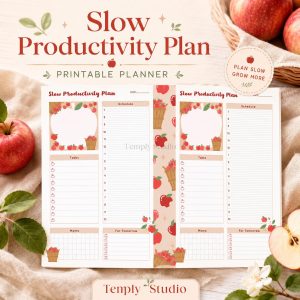
Pick no more than two or three stacks to start. Tiny, anchored habits outperform ambitious routines every time because they survive low-motivation days — which is when they matter most. A habit tracker page in your planner, checked weekly rather than daily, keeps this honest without turning into another chore. The Slow Productivity Planner is built around exactly this philosophy: fewer, better habits that compound quietly instead of a jam-packed routine that collapses by February.
Step 3: Create your weekly reset ritual (20 minutes)
The weekend reset gets 2027 started, but a 15-minute weekly reset keeps it on track. Pick your day and write down your personal checklist:
- Glance at the calendar for the week ahead — any conflicts or prep needed?
- Pick three priorities for the week (not ten — three).
- Check in on your quarterly milestones: one small action this week toward each.
- Quick brain dump: get every floating task out of your head and onto paper.
- One act of maintenance: tidy the desk, clear downloads, reset the phone home screen.
Laminate this (metaphorically) and run it every week. It’s the smallest investment with the largest return in this entire routine.
How to Avoid Resolution Burnout
Even the best new year reset routine won’t help if you fall into the traps that burn out every January. Watch for these four:
- The January sprint. Trying to change everything at once spikes willpower and crashes it. Start one habit per theme; add more in February if — and only if — the first ones are automatic.
- The all-or-nothing scorecard. Missing one day doesn’t ruin a habit. The research is clear: what matters is getting back on track quickly, not perfect streaks. Aim for “most days,” not “every day.”
- Goals you inherited. If a goal exists because Instagram, your parents, or your coworker suggested it, question it. The three-theme method only works with themes that are genuinely yours.
- No review rhythm. Goals decay without attention. Your quarterly reviews are the repair mechanism — put them in the calendar before you close this tab.
If February finds you wobbling, don’t scrap the plan — shrink it. Halve the habit, double the review frequency, and keep going. The goal was never a perfect January. It’s a better December.
Your New Year Reset Routine Checklist & Tools
Here’s the whole weekend on one card. Save it, print it, or copy it into your planner:
- Friday evening: Year review prompts → closure list → letter to future self
- Saturday: Five-zone declutter → 60-minute money review → 3-theme goal draft
- Sunday: Calendar skeleton → habit stacks → weekly reset ritual
- Tools: a planner with goal + reflection pages, a timer, your phone for unsubscribing, and a quiet playlist
You don’t need fancy equipment — but a planner designed for this kind of intentional planning makes the whole thing smoother. Pairing your reset weekend with a planner that has dedicated reflection, quarterly milestone, and habit-tracking pages means everything you decide this weekend has a home all year long.
Frequently Asked Questions
How long does a new year reset routine take?
Plan for about six to eight hours total, spread across Friday evening, Saturday, and Sunday. The schedule above breaks down to roughly 90 minutes on Friday, three to four hours on Saturday, and two hours on Sunday — with real breaks built in. You can compress it into one full day if needed, but the spacing matters: sleeping between reflection and goal-setting genuinely improves the quality of your decisions.
What if I start my reset in January instead of December?
That’s completely fine — the calendar doesn’t care, and honestly, a mid-January reset can work even better because the holiday noise has died down. The routine works any weekend you give it. Just adjust the “close out 2026” framing to fit whatever you’re wrapping up, and set your quarterly milestones to align with your actual start date.
How many goals should I set for 2027?
Fewer than you think. The three-theme method in this routine gives you three themes, three quarterly milestones, and three weekly habits — nine moving parts total, which is about what a busy adult can actually track. If a fourth goal sneaks in, ask which existing theme it belongs to, or which theme you’d trade for it. Constraint is a feature, not a bug.
What’s the difference between a reset routine and a vision board?
A vision board captures what you want; a reset routine builds how you’ll get it. They’re not competitors — a vision board is a lovely artifact for the “design” phase. But images alone don’t create change. This routine adds the missing half: closing out the old year, clearing the clutter, setting measurable milestones, and installing the weekly systems that turn the vision into Tuesday-afternoon reality.
How do I keep my new year plans alive past February?
Two mechanisms: the quarterly review dates you blocked on Sunday (the single most important step in this whole routine) and the weekly 15-minute reset. Motivation is a terrible long-term strategy; systems and scheduled check-ins are what carry you. When a review shows a habit isn’t working, adjust the habit — don’t abandon the theme. Course-correction is the plan working, not the plan failing.
One weekend. Three themes. A calendar that supports them and a weekly rhythm that keeps them alive. That’s the whole new year reset routine — and it’s more than enough to make 2027 the year that finally feels like yours.
Ready to make it happen? Start your reset with planners built for intentional planning — explore the full collection at Temply Studio and pick the one that fits your 2027.
Temply Studio
Stop chasing your goals with sticky notes and scattered notebooks. Our premium digital planners and Canva templates are designed to help you plan with intention, stay consistent, and actually enjoy the process.


Questions about this guide?
Ask about the planner, share how you use it, or tell us what to cover next. Your email stays private.