

Every year, millions of people set resolutions in January and forget them by February. A vision board 2027 flips that pattern: instead of a vague wish list, you build a daily visual reminder of the life you are working toward. Whether you want a career change, a healthier routine, or more travel next year, a vision board turns abstract goals into images you see every single day.
In this step-by-step guide, you will learn exactly how to create a vision board for 2027 — from clarifying your vision and finding the right images, to arranging your layout, activating the board, and reviewing it quarterly so it actually delivers results.
Why a Vision Board Works
A vision board is not magic. It is a practical focus tool. Your brain is constantly filtering information, and when you give it a clear, visual picture of what matters, you start noticing opportunities, resources, and actions that move you closer to those images. Psychologists call this the brain’s selective-attention mechanism: what you focus on, you act on.
A written goal list can feel abstract. A photo of the home office you want, the marathon finish line you are aiming for, or the savings number you are building toward feels concrete. That emotional connection is what keeps you motivated on the days your willpower runs low.
The difference between a vision board that works and one that becomes wall decoration comes down to process: clarifying what you truly want, choosing images that stir real emotion, and — the step most people skip — reviewing the board on a regular schedule.
Step 1: Clarify Your Vision for 2027
Before you cut out a single image, spend quiet time deciding what you actually want next year. A board crowded with random goals is just visual noise. Aim for clarity.
Grab a notebook or open a planning page and answer these questions honestly:
- Career: What would a great work year look like? A promotion, a new skill, starting a side project, going freelance?
- Health: How do you want to feel? Stronger, more rested, more energetic? What one habit would change everything?
- Relationships: Who do you want more time with? What kind of partner, friend, or family member do you want to be?
- Money: What financial milestone matters most — an emergency fund, debt payoff, a savings target, a new income stream?
- Experiences: Where do you want to go? What do you want to learn, try, or finally finish?
Now narrow it down. Pick 5 to 8 priorities maximum. One clear goal per life area beats ten vague ones. Write each as a present-tense statement: “I am fluent in conversational Spanish” rather than “I want to learn Spanish.” This present-tense framing is exactly what the New Moon Intentions Journal uses for monthly intention setting, and it works beautifully as the written layer behind your board.
Step 2: Gather Your Materials
You can build a physical board or a digital one — both work, so choose the format you will actually look at every day.
For a physical vision board
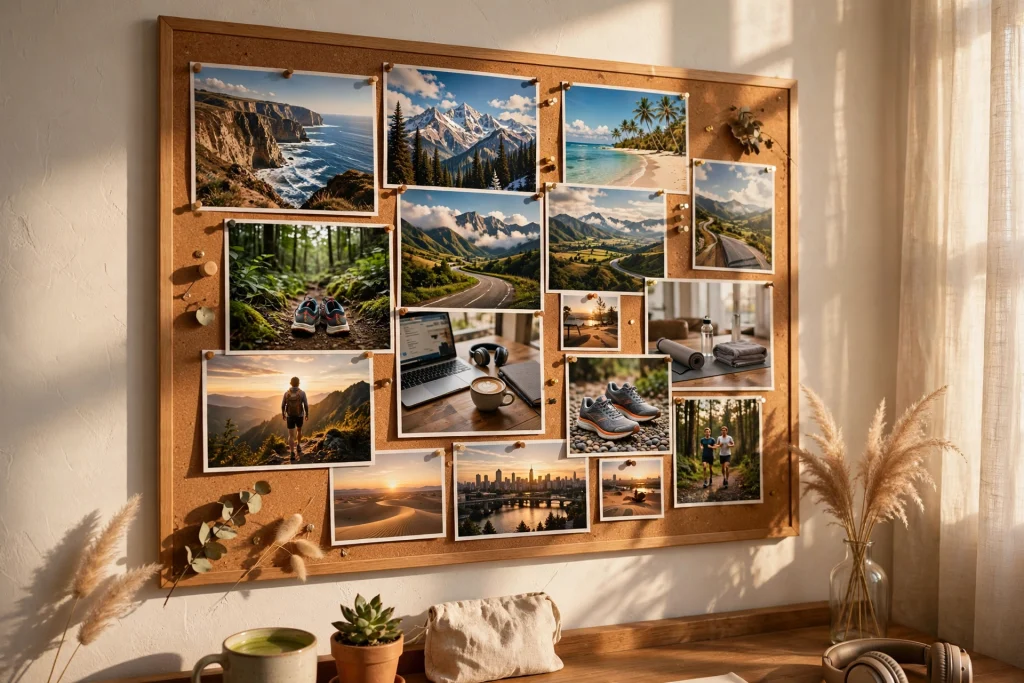
- A corkboard, foam board, or large piece of cardstock
- Magazines, printed photos, postcards, and affirmation cards
- Scissors, glue or pushpins, markers, and washi tape
- Optional: stickers, fabric scraps, ticket stubs, or other textures
For a digital vision board
- A Canva or Pinterest board, or a simple slide deck
- High-resolution images saved from your own photos or stock libraries
- A phone or desktop wallpaper version so it is always in front of you
A physical board is powerful because it lives in your space, but a digital board travels with you. Many people do both: a corkboard at home and a phone-wallpaper version for the commute. If you are planning across several years rather than just one, the 5-Year Goal Planner Canva Template pairs well with a board, giving you a written long-term roadmap behind the visuals.
Step 3: Find Images That Stir Real Emotion
This is the heart of the process. You are not decorating — you are collecting visual anchors for the feelings you want in 2027.
- Match one image to each priority. If career growth is a priority, find a photo that represents it for you: a desk that looks like your dream workspace, a conference stage, a paycheck figure. Specific beats generic.
- Choose emotion over aesthetics. The prettiest picture is useless if it leaves you cold. When an image makes your chest tighten or your smile widen, that is the one.
- Add words and numbers. Affirmation cards (“I follow through”), key figures (“$10,000 emergency fund”), and power words (focus, courage, calm) give your board the specifics that images alone cannot.
- Include your own photos. A photo of you at your happiest reminds you the board is about your life, not someone else’s highlight reel.
- Aim for 10 to 15 images total. Enough to cover your priorities, few enough that each one gets attention.
Source ideas: magazines you already own, your camera roll, free stock-photo sites, travel brochures, product catalogs, and printed screenshots. For a 2027 board, include at least one image that explicitly anchors the year — a “2027” banner or a photo dated to next year — so your brain files everything under the right timeframe.
Step 4: Arrange and Build Your Layout
There is no single correct layout, but a little structure makes the board more powerful than a random collage.
Two layouts that work well
- Life-wheel layout: Divide the board into sections — career, health, relationships, money, experiences — and place each priority’s images in its own zone. This keeps the board balanced and stops one area from dominating.
- Center-anchor layout: Put one central image representing your overall theme for 2027 (a word like “freedom” or “momentum”) in the middle, then arrange everything else around it. This works well when one big goal defines your year.
Practical tips as you build:
- Leave white space. A board crammed edge to edge overwhelms the eye and dilutes every image.
- Put your most important image at eye level or in the center — that is where your gaze lands first.
- Layer words over images where it helps, but keep text short: one word or one phrase per card.
- Step back and squint. If you cannot tell what the board is about from six feet away, simplify.
- Date it. Write “2027” on the board so every glance reinforces the timeframe.
Step 5: Activate Your Board (The Step Everyone Skips)
A board you never look at is decoration. Activation is what converts images into action, and it takes five minutes a day.
- Place it where you will see it. Bedroom wall, home-office corkboard, or your phone’s lock screen. Not the closet door, not a drawer.
- Spend two minutes with it each morning. Look at each image, feel the emotion behind it, and picture yourself already living it. This morning ritual is the entire “manifestation” mechanism — repeated focus, repeated action.
- Turn images into next actions. Each week, ask: “What is one small step I can take toward each image?” Write those steps somewhere you track tasks. A planner page is ideal — the 2027 Life Planner has monthly and weekly spreads where you can translate board images into dated action steps.
- Share it selectively. Telling one trusted person about your board creates gentle accountability. Broadcasting it to everyone creates pressure; choose wisely.
Step 6: Review Your Board Quarterly
Goals shift, and your board should shift with them. A quarterly review keeps the board honest and keeps you moving.
- End of March, June, September, and December: sit with your board for 20 minutes and ask what is working, what has changed, and what no longer fits.
- Swap out stale images. Goals you have already achieved? Celebrate, then replace them. Priorities that no longer excite you? They were probably someone else’s goal. Take them down.
- Score each life area 1 to 10. The low scores show you where next quarter’s effort belongs. Jot the scores in your planner so you can see the trend across the year.
- Add one “stretch” image per quarter. A slightly bigger version of something you are already progressing toward keeps momentum alive.
The December review doubles as your board-closing ritual: acknowledge what you achieved, archive the year’s board with a photo, and start sketching your 2028 vision while the wins are fresh.
Common Vision Board Mistakes to Avoid
- Too many goals. Twenty images mean zero focus. Cap it at five to eight priorities.
- Only material goals. A board of nothing but cars and houses feels hollow by March. Include health, relationships, and experiences.
- No action layer. Images without scheduled next steps are daydreams. Connect every image to a weekly action in your planner.
- Hiding it away. If you only look at it on New Year’s Day, it cannot do its job. Visibility is the whole mechanism.
- Never updating it. A board frozen in January while your life changed in May becomes a guilt object, not a guide. Review quarterly and revise freely.
FAQ: Vision Boards for 2027
Do vision boards actually work?
They work as a focus and motivation tool, not as magic. The mechanism is well understood: keeping your goals visually present sharpens attention, reinforces motivation, and makes follow-through more likely — but only when you pair the board with concrete action steps and regular reviews.
When should I make my 2027 vision board?
November or December 2026 is ideal — you can start the year with it already in place. But a board made in March beats one never made. The best time to build it is whenever you will actually use it.
Should my vision board be physical or digital?
Whichever you will look at daily. Physical boards are great for a fixed space like a bedroom or office; digital boards work better if you travel or want it as a phone wallpaper. Doing both costs little extra and covers all your viewing moments.
How many goals should go on a vision board?
Five to eight priorities is the sweet spot. Fewer and the board feels thin; more and it becomes visual noise that your brain starts ignoring. If you have more goals, put the extras in your written planner and keep the board for the big ones.
Start Your 2027 Vision Today
A vision board 2027 is one of the simplest high-impact rituals you can do for next year: clarify what you want, make it visible, and review it until it becomes real. Spend an afternoon building yours, connect it to weekly action steps, and let the daily reminder do its quiet work.
Ready to turn your board into a plan? Pair your finished vision board with the 2027 Life Planner — monthly, weekly, and daily pages designed to carry your board’s images into real, scheduled action all year long.
Temply Studio
Stop chasing your goals with sticky notes and scattered notebooks. Our premium digital planners and Canva templates are designed to help you plan with intention, stay consistent, and actually enjoy the process.
Questions about this guide?
Ask about the planner, share how you use it, or tell us what to cover next. Your email stays private.