





Learning how to stay organized as a solopreneur is one of the highest-leverage skills you can build for a one-person business. When you are the CEO, the marketer, the bookkeeper, and the customer support team all at once, chaos doesn’t just cost you time — it costs you clients, money, and your sanity. The good news: you don’t need a bigger brain or longer hours. You need simple systems that run on autopilot.
In this guide, you’ll get nine practical systems for staying organized as a solopreneur: one master task list, a weekly planning session, separate client and finance tracking, time blocking, and more. None of them require expensive software. All of them work with a single digital planner that holds your whole business in one place.
Why Solopreneurs Struggle With Organization
It’s not a discipline problem. Running everything yourself creates three specific organizational challenges that employees simply don’t face:
- No role boundaries. You switch between sales, delivery, admin, and marketing every hour. Each context switch drains focus.
- Nobody catches what you drop. There’s no assistant, no project manager, no one asking for the status update you forgot to send.
- Everything feels urgent. Client work, invoices, tax deadlines, and Instagram all compete for the same brain space.
The fix isn’t working harder. It’s building systems that remember things for you, so your brain is free to do the actual work.
System 1: Keep One Master Task List
The single biggest source of solopreneur chaos is tasks scattered across sticky notes, email flags, three apps, and your memory. Unify everything into one master list.
How to set it up
- Pick one home. A digital planner with a dedicated to-do section beats any combination of apps. If it’s not in the list, it doesn’t exist.
- Capture immediately. The moment a task pops into your head — during a client call, in the shower, at midnight — add it to your master list. Capture first, organize later.
- Tag by category. Use simple tags: Client Work, Admin, Marketing, Finance, Personal. This lets you batch similar tasks together.
- Review daily. Every morning, pull today’s top 3 tasks from the master list. Everything else stays in the list, out of your head.
A master list removes the constant background anxiety of “what am I forgetting?” — because the answer is always: nothing. It’s in the list.
System 2: Run a Weekly Planning Session
A weekly planning session is the heartbeat of solopreneur organization. Spend 30–45 minutes each week — ideally Friday afternoon or Sunday — reviewing and planning.
- Review last week: What got done? What slipped? What did you learn?
- Scan this week’s calendar: appointments, deadlines, deliverables.
- Choose your big three: the three outcomes that would make this week a win.
- Time-block the big rocks first: client delivery, then marketing, then admin.
This one habit prevents the classic solopreneur trap: busy all week, but nothing important actually moved forward.
System 3: Track Every Client Separately
Client details — quotes, deadlines, preferences, follow-ups — are the things most likely to fall through the cracks. Keep a simple client log with one page per client:
- Contact info and how they found you
- Project scope and agreed deadlines
- Notes from conversations (preferences, pain points)
- Last contact date and next follow-up date
Review your client log during your weekly planning session. A five-minute check-in per client saves you from missed follow-ups that cost real revenue.
System 4: Track Money Monthly, Not Just at Tax Time
Many solopreneurs discover their finances only when taxes are due — the most painful possible moment. Instead, spend 20 minutes each month logging income and expenses in a simple finance section of your planner.
- Income by client: so you can see who your best clients really are.
- Expenses by category: tools, advertising, subcontractors, supplies.
- Tax set-aside: transfer a fixed percentage of income to a separate account every month. Future-you will be grateful.
- Outstanding invoices: flag anything older than 14 days and follow up.
A monthly money check also shows you which services are actually profitable — information that should shape what you sell next year.
System 5: Batch Your Marketing Into a Content Calendar
Marketing dies first when client work gets busy — and then client work dies when the pipeline runs dry. Break the cycle with a simple monthly content calendar:
- Pick one main channel. Email, Instagram, LinkedIn — one channel done well beats three done sporadically.
- Plan one month at a time. During your weekly session, sketch the next 4 weeks of content themes.
- Batch creation. Write all of next month’s emails in one sitting. Design all graphics in another. Batching cuts production time dramatically.
- Repurpose everything. One deep article becomes five social posts, one email, and one video script.
System 6: Time-Block Your Week by Business Function
Solopreneurs who “fit things in whenever” get eaten alive by urgent requests. Instead, assign each day a primary function:
- Monday: Planning + client delivery kickoff
- Tuesday–Thursday: Deep client work (mornings), marketing (afternoons)
- Friday: Admin, finances, content creation, weekly review
Protect your deep-work blocks fiercely. Let clients know your response windows instead of answering messages instantly — responsiveness is a policy you set, not a reflex.
System 7: Keep One Business Dashboard
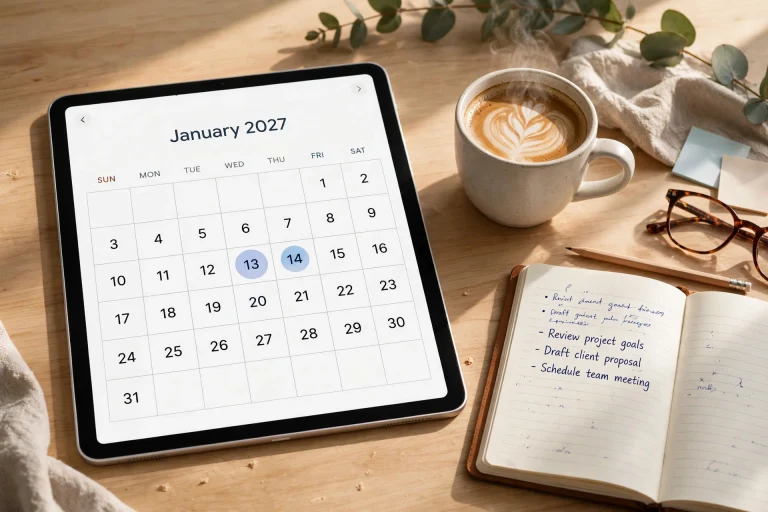
Systems 1 through 6 only work if they live in one place you actually open every day. This is where a dedicated solopreneur planner earns its keep: task list, weekly pages, client log, finance tracker, and content calendar all in one hyperlinked document you can carry on a tablet.
The 2027 Solopreneur Planner was designed exactly for this — project trackers, client logs, income and expense pages, and goal-setting layouts built for a one-person business. Pair it with the 2027 Business Planner for monthly, weekly, and daily planning pages with productivity and goal trackers.
One dashboard means one habit: open the planner each morning, and the whole business is in front of you.
System 8: Build Templates for Everything You Repeat
Solopreneurs repeat dozens of small processes: onboarding emails, proposals, invoices, social posts, project checklists. Every repetition you do from scratch is wasted energy.
- Client onboarding template: welcome email, intake questions, contract, first invoice — a checklist you run every time.
- Proposal template: scope, timeline, price options. Fill in the blanks, don’t start from a blank page.
- Content templates: post structures you reuse for testimonials, tips, behind-the-scenes.
Store templates in your planner or a notes app, and refine them every time you use one. Templates are systems that compound.
System 9: Do a Quarterly Business Review
Four times a year, step back for an hour and ask five questions:
- What were my revenue and profit this quarter?
- Which services were most profitable per hour?
- Where did new clients come from?
- What system broke or caused stress?
- What will I stop doing next quarter?
Question five is the most powerful. Solopreneur growth is as much about subtraction — dropping low-margin services, bad-fit clients, channels that don’t convert — as it is about addition.
Common Organization Mistakes Solopreneurs Make
- Too many apps. Five productivity tools create five places to check. Consolidate to one planner plus one notes app at most.
- Planning but never reviewing. A plan you never review is decoration. The weekly and quarterly reviews are the system.
- Organizing for fun. If reorganizing your folders feels productive, it probably isn’t. Organize the work, then do the work.
- No boundaries on communication. Instant replies train clients to expect instant replies. Set office hours and response windows.
FAQ
What’s the best way for a solopreneur to organize tasks?
One master task list in a single planner or app, reviewed daily. Tag tasks by business function (client work, marketing, admin, finance) and batch similar tasks together to reduce context switching.
How do solopreneurs manage time effectively?
By time-blocking the week by function — deep client work on set days, admin and marketing on others — and running a 30-minute weekly planning session to choose the three outcomes that define a successful week.
Should a solopreneur use a digital or paper planner?
Digital planners win for solopreneurs because everything is searchable, you can duplicate template pages (client logs, invoice trackers), and the whole business fits on a tablet. Paper works if you rarely need to reorganize — but client tracking and finance logs are much easier digitally.
How often should a solopreneur review their business systems?
Weekly for the task list and calendar (30–45 minutes), monthly for finances (20 minutes), and quarterly for the business as a whole (one hour). Each layer catches problems the others miss.
Start With One System Today
You don’t need all nine systems by tomorrow. Pick the one that would remove the most stress right now — for most solopreneurs, that’s the master task list — and run it for two weeks. Then add the next.
Ready to put your whole business in one place? The 2027 Solopreneur Planner gives you project trackers, client logs, income and expense pages, and goal-setting layouts designed for one-person businesses — and the 2027 Business Planner covers your monthly, weekly, and daily planning with built-in productivity trackers. Browse all digital planners here and start your most organized year yet.
Temply Studio
Stop chasing your goals with sticky notes and scattered notebooks. Our premium digital planners and Canva templates are designed to help you plan with intention, stay consistent, and actually enjoy the process.


Questions about this guide?
Ask about the planner, share how you use it, or tell us what to cover next. Your email stays private.