




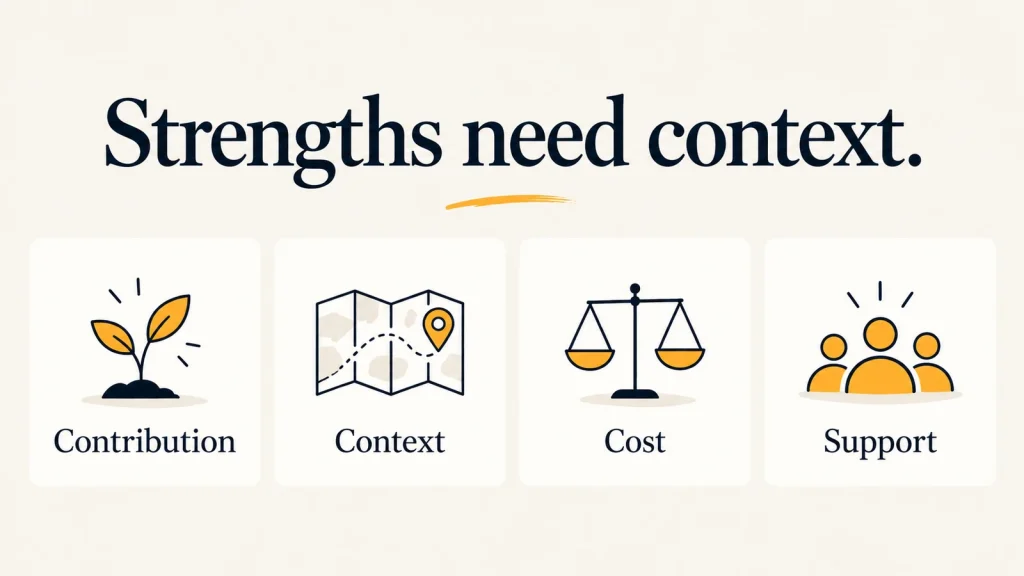
ADHD advantages are better discussed as possible individual strengths in a particular context, not a guaranteed package of “superpowers.” Research has explored positive experiences and characteristics alongside difficulties, but describing a strength is different from proving that ADHD causes it or that everyone with the diagnosis shares it.
This article looks at the kinds of evidence behind strengths claims and offers an original reflection format for ordinary planning. It does not assess abilities, recommend a career, or suggest changing treatment. You do not need to identify an advantage to have your difficulties taken seriously.
Quick answer: ADHD advantages may refer to individual strengths, research topics or comparative claims. Those are different kinds of evidence, and none supports a universal promise about every person.
Table of Contents
Three kinds of ADHD advantages claims
“I value this characteristic,” “researchers have studied this characteristic,” and “people with ADHD outperform other people at this task” are different statements. Each needs a different kind of evidence.
| Claim | What would help support it? | What it does not establish |
|---|---|---|
| A person experiences a characteristic positively | The person’s account in its context | That everyone has the same experience |
| A characteristic appears in strengths research | A clearly defined research review or study | That the characteristic is unique to ADHD |
| One group performs differently from another | A suitable comparison on a defined measure | A universal advantage in daily life |
| A support helps someone use a strength | Evidence about that support and its outcome | That a generic planner treats ADHD |
The distinction is useful when reading an upbeat headline. A study about what participants appreciate in themselves should not be rewritten as proof that a diagnosis predicts professional success, creativity, intelligence, or another broad outcome.
What one qualitative study found
In Nordby and colleagues’ 2023 study, Silver linings of ADHD, 50 help-seeking adults with an ADHD diagnosis in Norway wrote about positive aspects of their experience. Their responses were gathered within an internet-delivered intervention study and analyzed for themes. Participants described experiences that could feel beneficial or difficult depending on the situation.
This provides insight into participants’ accounts. It does not estimate how common each strength is among all adults with ADHD, and it does not compare their abilities with a representative non-ADHD group. The question specifically invited positive aspects, which is important context when interpreting the findings.
A qualitative account does not need to prove a universal advantage to be meaningful. It can show what an experience means to the person while leaving other research questions open.
What the 2026 research review adds
A scoping review by Rafael and colleagues, published online in March 2026, mapped 125 empirical studies of strengths that may relate to ADHD in adults. It included qualitative, quantitative, and mixed-methods research. Topics included creativity, positive experiences of attention, social attributes, resilience, and others.
A scoping review maps the range of research; this count is not proof that 125 studies each demonstrated a causal advantage. Nor does the proportion of papers discussing a characteristic equal the proportion of people who have it. The authors identify a need for further work on how strengths can be understood and used in suitable contexts.
Read the review’s questions and methods before converting it into a list of traits a person is supposed to possess. A growing research area can be worthwhile without every popular claim being settled.
Do not turn a creativity claim into a promise
Creativity can refer to generating ideas, producing an original work, solving a particular problem, or receiving recognition for a result. Those outcomes should not be collapsed into one unlimited ability.
Suppose a person enjoys suggesting several unusual approaches during a design discussion. That observation is useful for that task. It does not establish that they will prefer every creative role, finish every project, or perform better than every colleague.
When choosing how to use a strength, describe the activity itself: what the person contributed, where it was useful, and what else the work required. Avoid adding a causal explanation about their diagnosis unless the evidence actually supports it.
The same caution applies to claims about working under pressure, entrepreneurship, empathy, or resilience. A positive label can become an unrealistic expectation when it is assigned to everyone in a group.
Context changes what a characteristic contributes
A behavior can help one part of a task and create difficulty in another. Generating additional options might be welcome during brainstorming, while a later review may need the team to choose one option and preserve the agreed scope.
This is a task-design observation, not a clinical model. A practical question is: “Where was this contribution useful, and what support did the next phase require?”
Do not assume a person should always be assigned to the same role because someone considers it an ADHD strength. Ask what they enjoy, what they want to develop, and which responsibilities they have agreed to take on.
Worked example: from ideas to a usable event plan
Consider a fictional community organizer, Sam, who enjoys proposing different formats for a small exhibition. During an early discussion, the group finds two of Sam’s ideas useful. Later, the event needs a confirmed format, a materials list, and a handoff to the person preparing the venue.
The group can acknowledge the contribution specifically: “Those two options helped us see a better layout.” It does not need to declare that Sam has a diagnosis-based creative superpower.
They then agree on how the next stage will work. Sam wants to develop the chosen layout, another volunteer will confirm measurements, and both will review the same current version before production. Optional ideas are kept separate from the agreed plan.
The arrangement recognizes a contribution while still making the remaining responsibilities visible. It is not evidence that collaboration treats ADHD or that everyone needs the same division of work.
Try a context-based strengths note
Use the following questions to describe one actual experience. This is an original reflection aid, not a validated strengths inventory.
- Contribution: What did I do that was useful or meaningful?
- Context: What task, environment, or support made that possible?
- Evidence: What happened, rather than what label did I receive?
- Cost: Did the activity create a burden or make another responsibility harder?
- Choice: Do I want to use or develop this contribution again?
- Support: What would make the next attempt more workable?
You may not have an answer to every question. Avoid treating the page as a demand to feel positive about a difficult experience. A person can recognize a valued contribution and still dislike the obstacles around it.
For turning a chosen contribution into a realistic project, Temply Studio’s goal-setting workflow can help distinguish an outcome from the next action. It does not score strengths or predict success.
Recognizing strengths does not cancel support needs
The NIMH adult ADHD overview describes difficulties that can affect daily life and available forms of professional support. Noticing something you do well is not a reason to dismiss those difficulties or change a care plan without professional advice.
A person should not have to produce an impressive achievement before asking for support. Nor should support depend on accepting a positive narrative about the diagnosis.
Keep medical decisions separate from an informal strengths reflection. This article does not recommend starting, stopping, or changing treatment.
How to read the next “ADHD superpowers” article
Check whether its claims concern personal accounts, measured performance, or a treatment outcome. Look for the age group, sample, comparison, and definition of the strength. Then compare the headline with what the researchers actually concluded.
If a post says a percentage of adults have a particular advantage, verify whether the source measured people or merely counted papers mentioning the topic. If it recommends a profession, check whether the evidence actually examined success in that profession rather than a loosely related trait.
It is reasonable to appreciate encouraging language. It is also reasonable to reject a claim that does not fit your experience. Neither reaction supplies or removes a diagnosis.
Keep the description personal and specific
“I contributed a useful idea in that setting” says something you can inspect. “ADHD makes everyone naturally gifted at this” says much more than the evidence summarized here supports.
Use the smallest record that helps you remember the contribution and the conditions around it. Paper is enough. The planner-format guide is an optional next step if you want to compare where to keep project notes; no product is needed to identify a strength.
For related task-focused workflows, browse Temply Studio’s productivity and planning guides. Choose a method because it serves a real need, not because a label says it must work for you.
Sources: Nordby et al., Silver linings of ADHD; Rafael et al., ADHD-related strengths in adults: a scoping review; NIMH, ADHD in Adults.
Publisher: Temply Studio. Examples and reflection questions are original educational material, not a clinical assessment. This is not medical advice.
Temply Studio
Stop chasing your goals with sticky notes and scattered notebooks. Our premium digital planners and Canva templates are designed to help you plan with intention, stay consistent, and actually enjoy the process.
Questions about this guide?
Ask about the planner, share how you use it, or tell us what to cover next. Your email stays private.