




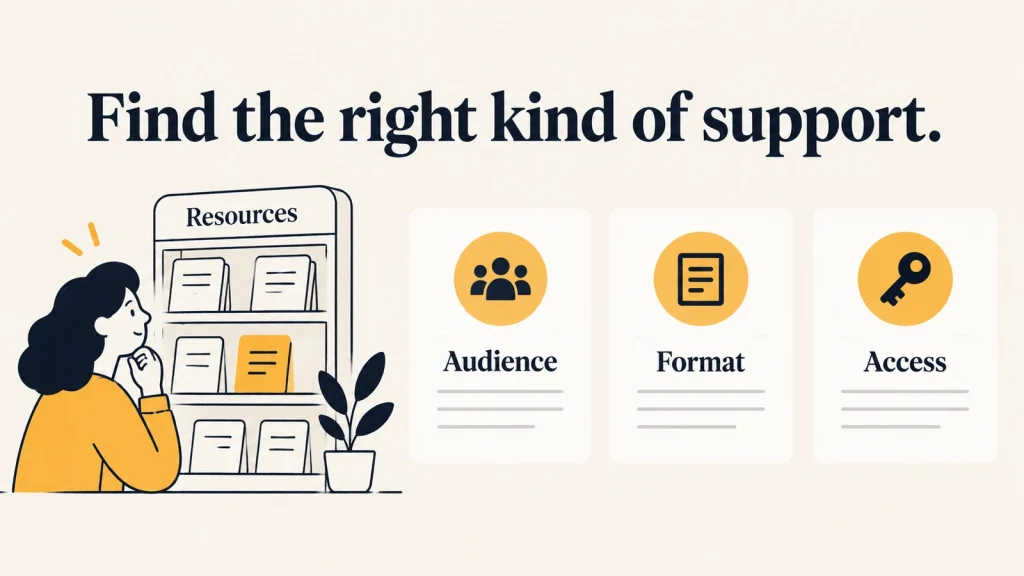
To find ADHD support groups, start with a current first-party directory, then check the group’s audience, format, access requirements, and ground rules. CHADD’s chapter locator and ADDA’s virtual programme pages are two starting points for adults. A listing is a lead to investigate, not a guarantee of availability, confidentiality, or suitability.
This guide concerns finding peer connection and educational support. Temply Studio does not run the groups listed here, make referrals on their behalf, or evaluate their clinical outcomes. A peer meeting should not be assumed to provide therapy, diagnosis, or emergency help.
Quick answer: ADHD support groups vary by audience and format and are not automatically therapy. Confirm eligibility, access, cost, privacy and facilitator role with the provider before joining.
Table of Contents
ADHD support groups: choose the kind of help you need
Write a short purpose before comparing groups. You might want to hear from other adults about ordinary daily responsibilities, ask questions about navigating information, or spend time in a community with shared experiences.
That purpose is different from seeking an assessment, a clinician-directed treatment plan, or help with an immediate safety concern. Use the NIMH help resource for information about professional and urgent support rather than relying on a future group meeting for those needs.
A group can be useful to explore without becoming your only support option. You do not need to decide on a permanent commitment before learning how it works.
Two official places to look
| Starting point | What the organisation describes | What you still need to verify |
|---|---|---|
| CHADD chapter locator | A US chapter network with local and virtual activities | The specific chapter’s audience, current meeting arrangements, and registration process |
| ADDA virtual programmes | Adult peer support groups and other virtual activities with membership-based access described on its pages | Eligibility, which activity you are joining, current access terms, and the next available session |
Use CHADD’s own directory and ADDA’s programme listing rather than an old event repost. ADDA also has a beginner peer-group page that describes its intended audience. Confirm admission requirements directly; this article does not promise that any group accepts everyone or is free.
For readers outside the United States, check geographic eligibility, language, time zone, and local alternatives. A virtual format does not automatically mean that a programme can serve every country or provide healthcare across jurisdictions.
Do not treat every online session as the same service
Read the organiser’s description carefully. A discussion group, educational webinar, facilitated course, and work session can all appear in an ADHD resource directory while serving different purposes.
| Format to ask about | Question that clarifies its role |
|---|---|
| Peer discussion | How do members share experiences, and who moderates? |
| Educational session | Is there a speaker or curriculum, and can participants ask questions? |
| Structured work session | Is the time for doing individual work rather than discussing personal concerns? |
| Clinical group | Is this actually therapy, who provides it, and what assessment or consent process applies? |
The table is a set of questions, not a classification of every provider. A title containing “support” does not answer them. When a programme combines formats, ask the organiser what you are enrolling in.
Check who the group is for
Some groups have a specific age range, identity, life stage, or relationship focus. A group for adults with ADHD is not automatically a group for their partners, parents, or employers.
Ask whether you meet the published criteria, whether a formal diagnosis is required, and whether first-time attendees can observe before participating. Do not assume you must disclose detailed health information simply to make an initial enquiry; first ask what information the organiser needs and why.
A mismatch is a reason to look for a better-fitting format, not evidence that you do not deserve support. Avoid entering a restricted community under an inaccurate description of yourself.
Review access, cost, and attendance expectations
Before joining, verify the specific event page rather than copying details from a directory summary. Record the date, time zone, online or physical location, registration step, and contact route for access problems.
Ask about fees, membership requirements, renewal terms, cancellation rules, and any attendance commitment. This article deliberately leaves out prices and meeting times because they can change and may differ between groups within the same organisation.
If you use a calendar, check the time zone on the actual invitation. A small note in a weekly review can hold a registration task or reminder to confirm details; it should not contain other members’ private information.
Ask privacy questions before sharing a personal story
Useful questions include whether meetings are recorded, whether captions or automated notes are retained, who can see a participant list, and how moderation handles screenshots or reposting.
Do not equate a password-protected meeting with a guarantee that everything said remains private. Ask for the group’s written rules and decide how much you are comfortable sharing. You can describe your own question without naming your employer, partner, children, or another member.
Respect other participants in the same way. Do not record, photograph, export conversations, or send their stories elsewhere without appropriate consent. If you need personal notes, record your own next question rather than a detailed account of somebody else’s life.
Use a short first enquiry
The following is an original example you can adapt:
“Hello, I am looking for an adult peer group focused on everyday life with ADHD. Could you confirm who the group is intended for, whether first-time attendees need to register, and where I can read the current fees and privacy rules? I would also like to know whether listening without sharing is allowed at a first meeting.”
Add a specific accessibility question when relevant, such as whether captions, breaks, a written agenda, or an alternative participation method are available. Ask rather than assuming a feature exists.
You do not need to send your full history in the first message. Keep the enquiry focused on deciding whether the group is a reasonable place to learn more.
Prepare for the first meeting without rehearsing a life story
Choose one question you might like to ask and one boundary you want to maintain. The question might concern finding a manageable routine; the boundary might be not discussing work details that identify clients.
Check the joining instructions and give yourself time to resolve ordinary access issues. If the meeting format requires introductions, a brief statement of what you hope to learn may be enough, subject to the organiser’s rules.
You are not required by this guide to share more than feels appropriate. Ask the facilitator how participation works if the expectations are unclear.
Evaluate fit after attending
Review the experience as a practical decision, not a medical outcome score. Did the purpose match what was advertised? Were rules explained? Was the discussion respectful? Were you able to participate in a way compatible with your needs?
Notice whether personal experiences were clearly treated as experiences or presented as universal diagnoses and treatments. A consequential recommendation should be checked with an appropriate professional, not accepted merely because several people repeat it.
Decide whether to return, ask a clarifying question, or try another format. You may prefer a different pace, group size, audience, or level of structure. No attendance streak or long-term commitment is implied here.
Common questions about ADHD support groups
Can I join before a formal diagnosis?
Eligibility belongs to the specific organiser. Read the requirements and ask directly. Do not assume that every group requires a diagnosis or that every group accepts people who are exploring the possibility.
Are online groups the same as therapy?
Not necessarily. Confirm the actual service, facilitator role, and consent process. A peer-support listing should not be interpreted as a promise of clinical care.
Can a spouse attend an adult ADHD group?
Only when the audience rules allow it. A partner-focused or couples programme may be more appropriate to investigate than a group reserved for adults discussing their own ADHD experiences.
Choose one directory and one question
Begin with a first-party listing and send a focused enquiry only after reading its current details. Keep one source link and a note about your next decision. Temply Studio’s general planning guides can help with ordinary scheduling, but joining a group does not require a Temply product.
Publisher: Temply Studio. Resource pages checked October 2, 2026. Group participation and clinical outcomes have not been tested by Temply Studio. This is educational resource-navigation guidance, not medical advice.
Temply Studio
Stop chasing your goals with sticky notes and scattered notebooks. Our premium digital planners and Canva templates are designed to help you plan with intention, stay consistent, and actually enjoy the process.


Questions about this guide?
Ask about the planner, share how you use it, or tell us what to cover next. Your email stays private.