




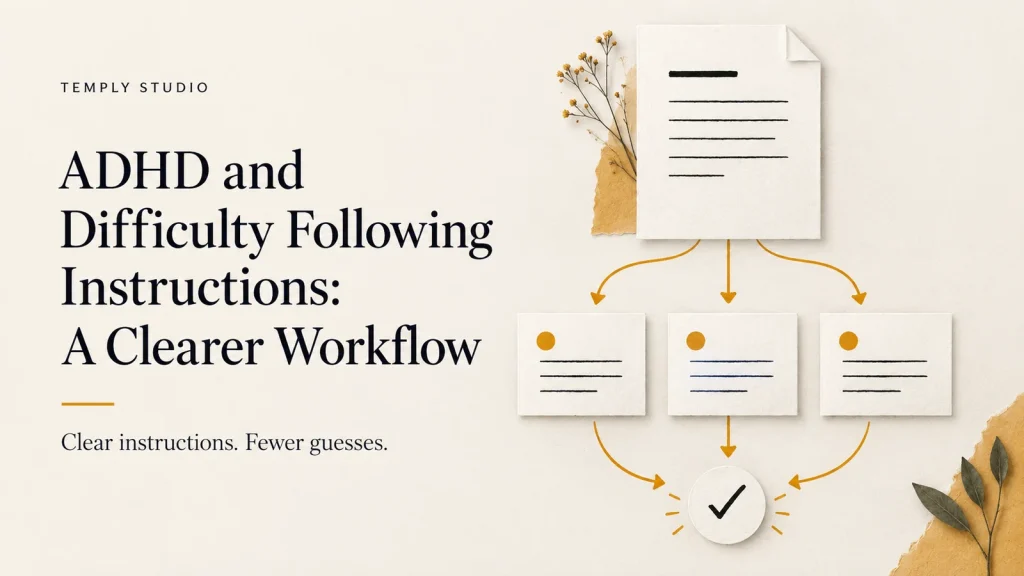
“ADHD difficulty following instructions” can cover different situations, so begin with a specific question: which part of the request became unclear or difficult to carry out? Ask for a stable written reference, identify the actual actions, confirm important uncertainties with the person giving the instruction, and mark completed steps without changing the original requirements.
This guide is for adults handling ordinary work or personal tasks. The NIMH adult ADHD overview includes trouble following instructions among possible difficulties. That does not make a missed instruction an ADHD test. The examples here are original planning suggestions, not a clinical intervention or a substitute for training.
Quick answer: For ADHD difficulty following instructions, first separate missing information, changed requirements and steps that are hard to track. Confirm the source and expected result before adding another checklist.
Table of Contents
ADHD difficulty following instructions: find the gap before adding another checklist
Imagine receiving this message: “Update the event sheet, use the latest details, send it before the meeting, and check with Alex about the photo.” It contains several requests but leaves important questions unanswered. Which sheet is current? What counts as the latest details? Is Alex checking the photo, granting permission, or choosing it? What time does the meeting begin?
A checklist that copies the message word for word still contains those gaps. First distinguish missing information from a step you understood but lost track of. You do not need to decide the psychological cause before asking an ordinary clarification question.
| What happened? | Question to resolve | Possible planning response |
|---|---|---|
| The instruction was vague | What exactly should the result contain? | Ask for a specific example or finish condition |
| Some spoken details were missed | Can I check a written version? | Confirm a short recap with the sender |
| The instruction changed | Which version now applies? | Identify the current reference and retire the old note |
| You cannot tell what is complete | Which step has a confirmed result? | Record completion against the relevant action |
Keep the original instruction available
Store or link to the authoritative message, document, or procedure in the approved location. Your personal checklist is a working aid, not a replacement for that source. Include the file name, sender, or version date when those details help distinguish similar requests.
The NHS adult ADHD guidance lists written instructions alongside spoken instructions as one possible workplace or study adjustment. Here, the practical takeaway is to discuss a format you can revisit. This UK guidance does not establish a particular legal entitlement in every country or workplace.
Written information may still be difficult to use when it is inaccessible, excessively long, or missing context. Ask about an appropriate format, a worked example, or a demonstration when needed. Do not record a conversation or send confidential instructions to an external tool without permission and any required workplace approval.
Translate the request into actions without changing its meaning
Write each action with a verb, an object, and any important condition. “Check photos” could become “ask Alex which approved photo belongs in the event sheet.” Keep exact identifiers, measurements, and other critical details tied to the original source instead of rewriting them from memory.
Separate the work from its result. Opening a document is an action; providing the correct updated document is the outcome. Temply Studio’s goal-setting system guide explains that outcome-versus-action distinction for broader planning. This article stays focused on faithfully carrying out a request somebody has already given.
Do not split the task so finely that updating the checklist becomes the main job. Add a separate step when it prevents a likely omission, identifies a required check, or makes a pause easier to understand.
Confirm the uncertain parts before starting
A short recap gives the sender a chance to correct your interpretation. For the fictional event-sheet request, you could write:
“I will update Event Sheet v3 using the details in today’s email. I will confirm the approved photo with Alex and send you a review copy by 2 p.m. I will not distribute it to attendees. Is that the result you need?”
Notice that the recap separates a review copy from public distribution. It also exposes the file, source, deadline, and permission boundary. The exact wording is not a tested communication formula; adapt it to the relationship and task.
When you cannot get a timely answer, state what is blocked and what can proceed safely. Silence is not approval. In a workplace, use the relevant escalation or supervision route rather than inventing missing requirements.
Use a checklist that preserves questions and conditions
A checklist can include a question, not just a row of boxes. “Waiting for Alex to confirm the photo” is more accurate than marking the photo step complete because you sent a message.
| Step | Current state | Completion evidence |
|---|---|---|
| Open the confirmed event sheet | Ready | File name matches the sender’s reference |
| Update the event details | Ready | Changed fields checked against the source |
| Confirm the photo | Waiting | Alex’s decision is received |
| Send the review copy | Not ready yet | Correct recipient and version checked before sending |
These are fictional document-editing steps. They are not instructions for a real event or a reusable safety procedure. Keep the checklist close to the working material so that checking it does not require searching several apps.
When instructions change, change the record deliberately
A later message can change the deadline without changing the content, or change the content without authorizing distribution. Record exactly what changed. A useful note might say, “Deadline changed to tomorrow; photo permission still pending.”
Before continuing, identify which steps remain valid and which need checking again. A step marked complete under the old instructions may no longer satisfy the new request. Ask the instruction owner when a change is ambiguous.
Avoid keeping two active checklists with different versions of the request. Preserve old information where required, but clearly distinguish it from the current working instructions.
After an interruption, restart from evidence rather than a guess
Before stepping away, record the last confirmed step and the next unresolved question. “Dates checked; waiting for approved photo” gives you a more useful return point than “almost finished.”
On return, compare your note with the current source. Check whether a new message arrived, a file changed, or another person completed part of the work. Then continue from the next valid action.
For ordinary low-risk work, this may be a short review. For regulated, safety-sensitive, or tightly controlled tasks, follow the required restart and verification procedure instead of this informal method.
Stop when simplifying would remove a safeguard
Do not shorten medication directions, equipment procedures, food-safety requirements, financial authorizations, or other critical instructions into an unofficial version that omits checks. Ask the responsible professional or supervisor for an accessible explanation of the approved procedure.
A checklist cannot grant permission, replace required competence, or prove that a task is safe. When you are uncertain about a consequential instruction, stop the affected action and seek clarification through the appropriate channel.
A small instruction card you can copy
- Source: Where is the current instruction?
- Result: What should exist when the request is complete?
- Actions: What must happen, and in what order?
- Questions: What needs confirmation, and from whom?
- Check: What will show the request was completed correctly?
Use these fields on paper or in a note you already access. The card is not a diagnostic form, and none of its fields needs a score. Leave out fields that add no useful information for the task.
ADHD difficulty following instructions: common questions
Should every instruction be written down?
Not necessarily. Prioritize the requests whose details, order, or conditions are difficult to retain or easy to confuse. Agree a practical format instead of transcribing every conversation.
What if the written instructions are still confusing?
Point to the exact unclear part and ask what the expected result looks like. An example or approved demonstration may be more useful than repeatedly reading the same ambiguous wording.
Does struggling with directions mean I have ADHD?
No single difficulty establishes a diagnosis. If persistent attention or organization problems are affecting daily life, consider discussing them with a qualified healthcare professional rather than treating a planning checklist as an assessment.
Make one real request easier to verify
Choose an ordinary task, locate its current instruction, and write the result plus one question you need answered. That is enough to begin testing whether your working record is clearer.
If you need a different place to keep the card, compare digital planner formats without assuming any product contains this specific layout. For adjacent nonclinical workflows, browse the Temply Studio planning guides. Buying a planner is not required to use the method.
Publisher: Temply Studio. General organizational guidance, not medical or legal advice. The worked example and instruction card are original editorial suggestions, not documented treatment results.
Temply Studio
Stop chasing your goals with sticky notes and scattered notebooks. Our premium digital planners and Canva templates are designed to help you plan with intention, stay consistent, and actually enjoy the process.



Questions about this guide?
Ask about the planner, share how you use it, or tell us what to cover next. Your email stays private.