


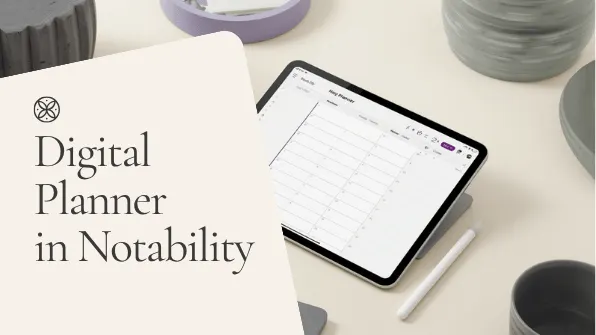
Quick answer: To import a digital planner into Notability, save the planner PDF somewhere you can find it, keep an untouched source copy, then use Notability’s Library import command or share the file to Notability from another app. After import, open the note, check page order and PDF navigation, and test one or two planner links before adding a large amount of handwriting.
Notability’s current support documentation says you can import files from the Library, from a new note, through drag and drop on Mac, or by sharing from another app. This guide focuses on PDF digital planners rather than native Notability templates.
Before you import a digital planner
- Confirm the download is a PDF or another format Notability currently supports for your workflow.
- Extract the file first if it arrived inside a ZIP package.
- Keep one untouched copy of the original download.
- Use a clear filename so the imported working copy is easy to identify.
- Check the individual product page for current file, software, delivery, and license details.
A preview image is not the same as the planner PDF. If you import a JPG or PNG preview instead of the actual planner, the document will not behave like the intended multi-page PDF.
Method 1: import from the Notability Library
Notability currently documents this Library workflow:
- Press and hold +New in the Library.
- Select Import.
- Choose a source such as Files or a connected storage provider.
- Select the planner file.
- Wait for the import to finish, then open the new note.
The exact storage choices shown in your app can depend on your device and connected services.
Method 2: import into an existing note
Notability also documents importing from inside a new or existing note. From the bottom of the note, choose Import and select the file you want to add. Use this only when adding the planner to an existing note is genuinely your intended structure. For most full digital planners, a separate note is easier to identify and archive.
Method 3: share the PDF from another app
You can open the PDF in Files or another app, use that app’s Share command, and choose Notability. This can be convenient immediately after downloading a file. Before sharing, confirm you are sending the actual planner PDF rather than a preview or compressed archive.
After import: verify the first five things
- Page count and order: Make sure the first, middle, and last sections appear.
- Page rendering: Check that text, backgrounds, and images are visible.
- Orientation: Confirm portrait or landscape pages appear as expected.
- Navigation: Test any table of contents, outline, or hyperlink behavior you rely on.
- Writing: Add a small test annotation, then undo or remove it.
Testing a few representative pages is faster than filling the planner first and discovering a file problem later.
Use PDF outlines when the planner includes them
Notability says imported PDFs with a table of contents can expose document headings and sections through PDF Outlines. In the Content Manager, choose Outlines and tap a heading to jump to that section.
An outline is not the same thing as a planner tab hyperlink. A PDF can contain one, both, or neither. If navigation matters, test the actual file rather than assuming the visual design proves it is interactive.
Understand hyperlinks and planner navigation
A hyperlinked digital planner contains interactive PDF link areas that can jump to another page or an external destination. Whether a specific link works as expected depends on the PDF and the app’s current support. If you are comparing planner navigation concepts, read what a hyperlinked digital planner is.
If you are deciding between Notability and Goodnotes rather than troubleshooting import, use the Goodnotes vs Notability comparison. That keeps app-choice intent separate from this import workflow.
What to do if imported PDF content is missing or looks wrong
Notability’s support documentation notes that some PDFs store images, form fields, or annotations in ways the app may not display correctly. Its troubleshooting guidance says flattening the PDF can resolve many such cases.
Flattening can also change the editability or behavior of content, so do not overwrite your original file. Create a separate troubleshooting copy, flatten that copy using an appropriate PDF tool, and compare the result.
If the planner imports as a blank or incomplete note
- Confirm the original file opens correctly in another PDF viewer.
- Check that the download finished completely.
- Make sure you selected the actual PDF rather than a shortcut or preview.
- Try importing the untouched source again as a new note.
- If specific content is still missing, test a flattened copy while preserving the original.
Do not convert a multi-page planner into a one-page custom template by mistake
Notability’s custom-template documentation states that when a multi-page PDF is used to create a custom template, the template is created from the first page. That is a different workflow from importing a multi-page planner as a note.
If you want the complete planner, use file import. Use custom-template features only when you intentionally want a reusable page background.
Organize the imported planner
Give the note a name that includes its purpose or period. Place it in the relevant subject or folder structure and avoid importing multiple unnamed copies. If you are testing a new planner, keep the first working copy separate from the original download.
Create a safe backup routine
The imported note is your working document. The purchased PDF is your source file. Keep those roles separate. If you also create exports or device backups, name them clearly so you know which copy can be edited and which copy is only for viewing or recovery.
The digital planner backup and file organization guide provides a general framework that works across planner apps.
Common Notability planner import mistakes
- Importing the ZIP file or preview image instead of the actual PDF.
- Using the custom-template workflow when the goal is to keep a multi-page planner.
- Deleting the original file after the first successful import.
- Assuming outlines and hyperlinks are the same navigation feature.
- Flattening the only copy during troubleshooting.
- Importing several copies without naming them.
- Assuming every digital planner is compatible with every Notability version or device.
Frequently asked questions
Can I import a PDF planner into Notability?
Notability currently documents PDF and other file import workflows. The exact planner behavior still depends on the individual file and the features you need.
Why is some PDF content missing after import?
Notability documents that some PDFs store content in ways it cannot display correctly. A flattened troubleshooting copy can help in many cases, but preserve the original before changing it.
Are PDF outlines the same as hyperlinks?
No. Outlines are document headings or sections exposed in the Content Manager. Hyperlinks are clickable areas embedded in the PDF.
Should I turn my planner into a custom template?
Not if you want to retain a full multi-page planner. Notability notes that a custom template created from a multi-page PDF uses the first page.
Can I use the same planner in Goodnotes and Notability?
Do not assume universal compatibility. Verify the specific planner’s files, navigation, software requirements, and license before choosing an app.
Official Notability sources
- Notability: Importing Files
- Notability: Import – File Content Doesn’t Appear
- Notability: PDF Outlines
- Notability: Custom Templates and Note Background
Choose a planner after checking the exact file
Browse the Temply Studio digital planner collection only after checking the individual product’s current file format, navigation, intended software, delivery, and license. No physical item is implied by this guide.
Run a small annotation test before full setup
Write one short note, add one highlight, switch pages, close the document, and reopen it. A five-minute test can confirm that the imported planner behaves normally before you spend time organizing an entire semester, month, or project inside it.
Use one troubleshooting copy at a time
If an import looks wrong, duplicate the source outside Notability and test one change at a time. For example, compare the untouched PDF with one flattened copy. Avoid generating several unnamed versions because it becomes difficult to identify which change affected the result.
Check storage and sharing decisions separately
Importing a planner, backing it up, syncing it, and sharing it are different operations. Decide separately where the source PDF lives, where the working note lives, and how you will recover important work. Do not assume that one successful import proves a complete backup plan.
Keep app comparison separate from import troubleshooting
If the planner imports correctly but you dislike the writing tools, navigation, or organization model, that is an app-fit decision rather than an import failure. Use the app-comparison guide for that decision so troubleshooting remains focused on the file and import process.
Temply Studio
Stop chasing your goals with sticky notes and scattered notebooks. Our premium digital planners and Canva templates are designed to help you plan with intention, stay consistent, and actually enjoy the process.


Questions about this guide?
Ask about the planner, share how you use it, or tell us what to cover next. Your email stays private.